Req 3a — Inside a Railroad Company
A Class I freight railroad is one of the most complex businesses in America — it operates across thousands of miles, employs tens of thousands of people, and manages billions of dollars in assets. Like any large company, it is divided into departments, each responsible for a piece of the whole operation.
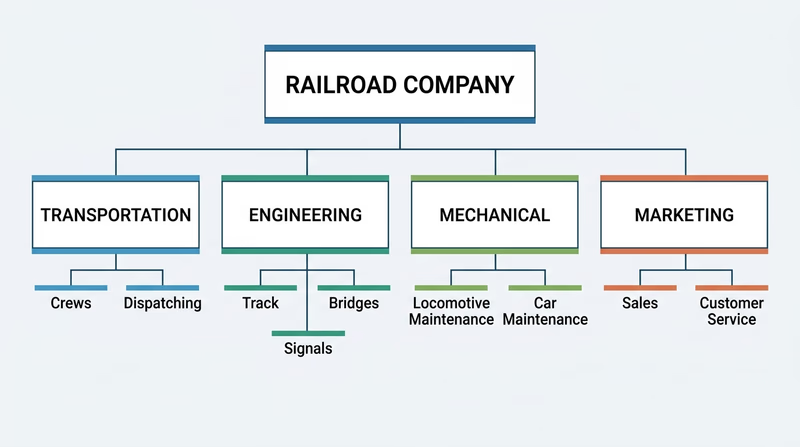
You need to name four departments and describe what each one does. The departments below are real organizational units found at major U.S. freight railroads.
Four Departments to Know
1. Transportation (Operations)
The Transportation department is responsible for everything that moves: trains, crews, and cars. This is the department most people think of when they picture a railroad. It includes:
- Train dispatchers — These are the air traffic controllers of the railroad. They sit in centralized dispatch centers and authorize train movements across the entire network, using computer systems that display every train’s position in real time.
- Locomotive engineers — They operate the locomotive and are responsible for safely moving the train.
- Conductors — They manage the train as a whole: communicate with dispatch, supervise switching moves at yards, and are responsible for the crew.
- Yard crews — They switch cars in classification yards, building and breaking down trains.
The Transportation department’s goal is to move the maximum amount of freight in the minimum time with the maximum safety.
2. Engineering (Infrastructure & Maintenance of Way)
The Engineering department owns and maintains the physical infrastructure: track, bridges, tunnels, signals, and communications systems. No train moves safely without this department’s work.
Subdivisions within Engineering typically include:
- Track maintenance — Gangs of workers inspect, repair, and replace rails, ties (sleepers), and ballast on a continuous cycle.
- Structures — Engineers and inspectors maintain the thousands of bridges and culverts on the network.
- Signals and communications — Technicians maintain the signal system, grade-crossing equipment, and the communications backbone that connects dispatch to field crews.
3. Mechanical
The Mechanical department maintains and repairs locomotives and rolling stock (freight cars). A railroad’s locomotive fleet represents billions of dollars in assets that must stay in service to generate revenue.
Key functions:
- Running repairs — Quick fixes done at locomotive servicing facilities along the main line (fueling, oil checks, minor mechanical work).
- Heavy overhauls — Major rebuilds done at large back-shop facilities. A locomotive may receive a complete mechanical overhaul every few years.
- Car inspection — Federal regulations require that freight cars be inspected at regular intervals. Mechanical department car inspectors check brakes, couplers, wheels, and other components.
4. Marketing and Sales
The Marketing department is responsible for selling space on the railroad to shippers — the companies that actually have freight to move. Without customers, there is no revenue; without revenue, there is no railroad.
Key functions:
- Account management — Sales representatives maintain relationships with major shippers and negotiate contracts.
- Pricing — Analysts set rates for different commodities and services.
- New business development — Marketing teams identify new traffic opportunities, such as attracting a new intermodal terminal or winning a long-term coal supply contract.
- Customer service — Representatives handle inquiries, trace missing cars, and manage claims for damaged freight.
Other Departments Worth Knowing
If your counselor asks for more than four, you have options:
- Finance and Accounting — Manages the company’s financial reporting, capital allocation, and investor relations.
- Human Resources — Manages hiring, training, labor relations, and compliance with union agreements (most railroad operating crafts are unionized).
- Safety — Develops and enforces safety rules, investigates accidents, and manages regulatory compliance with the Federal Railroad Administration (FRA).
- Information Technology — Maintains the computer systems that run dispatch, car tracking, locomotive monitoring, and customer portals.
- Legal and Government Affairs — Manages regulatory relationships with the FRA and STB (Surface Transportation Board), handles litigation, and monitors legislation.
Req 3a Preparation Checklist
- Chosen four specific departments (from the list above or from research)
- Can describe what each department is responsible for in 2–3 sentences
- Can give at least one specific job title or role within each department
- Ready to explain the departments verbally without referring to notes