Req 4 — Track Safety and Safe Behavior
Rail safety is not just a rule—it is the reason railroading can exist as a public good. Requirement 4 asks you to learn where these rules come from (4a), what they say about the track itself (4b), what they say about walking near tracks (4c), how drivers should behave at crossings (4d), and how to stay safe on light rail and commuter trains (4e). Work through all five sections and be ready to explain each one in your own words.
Requirement 4a
Operation Lifesaver (OL) is a nonprofit public-education program founded in 1972 in Idaho after a series of crossing accidents. It has since grown into a national effort involving railroads, state agencies, law enforcement, and volunteer presenters. The Federal Railroad Administration (FRA) supports it as the country’s primary rail-safety outreach program.
Mission statement (in your own words for the counselor): Operation Lifesaver’s mission is to end collisions, deaths, and injuries at highway-rail grade crossings and along railroad tracks through education, engineering, and enforcement.
What OL Does
- Trains volunteer “OL Ambassador” presenters who visit schools, community groups, and driving schools.
- Develops public-service campaigns aimed at pedestrians, drivers, and teens.
- Works with law enforcement to enforce crossing laws.
- Tracks national crossing-accident statistics published annually by the FRA.
- Advocates for engineering improvements like better crossing gates and sight-line clearance.
Key Statistics to Know
The FRA records every grade-crossing and trespassing incident in the United States. In a typical recent year, approximately 2,100 collisions occur at highway-rail grade crossings, and roughly 500 people are killed at crossings or along tracks. Most incidents involve a vehicle or pedestrian who did not yield to an active warning.
Operation Lifesaver — oli.org The official OL site with safety tips, presenter resources, and national crossing-incident statistics. Link: Operation Lifesaver — oli.org — https://oli.org/Requirement 4b
The requirement asks you to list nine tips. You should be able to say them aloud or write them from memory. These come directly from Operation Lifesaver and FRA guidance.
9 Track Safety Tips
Know all nine — you must list them for your counselor
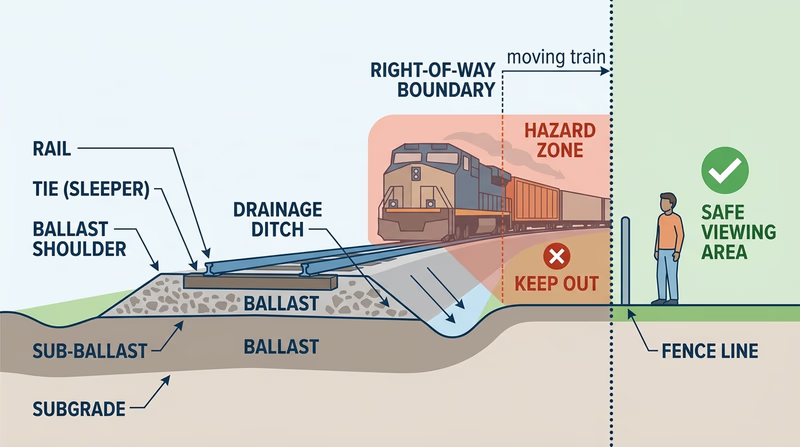
- 1. Stay off the tracks. Railroad tracks, bridges, and rights-of-way are private property. Trespassing is illegal and dangerous.
- 2. Never walk on, along, or between tracks. A train can come from either direction at any time, and you may not hear it until it is very close.
- 3. Do not attempt to hop a freight train. Moving trains are unpredictable. Cars can rock, roll, or shift without warning.
- 4. Cross only at designated crossings. Do not cut across tracks at random points or between cars in a train yard.
- 5. Never race a train to a crossing. A train traveling at 55 mph needs a mile or more to stop; it cannot yield to you.
- 6. Watch for multiple tracks. After one train passes, a second train may immediately follow on an adjacent track from the other direction.
- 7. Stay back from the edge of the platform. Stand well behind the yellow safety line until the train has fully stopped and doors open.
- 8. Do not retrieve items that fall onto the track. Alert a station employee or call the railroad’s emergency number instead.
- 9. Never stand or play near a railroad bridge or trestle. There is nowhere to go if a train approaches, and trains cannot stop in time.
Requirement 4c
These nine considerations are specifically for pedestrians who may be legitimately near (but not on) a railroad corridor—for example, walking on a road that parallels tracks, crossing a street at a grade crossing, or waiting at a station.
9 Pedestrian Safety Considerations
For walking near (not on) railroad tracks
- 1. Stay alert—remove headphones. Earbuds and loud music block the sound of an approaching train and crossing warnings.
- 2. Never assume a crossing is safe because it is quiet. Look both ways and check for approaching trains before stepping onto any crossing.
- 3. Obey all signals and gates immediately. When lights flash or a gate lowers, stop and wait, even if you do not see or hear a train yet.
- 4. Cross at a 90-degree angle to the tracks. This minimizes the time your feet are in the crossing zone.
- 5. Watch for overhang. A passing train extends 3 feet or more beyond the rail. Stand well back from the track edge.
- 6. Do not cross between the gates. If a gate lowers while you are on the crossing, keep moving to exit the crossing—do not turn back under a lowered gate.
- 7. Never assume tracks are abandoned. Overgrown or rusted tracks can still carry active train traffic.
- 8. Wait for the full train to pass before crossing. Vehicles have been struck by a second train immediately after the first one cleared.
- 9. Do not linger in the crossing area. Cross briskly and move at least 15 feet from the nearest rail before stopping.
Requirement 4d
This is a “tell” requirement—prepare a clear explanation, not just a list. Organize your answer around what happens before, at, and after a grade crossing.
Before the Crossing
- Slow down when you see the advance warning sign (the round yellow sign with a black X and two Rs). Expect a crossing ahead.
- Look and listen in both directions. Open the car window if visibility is poor.
- Never shift gears on or immediately before the crossing. Stay in a gear that keeps you moving smoothly through.
- Check for clearance on the other side before you start crossing. Do not move onto the tracks if traffic may force you to stop on them.
At the Crossing
- Obey all signals immediately. Flashing lights and a lowered gate mean a train is approaching or present—stop completely.
- Stop 15 feet from the nearest rail when required. This keeps you safely clear of the train’s overhang.
- Do not go around a lowered gate. It is illegal, and it means the system has confirmed a train is coming.
- Watch for multiple trains on multiple tracks. A freight train may hide a second train approaching on the adjacent track.
If Stalled on the Crossing
- Evacuate everyone immediately. Do not try to restart the vehicle.
- Move away from the tracks at a 45-degree angle in the direction of the approaching train—this keeps you clear of debris if the train strikes your vehicle.
- Call 911 and the emergency number on the ENS sign at the crossing (if visible) to alert the railroad dispatcher.
Requirement 4e
Light rail (streetcar-style systems in cities like Dallas, Denver, and Portland) and commuter rail (regional trains like Metra, LIRR, and Caltrain) share tracks and stations with pedestrian traffic. The precautions are distinct from highway-crossing safety.
At the Station or Platform
- Stand behind the yellow tactile strip or safety line at all times until the train has completely stopped and the doors open.
- Do not lean over the platform edge to look for the train.
- Keep luggage and belongings pulled close so nothing falls onto the track bed.
- If an item falls onto the tracks, do not jump down to retrieve it—report it immediately to a station employee.
Boarding and Exiting
- Wait for passengers to exit before you board.
- Move quickly but carefully across the gap between the platform and the train car; gaps can be wide on curved platforms.
- Do not hold doors open—train doors are not like elevator doors and can strike you if forced.
On the Train
- Brace yourself when the train is moving, especially around curves and when braking.
- Secure bicycles and large items so they cannot shift into other passengers.
- Know where the emergency intercom is located inside the car and how to use it.
Light Rail Specific
- Light rail often runs at street level through intersections. Treat any intersection with tracks like a grade crossing—look both ways, even mid-block.
- Light rail is quiet and fast; do not assume pedestrian crossing signals protect you from a light rail train running on a separate signal phase.