Req 5 — Reading Railroad Signs
Every railroad crossing and adjacent corridor is marked by a system of signs and devices that work together to tell a driver or pedestrian exactly what to expect and what to do. Some signs are static—they give information. Others are active—they change state when a train is detected. Knowing the difference, and what each specific sign looks like and requires of you, is what this requirement tests.
Work through each section below. For each sign or device, you should be able to describe its appearance (shape, color, symbols), where it is located, and what action it requires from a driver or pedestrian.
Requirement 5a — Passive Signs and Active Signs
The distinction between passive and active is foundational to understanding all the other signs and devices in this requirement.
Passive Signs
A passive sign is always present and always looks the same. It does not change state based on whether a train is present. Passive signs give you information and require you to take action based on your own observation.
- What they look like: Stationary signs: rectangular, triangular, round, or diamond-shaped panels mounted on posts. They do not flash, move, or make sound.
- Where you see them: Advance warning signs on the road approaching a crossing; crossbuck signs at the crossing itself; no-trespassing signs along the right-of-way.
- What they require: The driver or pedestrian must slow down, look, listen, and judge whether a train is coming. Passive signs do not tell you a train is present—you have to determine that yourself.
Active Signs and Devices
An active device changes state when a train is detected by track circuits. It does something—lights flash, gates lower, bells ring.
- What they look like: Electrically powered devices: flashing red lights, swinging gates with red lights, cantilever structures spanning multiple lanes, bells or sirens.
- Where you see them: At the crossing itself, mounted on the same post assembly or on overhead cantilever arms.
- What they require: Stop immediately and wait until the lights stop flashing, the gate rises fully, and it is safe to proceed. An active device that is operating means the system has detected a train—do not treat it as optional.
Requirement 5b — Devices at the Crossing
These are the active devices installed at the crossing itself. They are triggered by the train detection system.
Flashing Red Lights (with or without bells)
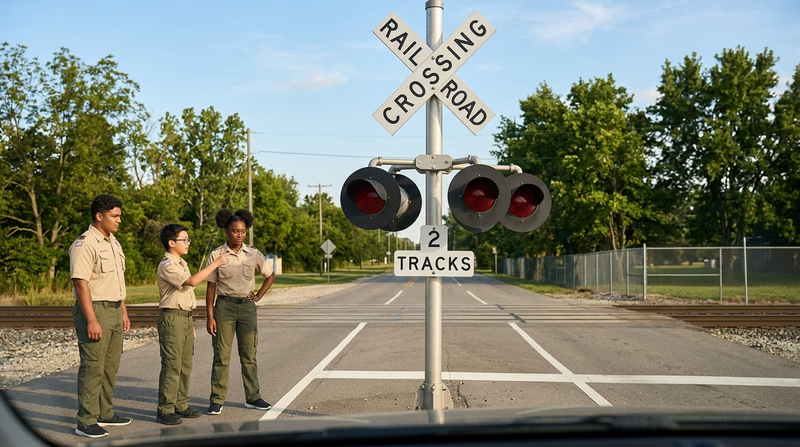
- Appearance: Two round red lights mounted side by side (or on a horizontal bar) that flash alternately—left, right, left, right. Often mounted below a crossbuck sign on the same post. A bell may be mounted on the same assembly and rings while lights flash.
- Where located: On a post at the right side of the road, at or just before the crossing. There is typically one on each side of the tracks.
- What it means: A train is approaching or is in the crossing area.
- Required action: Stop before the stop bar (or at least 15 feet from the nearest rail) and remain stopped until the lights stop flashing and it is fully safe to proceed. Do not go around or between the signals.
Flashing Red Lights and Gates
- Appearance: Same flashing red lights as above, plus a lowered gate—a striped red-and-white horizontal arm with reflective material and red lights along its length. The gate descends across your lane when the system activates.
- Where located: On the approach to the crossing, one gate per lane. On multi-lane roads, exit gates may be installed on the far side as well.
- What it means: A train is near. The gate physically blocks the lane.
- Required action: Stop before the gate. Never drive around, under, or through a lowered gate. If the gate lowers while you are already in the crossing, keep moving forward to clear the tracks—do not reverse under a gate.
Cantilever Flashing Lights
- Appearance: A horizontal arm extending over the road from a tall post, with multiple signal heads suspended from it to cover multiple lanes. Lights flash red in the same alternating pattern as standard signals. Used at wide roads or multi-lane highways.
- Where located: Arching over the lanes on the approach to the crossing, providing visibility to drivers in all lanes.
- What it means: Same as standard flashing lights—a train is approaching.
- Required action: Same as standard signals. All lanes must stop.
Requirement 5c — Markings on the Road
Road-surface markings give drivers guidance even before they reach the active device zone.
Pavement Markings (RXR)
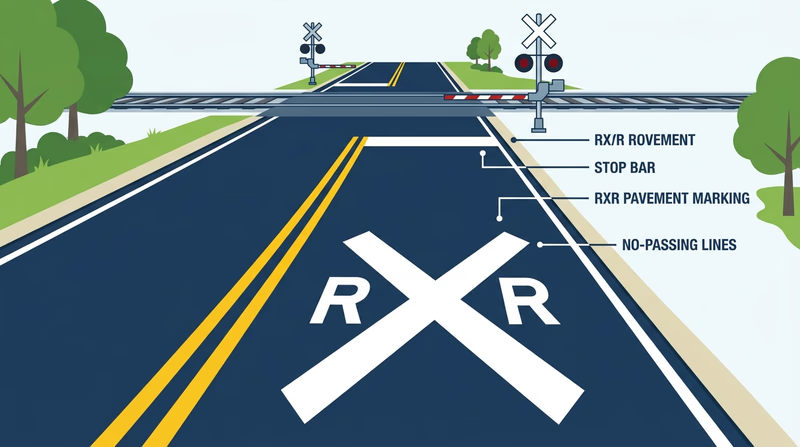
- Appearance: A large white “RXR” painted on the road surface, often accompanied by a large white X. Some crossings also have yellow no-passing lines approaching the crossing area.
- Where located: On the pavement on the road leading to the crossing, typically 50–100 feet before the stop bar.
- What they mean: A railroad crossing is ahead. Drivers should begin reducing speed and preparing to stop if needed.
- Required action: Begin looking and listening for trains. Prepare to stop.
Stop Bar
- Appearance: A solid white line painted across the full width of your lane (or lanes) perpendicular to the road.
- Where located: At the crossing, typically 15 feet or more back from the nearest rail.
- What it means: This is the stop line for the crossing. If any warning device is active, you must stop here—not at the rail.
- Required action: Stop with your front bumper at or behind this line when any signal is active or when you are yielding at a passive crossing.
Requirement 5d — Signs Before the Crossing
These signs appear on the road before you reach the crossing itself. They are all passive signs.
Advance Warning Sign
- Appearance: Round yellow sign with a black X and two Rs (the same symbol as the crossbuck). Round shape is unique—most warning signs are diamond-shaped, so the round shape of this sign is instantly recognizable.
- Where located: 250–750 feet before the crossing on the approach road, on the right side. Distance varies based on road speed.
- What it means: A railroad crossing is ahead.
- Required action: Slow down, prepare to stop, and start looking and listening for trains.
Advance Warning Sign for Side Streets
- Appearance: Same round yellow RXR design, but positioned to warn drivers turning from a side street that they will immediately encounter tracks.
- Where located: On the side street before the turn, so the driver is alerted before they make the turn and find themselves suddenly at a crossing.
- Required action: Same as the standard advance warning sign—slow down and be prepared for a crossing immediately upon turning.
No Train Horn Sign
- Appearance: Rectangular white sign with black text: “NO TRAIN HORN.” May include a graphic of a horn with a line through it. Sometimes called a “quiet zone” sign.
- Where located: On the approach road to a crossing in an officially designated quiet zone. Quiet zones require enhanced engineering safety measures to compensate for the absence of the horn.
- What it means: Trains do not routinely sound their horn at this crossing. Enhanced passive or active warning devices are present instead.
- Required action: Do not expect a horn warning. Be especially alert when approaching this crossing.
Low Ground Clearance Grade Crossing Sign
- Appearance: Yellow rectangular or diamond-shaped sign showing a train over a vehicle with a low clearance symbol. Sometimes shows a specific clearance height.
- Where located: Before crossings where the road dips or humps significantly at the tracks, creating a risk that a low-clearance vehicle (car hauler, RV, flatbed) could become high-centered on the rails.
- What it means: Vehicles with low ground clearance may become stuck on the crossing. This is a known hazard at this location.
- Required action: If you are driving a vehicle that may have low clearance, do not proceed. Use an alternate crossing.
Requirement 5e — Signs Along the Railroad Property
No Trespassing Sign
- Appearance: Rectangular white sign with black text: “NO TRESPASSING.” May include the railroad’s name, a case number reference, or a posted fine amount. Some railroads use orange or yellow versions.
- Where located: Along the right-of-way fence line, on bridge approaches, at tunnel portals, and at yard entry points. These signs are placed throughout railroad property boundaries.
- What it means: The railroad right-of-way is private property. Entering without authorization is illegal. Federal and state laws establish penalties.
- Required action: Stay off railroad property entirely unless you are at a designated public crossing or station.
Requirement 5f — Signs at the Crossing
These signs are mounted at or immediately adjacent to the crossing itself.
Crossbuck Sign
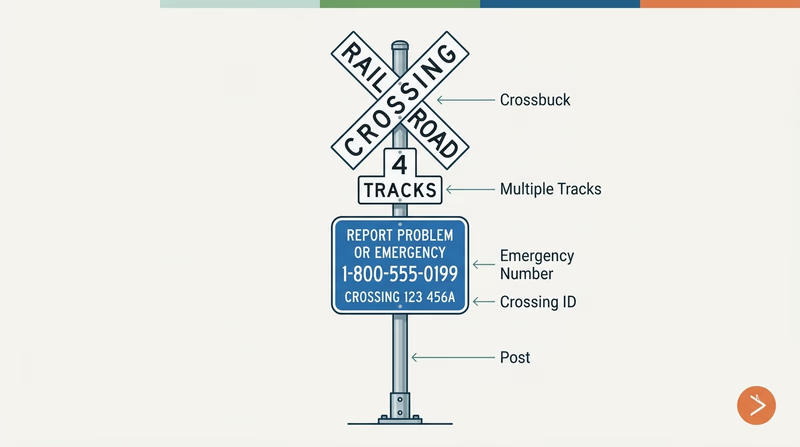
- Appearance: White X-shaped sign with the words “RAILROAD CROSSING” split across the two diagonal arms. One of the most recognized signs in the United States.
- Where located: At the crossing, on the right side of the road. At passive crossings (no lights or gates), this is often the only active sign at the location.
- What it means: You are at a railroad crossing.
- Required action: At a passive crossing with a crossbuck and no active devices, you must yield to any train. The crossbuck is a yield sign—slow down, look both ways, and cross only when you are certain no train is approaching.
Emergency Notification System (ENS) Sign
- Appearance: Blue rectangular sign with a phone number, a crossing identification number (DOT number), and the railroad company’s name. Sometimes reads “EMERGENCY NOTIFICATION” or simply shows the railroad’s emergency line.
- Where located: Mounted at the crossing, often on the signal post or crossbuck post.
- What it means: If there is an emergency at this crossing—a stalled vehicle, a collision, a gate malfunction—you can call this number to immediately reach the railroad’s dispatcher, who can stop approaching trains.
- Required action: In any emergency on the crossing, call this number first, then 911. The dispatcher can halt trains far faster than emergency services can respond. Write down or photograph the number before you need it.
Multiple Track Sign
- Appearance: Rectangular black-and-white sign mounted below the crossbuck sign, reading “2 TRACKS,” “3 TRACKS,” or the appropriate number.
- Where located: Directly below the crossbuck sign at crossings with more than one track.
- What it means: There are additional tracks beyond the first one you cross.
- Required action: After one train clears, do not move until you have looked for trains on all additional tracks. A second train can follow immediately on the adjacent track, often from the opposite direction and harder to see past the first train.
Stop Sign
- Appearance: Standard red octagonal stop sign with white “STOP” text—identical to the stop sign used in road traffic.
- Where located: At crossings where state law requires all vehicles to stop completely before proceeding. Less common than yield-only crossings.
- What it means: Every vehicle must come to a complete stop, look and listen, and proceed only when certain no train is approaching.
- Required action: Full stop, regardless of whether a train is visible or audible.
Yield Sign
- Appearance: Standard red-and-white triangular yield sign—identical to the yield sign used in road traffic.
- Where located: At passive crossings where a full stop is not legally required but drivers must yield to trains.
- What it means: Slow down and be prepared to stop if a train is approaching or present.
- Required action: Slow to a safe speed, look and listen carefully, and cross only when you have confirmed no train is approaching from either direction.
Signs at the Crossing — Quick Review
Make sure you can describe all five for your counselor
- Crossbuck: White X, “RAILROAD CROSSING” — yield to trains at passive crossings.
- ENS sign: Blue, phone number + crossing ID — call in any emergency at the crossing.
- Multiple track sign: Below the crossbuck — counts additional tracks you must check.
- Stop sign: Red octagon — full stop required before crossing.
- Yield sign: Red-and-white triangle — slow down and yield to trains.