Req 6 — Signals, Horns, and Rear-End Devices
Trains cannot steer or stop quickly, so railroads rely on a sophisticated communication system—signals along the line, horn patterns at crossings, and devices at the rear of trains—to coordinate safe movement and alert people to a train’s presence and intentions. Requirement 6 asks you to understand how that system works from the ground up.
Work through all four sections. For 6a, you should be able to describe two signal types by color or configuration. For 6b, you should know three horn sequences by sound pattern and meaning. For 6c, you should be able to describe multiple emergency-stop methods. For 6d, you should be able to explain the EOTD/FRED’s function and why it replaced the caboose.
Requirement 6a
Railroad signals communicate track conditions to train crews. Unlike highway traffic lights, which operate on a time cycle, railroad signals respond directly to the position of trains detected in track circuits. Understanding how they work—and what two basic types look like—is what this section requires.
How Railroad Signals Operate
Railroad tracks are divided into blocks—defined sections of track, typically separated by insulated rail joints. When a train’s wheels (which are conductive steel) cross from one block into the next, they complete an electrical circuit between the two rails. That circuit is detected by the signal system, which then changes the signal at the entry of that block.
- Block occupied → the signal shows red (stop) to any following train.
- Block clear → the signal may show green (proceed) or yellow (approach with caution, next block may be occupied).
Modern systems add a second block of lookahead: a yellow signal means the next signal ahead is red, giving the engineer time to brake before reaching it. This is the basis for most approach-signal systems.
Signal Type 1: Color-Light Signal
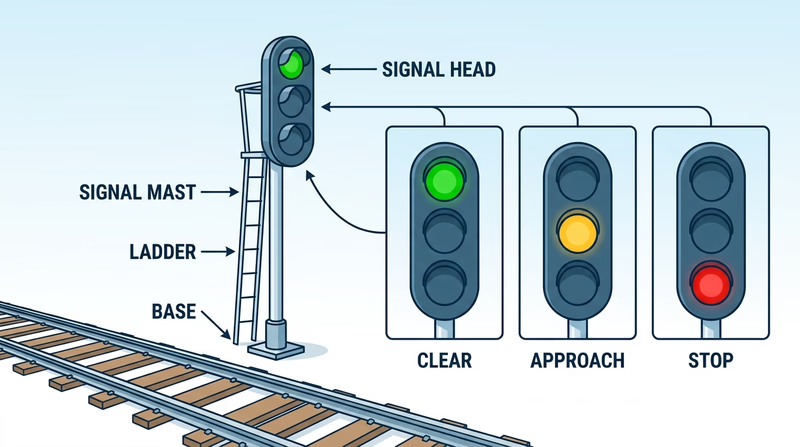
- Appearance: A signal head with multiple round lenses (usually three) arranged vertically—green on top, yellow in the middle, red on the bottom. The head is mounted on a mast or bridge.
- How it works: Only one light is illuminated at a time.
- Basic meanings:
- Green (clear): The block ahead is unoccupied. Proceed at authorized speed.
- Yellow (approach): The next signal ahead shows red. Prepare to stop at the next signal.
- Red (stop): The block ahead is occupied or a switch is misaligned. Stop before the signal.
- Where you see it: On main lines across North America, at yard throats, and at interlockings where tracks converge.
Signal Type 2: Semaphore Signal (Position-Light)
- Appearance: A horizontal arm mounted on a post that physically moves to different angles to convey meaning. Older semaphore signals are rare on Class I railroads today but remain in service on some heritage and commuter lines.
- How it works: A motor or relay moves the arm to one of three positions.
- Basic meanings (upper-quadrant semaphore):
- Arm up (45° above horizontal): Clear—proceed.
- Arm horizontal: Caution/approach.
- Arm down (45° below horizontal): Stop.
- Where you see it: Commuter rail lines in the Northeast (Metra, some LIRR territory), preserved steam railroads, and some European-style systems.
Signal Review
Be able to describe both types and explain the logic
- Color-light signal: Multiple colored lenses—green (clear), yellow (approach), red (stop).
- Semaphore/position signal: Arm angle conveys meaning—up (clear), horizontal (caution), down (stop).
- How both operate: Track circuits detect train position; block occupancy changes the signal state.
- Why yellow matters: Yellow buys the engineer reaction distance. Without it, a red would appear too late to stop safely.
🎬 Video: How to Read Railroad Signals — The Central Texas Railfan — https://www.youtube.com/watch?v=Q1UlOEUdows
Requirement 6b
Train horn signals are a standardized communication system described in FRA regulations (49 CFR Part 222). Engineers sound the horn to alert pedestrians and drivers at crossings, communicate with crew members, and signal movement intentions. The patterns use long blasts (—) and short blasts (•).
Signal 1: Approaching a Public Grade Crossing
Pattern: — — • — (long, long, short, long)
This is the most important horn signal to know. Federal regulations require this signal to begin between ¼ mile and the crossing and to be repeated or prolonged until the engine occupies the crossing.
- Meaning: A train is approaching a public highway-rail grade crossing. This signal warns all road users that a train is about to pass through the intersection.
- Who it is for: Drivers and pedestrians near the crossing.
- What to do when you hear it: If you are near a crossing, stop clear of the tracks and wait. Do not attempt to beat the train.
Signal 2: Stop
Pattern: • (one short blast)
- Meaning: The engineer is commanding the train to stop, or is acknowledging a stop signal from a crew member. Also used when a train is standing and beginning a move in reverse at slow speed.
- Who it is for: Crew members on the ground or in another car, and anyone nearby in a yard.
- What to do when you hear it: If you are anywhere near railroad property, move away from the tracks and clear the area.
Signal 3: Proceed (after stop)
Pattern: — — (two long blasts)
- Meaning: The train is about to begin moving forward. Used when the train has been stopped and is about to start.
- Who it is for: Crew members and anyone near the tracks.
- What to do when you hear it: Clear the area and stay back from the tracks.
Three Horn Signals
Know the pattern and what it means
- — — • — (long long short long): Approaching a public grade crossing — wait clear of tracks.
- • (one short): Stop. Also: reversing at slow speed in a yard.
- — — (two long): Proceeding forward from a stop.
Requirement 6c
If you witness an emergency at or near a railroad track—a stalled vehicle, a person on the tracks, a structural failure on a bridge ahead—the fastest ways to stop a train involve both direct signaling and calling the dispatcher.
Method 1: Call the Emergency Notification System (ENS)
The most effective and fastest method in modern railroading is to call the ENS number displayed on the blue sign at the nearest crossing (covered in Req 5f).
- How it works: The number connects directly to the railroad’s dispatcher. The dispatcher can communicate with the engineer over radio and can also set signals to stop approaching trains remotely.
- Why it works: Dispatchers have authority over the entire subdivision and can stop multiple trains simultaneously. They can also call ahead to other trains you cannot see.
- Also call 911: The dispatcher handles the train; 911 handles emergency services on the ground.
Method 2: Wave a Fusee (Railroad Flare)
A fusee is a red burning flare used by railroad crews. When placed on the track or waved by a person standing trackside, it is a recognized emergency stop signal.
- Signal: A fusee placed burning on the track means “stop immediately.” A person waving a red light or flare in circular motion from a position ahead of the train also signals stop.
- Why it works: Engineers are trained to stop for any fire or unexplained light on the track.
- Practical note: Fusees are carried by train crews, not the general public. The principle is important to understand even if you are unlikely to use one.
Method 3: Wave Any Object Vigorously
In a true emergency where no fusee or phone is available:
- Stand in a clearly visible position trackside (not on the track itself).
- Wave any large object (coat, backpack, shirt) in large sweeping motions across your body horizontally, or in circles.
- Engineers are trained to respond to any unusual and urgent trackside signal by applying brakes.
Requirement 6d
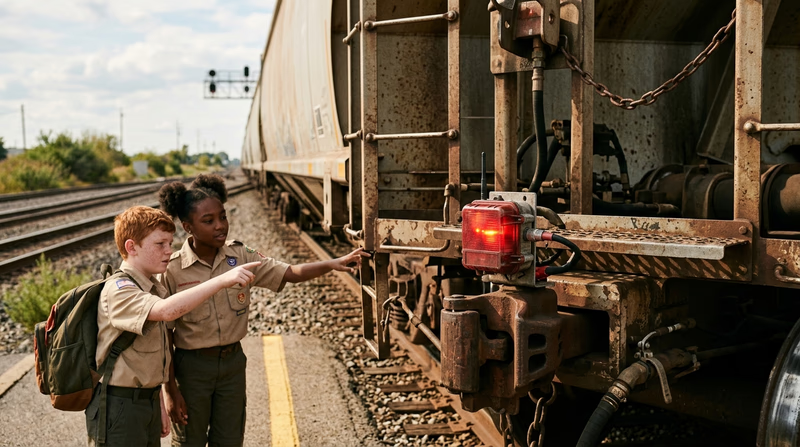
The End-of-Train Device (EOTD)—informally called FRED (Flashing Rear End Device)—is a small electronic unit attached to the rear coupler of the last car on a freight train. It replaced the traditional caboose beginning in the 1980s and is now required on most freight trains in North America.
What It Looks Like
A compact box or cylinder, roughly the size of a large toolbox, attached to the rear coupler of the last car. It has:
- A red flashing light visible from behind (warning following trains and vehicles at crossings)
- A brake-pipe pressure gauge connected to the train’s air brake line
- A radio transmitter/receiver for two-way communication with the locomotive
- A motion sensor (on two-way units) to detect if the rear of the train has stopped moving
Primary Functions
1. Rear visual warning
The red flashing light on the rear of the train performs the same safety function the caboose’s red marker lights once served: it marks the end of the train so that following trains, crossing users, and maintenance workers know where the train ends. Without it, a very long freight train at night or in poor visibility could be impossible to identify as still moving through a crossing.
2. Brake-pipe pressure monitoring
The EOTD continuously monitors air pressure in the train line (the brake pipe) at the rear of the train and transmits that reading to the locomotive cab.
- Normal reading: Confirms brake integrity throughout the train length.
- Pressure drop: Signals a possible brake-line break, open hose, or emergency brake application from somewhere in the train.
3. Emergency brake application (two-way EOTD)
On modern two-way units, the engineer can command the EOTD to open the rear brake valve from the locomotive cab. This vents air from the rear of the train simultaneously with braking from the front, reducing the stopping distance of a long train significantly.
- Why this matters: A 10,000-foot freight train can take more than a mile to stop from highway speed. Applying emergency brakes from both ends simultaneously can cut that distance meaningfully.
- This function is required in the United States on trains exceeding a certain length or speed, per FRA regulations.
4. Motion detection (two-way EOTD)
The motion sensor confirms whether the rear of the train is still moving. This protects against a train separation—a scenario where the train breaks apart in the middle. If the locomotive is moving but the rear is stopped, the EOTD will alert the engineer immediately.
Why the Caboose Was Replaced
The caboose required a crew of conductors to ride at the rear to monitor the train and the track behind it. Advances in sensors, radio communication, and on-board monitoring technology made it possible to perform all of those monitoring functions electronically, without additional crew.
EOTD / FRED Key Points
Be able to explain each function clearly
- Red flashing light: Marks the end of the train — warning for following trains and crossing users.
- Brake-pipe monitor: Continuously reads rear air pressure — detects line breaks or leaks.
- Emergency application (two-way): Engineer can vent brakes from rear simultaneously — shortens stopping distance.
- Motion sensor: Detects if rear of train stops while locomotive moves — catches train separations.
- Replaced the caboose in the 1980s because technology made human monitoring from the rear unnecessary.