Req 7a8 — DC and DCC Control
This is an explanation requirement — no building or operating is needed. You need to understand how the two main control systems work and be able to clearly explain the difference to your counselor. The key is understanding not just what the names are, but how each system controls individual locomotives.
Direct Current (DC) Control
How it works: A DC power pack outputs a variable DC voltage to the track. Locomotives pick up this current through their wheels. The speed of a locomotive is controlled by the voltage level — higher voltage, faster speed. The direction is controlled by reversing the polarity of the current on the track (the power pack’s direction switch does this).
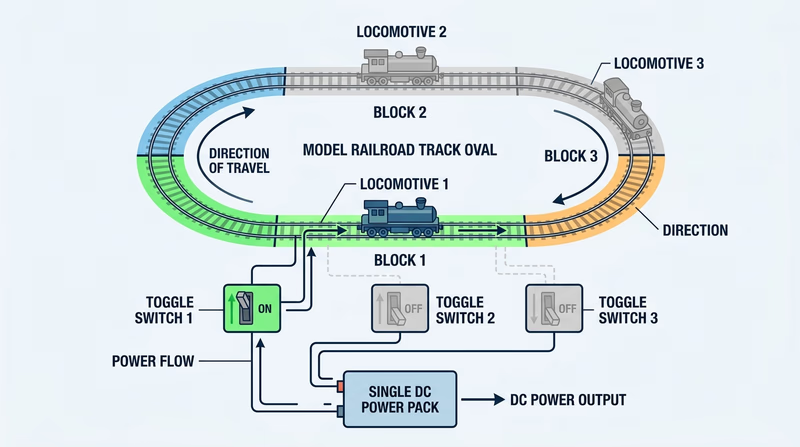
The critical limitation: Because the voltage goes to the track, every locomotive on that section of track receives the same voltage at the same time. If you raise the voltage to speed up one train, every locomotive on that block speeds up. If you want independent control of two trains, you must divide the layout into electrical blocks — sections of track that can be powered independently — and switch the power between them manually.
Block control: A complex DC layout may have dozens of blocks, each with its own toggle switch. The operator selects which block gets power from which throttle. This works, but requires significant wiring and careful attention while operating.
Digital Command Control (DCC)
How it works: DCC sends a constant full voltage to the track, but embeds digital instructions in that voltage signal — encoded as small variations in the power waveform. Each locomotive has a small decoder chip installed inside it. The decoder reads the digital signal and executes only the instructions addressed to its specific ID number.
The key difference: Because instructions are addressed to individual decoders, you can run multiple locomotives independently on the same track at the same time, with no block wiring. Locomotive 1 responds only to commands sent to address 1; locomotive 2 responds only to commands sent to address 2 — even if both are on the same section of track.
What decoders can do:
- Control speed and direction independently for each locomotive
- Control a locomotive’s lights (headlight, cab lights, ditch lights)
- Play digitally recorded sounds — actual engine sounds, horns, bells, and more
- Control acceleration and braking momentum for realistic operation
Side-by-Side Comparison
| DC Control | DCC | |
|---|---|---|
| Track voltage | Variable (0–12V typical) | Constant full voltage |
| Speed control | Voltage level | Digital command to decoder |
| Multiple trains | Requires block wiring | Independent, same track |
| Sound | Not possible | Yes, via sound decoders |
| Decoder in loco? | No | Yes, required |
| Setup cost | Lower | Higher initially |
| Wiring complexity | Increases with layout size | Stays simple |
🎬 Video: DC vs. DCC: What's BEST for Your Model Railroad?! — 5 Minute Modeler — https://www.youtube.com/watch?v=z5TiK_Ay-0g
What to Tell Your Counselor
Practice explaining these four points out loud before your counselor meeting:
- In DC, voltage controls speed — and all locomotives in a block respond to the same voltage
- In DCC, full voltage is always on the track, and decoders inside each locomotive respond only to commands addressed to them
- DCC allows independent operation of multiple locomotives without block switching
- DCC also enables sound, lighting effects, and more realistic momentum curves