Reading Merit Badge — Complete Digital Resource Guide
https://merit-badge.university/merit-badges/reading/guide/
Introduction & Overview
Reading is one of the most useful skills you will ever build. It helps you learn new things, understand other people, follow directions, solve problems, and enjoy stories that can stay with you for years. The Reading merit badge is not about racing through pages. It is about learning how to choose, use, discuss, and share what you read.
A strong reader can walk into a library and find the right book, compare ideas from different sources, and explain what a book meant to them. Those same skills help Scouts in school, in leadership, and later in careers. This badge turns reading from “something you have to do” into a tool you can use on purpose.
Then and Now
Then — Stories Carried by Voice and Print
For most of human history, stories and knowledge traveled by memory, not by app. Elders told histories out loud. Scribes copied books by hand. When printing presses spread across Europe in the 1400s, books became easier to make and easier to share. Libraries grew, newspapers appeared, and ordinary people gained access to ideas that had once been locked away in a few private collections.
Reading changed lives because it changed access. A Scout in one place could learn about science from another place. A reader could meet people from another time. Printed words let knowledge travel farther than a single voice could reach.
Now — Reading in a World of Screens and Choices
Today, reading happens on paper, phones, tablets, signs, manuals, news sites, and library databases. You can borrow an ebook in seconds, compare book reviews, or read an article from across the world before breakfast. That makes reading more available than ever — but it also means you need better judgment.
Modern readers do more than decode words. They choose reliable sources, notice bias, compare formats, and think about audience. Deep reading still matters because it builds focus, empathy, and critical thinking in a world full of distractions.
Get Ready!
This badge will send you into a library, into different genres, and into conversations about what you read. You will practice noticing what works, what does not, and why. Come curious — and be ready to try books and reading projects you might not have chosen on your own.
Kinds of Reading
Reading for Story
Fiction, fantasy, mystery, and historical novels let you step into another person’s decisions and problems. Story reading builds imagination and empathy because you are following motivations, consequences, and emotions from the inside.
Reading for Information
Nonfiction books, magazines, manuals, and articles help you understand how the real world works. This kind of reading teaches you how to gather facts, compare sources, and learn new skills — which becomes especially important in Req 4 and Req 5.
Reading for Expression
Poetry, speeches, and essays show how much power can fit into a few carefully chosen words. These forms are often shorter than novels, but they demand attention to tone, rhythm, and meaning.
Reading for Direction
Recipes, instructions, maps, rules, and handbooks may not feel like “fun reading,” but they are some of the most practical reading you will ever do. When you tie a knot, build a project, or follow a trail guide, reading becomes action.
Reading for Citizenship
News stories, issue explainers, and history sources help you understand the world around you. Good readers learn to ask: Who wrote this? What evidence is included? What might be missing? Those questions turn reading into good judgment.
Ready to build the most practical reading skill of all — finding the right information when you need it? Start in the library.
Req 1 — Library Skills in Action
This requirement gives you the basic moves every library user needs. You will tour a library, learn how the catalog is organized, search by different clues, find books on the shelves, and understand how a library card works. By the end, you should feel comfortable walking into a library and using it without guessing.
What this page covers
Five practical library skills- 1a — Tour the library: Notice how the building, collections, and services are organized.
- 1b — Search the catalog: Look up books by author, title, and subject.
- 1c — Pick six books: Use the catalog to choose books from four different types.
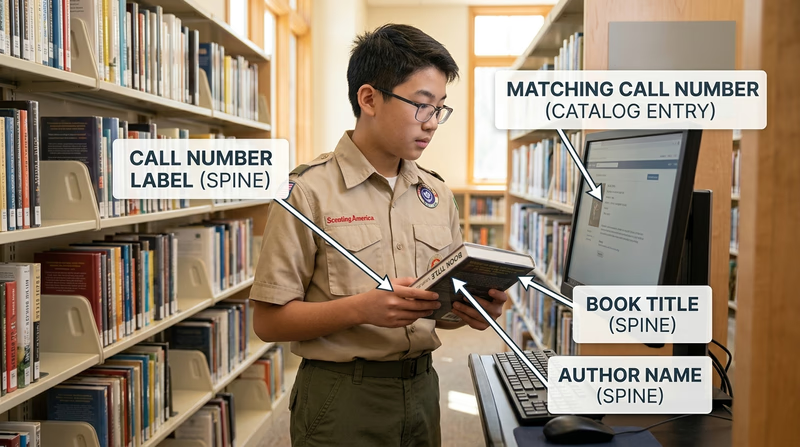
- 1d — Find them on the shelves: Match the catalog record to the physical location.
- 1e — Understand library cards: Learn how borrowing privileges work.
Requirement 1a
A library is more than rows of books. It is a system designed to help people find information, borrow materials, and get help from trained staff. On your tour, pay attention to the layout. Many libraries separate picture books, chapter books, teen books, adult fiction, nonfiction, reference materials, computers, meeting rooms, and special collections so visitors can quickly head to the right area.
Also notice the services. A public library may lend ebooks, audiobooks, movies, museum passes, hotspots, and games. A school library may focus more on research help, classroom support, and age-appropriate collections. Ask what the librarians help people do most often. The answer might include homework help, job searching, printing, genealogy, literacy programs, or story time.
🎬 Video: How Is a Library Organized (video) — https://youtu.be/wm3OYbqWGt4
🎬 Video: Library of Congress Classification (video) — https://youtu.be/Vq_nXCKqvvI?si=GIOeyfCbat453Qtp
Requirement 1b
This is where libraries become powerful. A catalog is an index of what the library owns and where to find it. Old-school card catalogs used drawers of cards. Modern catalogs do the same job on a screen. The search types matter because each one answers a different question.
Search by author
Use this when you already know who wrote the book. This helps when you liked one title and want more by the same person.
Search by title
Use this when you know the exact name or most of it. This is usually the fastest way to confirm whether a library has a specific book.
Search by subject
Use this when you know the topic but not the title. Search terms like “volcanoes,” “World War II,” or “dog training” help you discover multiple books at once.
A good Scout practices all three. If one search gives weak results, try another angle. That habit will help again in Req 5 when you compare different sources about the world around you.
🎬 Video: How to Use a Card Catalog (video) — https://youtu.be/bBoBFioGVJc?si=W5X75XCeu-dxS8if
Requirement 1c
This step turns searching into decision-making. Try to choose books that are genuinely different from one another. For example, you might pick a biography, a science nonfiction book, a novel, and a poetry collection. Then add two more books from any of those categories or from other types such as history, graphic novels, essays, or field guides.
When you search, write down three details for each book: the title, the author, and the call number or shelf location. If your library shows whether the book is checked in, note that too. A catalog search is only half complete until you can actually use the result.
🎬 Video: Locating a Book in a Library (video) — https://youtu.be/yqg41rMDlKA
Requirement 1d
Finding a book on the shelf means translating catalog information into real-world location. Start with the call number. In many public and school libraries, fiction may be shelved alphabetically by the author’s last name, while nonfiction often uses a number system. Read the shelf signs carefully, then narrow down from section to shelf to exact spot.
If you cannot find a book, that is normal. It may be checked out, waiting to be reshelved, placed on a display, or misshelved by another visitor. This is a good moment to ask a librarian for help. Knowing when to ask is part of using a library well, not a sign you failed.
Requirement 1e
A library card is your borrowing account. It tells the library who has checked out an item and when it is due back. It also unlocks digital borrowing, online databases, and sometimes computers, printers, or study room reservations.
Most libraries require proof that you live in the service area, plus a parent or guardian if you are under a certain age. Some school libraries issue student accounts automatically. Policies vary, so ask what documents are needed, how long cards last, and what happens if a card is lost.
A library card matters because it turns the library from a place you visit into a resource you can actually use. It is one of the simplest tools for lifelong learning.
🎬 Video: How Do I...Get a Library Card (video) — https://youtu.be/LOhNkY0yb4s?si=fCdFQINKX1P4wNYJ
When you finish this requirement, you will know how to find books instead of waiting for books to find you. Next, you will use those library skills to choose books worth reading.
Req 2 — Choose Books You'll Actually Finish
This requirement is about moving from random reading to intentional reading. You will start with an author you already enjoy, then look outward at recommendation lists to find new possibilities. Good readers do both: they follow what already works for them, and they stay open to books they have not met yet.
Requirement 2a
If you have ever finished a book and thought, “I want more like that,” you are already thinking like a reader. Authors often return to similar themes, settings, or styles. An author who wrote one mystery you loved may have written a whole series. A nonfiction author who explained one topic clearly may have written others on related subjects.
Start with a title you genuinely enjoyed. Then search the library catalog by author, check the author’s website if one exists, or look at the book’s inside pages for “also by” lists. Notice patterns. Does the author mostly write adventure? Biography? Humor? Fast-paced short chapters? Rich description? Those patterns help you explain what you liked, not just that you liked it.
Library of Congress — Read.gov Free access to classic books, author collections, and reading-themed resources from the Library of Congress. Link: Library of Congress — Read.gov — https://read.gov/Requirement 2b
Best-books lists are useful because they help you discover titles outside your usual habits. But they are not magic. A great list reflects someone’s purpose. One list may focus on classics, another on recent releases, and another on books for teens interested in science or sports. The smart move is to ask why a book made the list.
As you browse, look for clues that a book fits you:
- Is the topic interesting to you right now?
- Is the reading level a good stretch, not a wall?
- Is the format appealing — novel, biography, poetry, graphic nonfiction?
- Does the description make you curious enough to keep going?
You only need to identify one book you would like to read, but take a minute to compare two or three candidates. That makes your final choice stronger.
How to judge a best-books list
Not every recommendation is the right recommendation for you- Check the audience: A list for adults may not match your interests or reading level.
- Check the purpose: Is it highlighting literary quality, popularity, historical importance, or fun?
- Check the date: A newer list helps you find current titles; an older list may point you toward classics.
- Check the summary: Pick a book because the description hooks you, not just because it won something.
🎬 Video: Best Selling Books Ever (video) — https://www.youtube.com/watch?v=wPDAjvQCgIg
🎬 Video: 10 Most Read Books of All Time (video) — https://www.youtube.com/shorts/_FWW0V4rwj4
The goal of Req 2 is not just to find a book. It is to learn how readers choose well. Next, you will decide how to respond to what you have read — by writing, comparing, or speaking.
Req 3 — Choose How to Share What You Read
You must choose exactly one option for each book, but you do not have to use the same option every time. One book might work best as a written review. Another might be perfect for a book talk. Another may lead to a strong book-versus-movie comparison. The point is to show that you did more than finish the pages — you thought about what you read.
Your Options
- Req 3a — Write a Thoughtful Review: Explain what worked, what did not, and who else might enjoy the book. You gain practice turning personal reactions into clear reasons.
- Req 3b — Compare Book and Movie: Notice what changed when a story moved from page to screen. You gain practice spotting adaptation choices and comparing two versions fairly.
- Req 3c — Give a Book Talk: Present the book out loud to other people. You gain confidence speaking, summarizing, and getting others interested without spoiling the story.
How to Choose
Choosing your response option
Match the option to the kind of book and the kind of evidence you want to show- Pick 3a if you like writing and want time to organize your thoughts carefully.
- Pick 3b if the book has a movie version you can access and you enjoy comparing details.
- Pick 3c if you like speaking to a group or want to practice public presentation skills.
- What you’ll gain: Reviews sharpen judgment, comparisons sharpen analysis, and book talks sharpen communication.
A poetry book may be easier to discuss in a short talk. A long novel with a famous adaptation may fit 3b well. A biography that gave you strong opinions may make a great 3a review. Choose the option that helps you show your real thinking.
🎬 Video: Every Book Genre Explained (video) — https://youtu.be/aPVgS3CI5SU?si=OkVFctCrfbNYCegr
🎬 Video: Literary Genres: Nonfiction (video) — https://youtu.be/mQINQAxu-5k?si=dNoZJStT4sCeK5NA
🎬 Video: How to Get Into Poetry as a Beginner (video) — https://youtu.be/G5GUUgHVruQ?si=Vb-wmUTGtTSsRvDN
Now choose the first response style you want to try. A book review is often the easiest place to start because it helps you organize your opinions clearly.
Req 3a — Write a Thoughtful Review
A good book review sounds like a real reader talking to another real reader. It is not a plot summary, and it is not a school report that tries to sound fancy. Your job is to explain your reaction clearly enough that another person could decide whether the book might fit them.
Start with the basics: title, author, and what kind of book it is. Then move quickly to your opinion. What kept you reading? What dragged? Were the characters believable? Did the book teach you something useful? Was the ending satisfying? Specific reasons matter more than big words.
A simple review structure
1. Say what the book is
Give a quick introduction. One or two sentences is enough.
2. Say what worked for you
Be specific. Maybe the mystery clues were clever, the biography was easy to follow, or the poems used strong images.
3. Say what did not work for you
This does not mean being harsh. Maybe the opening was slow, some chapters felt repetitive, or the topic was interesting but the writing was dry.
4. Say who should read it
This is where you recommend the book to a certain kind of reader. “Good for Scouts who like survival stories” is stronger than “I recommend it.”
Questions to answer in your review
Use these to turn your opinion into evidence- What kind of book is it? Fiction, nonfiction, poetry, biography, or something else?
- What stood out? Characters, facts, humor, suspense, language, pacing, illustrations?
- What was weak? Slow sections, confusing parts, too much detail, not enough detail?
- Who is the best audience? New readers, history fans, mystery lovers, sports readers, younger kids?
🎬 Video: How to Write a Book Review (video) — https://youtu.be/IhYF3v3zTeo
🎬 Video: How to Write a Book Review (12 Steps) (video) — https://youtu.be/BJfKSm0VpuU?si=IsukhqXWGXupIMa1
If you can explain both what you liked and why, you are doing real reading analysis. Next, you can take that same skill into a comparison between a book and its movie version.
Req 3b — Compare Book and Movie
The fastest way to see how storytelling works is to compare the same story in two formats. A book can spend pages inside a character’s thoughts. A movie has to show that feeling through acting, music, camera work, or dialogue. That means changes are almost guaranteed.
Do not treat every difference as a mistake. Some changes are made for time. Some combine several characters into one. Some remove scenes that work on the page but would slow down a movie. Your job is to notice the choices and decide whether they improved the story, weakened it, or simply changed the experience.
What to compare
Plot
Did the movie keep the same major events? Were scenes added, removed, or moved around?
Characters
Did characters act the same way? Were any left out? Did one become more important in the movie?
Setting and mood
Did the movie match the feeling you imagined while reading? Sometimes a movie changes the tone from serious to funny, or from quiet to action-heavy.
Theme
Did the main message stay the same? A story about courage, friendship, or injustice can feel different if the ending changes.
🎬 Video: 7 Big Differences (video) — https://youtu.be/Ho70o1kiwf4
When you compare a book and movie well, you are really comparing two ways of communicating. Next, you can try the most social option of all: getting other people interested in a book through a book talk.
Req 3c — Give a Book Talk
A book talk is part summary, part sales pitch, and part conversation starter. Your goal is not to retell the whole book. Your goal is to make your listeners curious enough to read it themselves.
A strong book talk is short, focused, and energetic. Start with the hook: the problem, mystery, challenge, or surprising idea at the center of the book. Then share just enough detail to help people understand the kind of story or information it offers. End with why this audience might care.
Build your talk in three moves
Hook them fast
Open with a question, a surprising fact, or a moment of tension from the book. For example: “What would you do if you had to survive alone with only a hatchet?”
Give the setup
Name the title and author, then explain the book’s basic situation without giving away the ending.
Give the invitation
Tell your audience who would enjoy the book and why. Mystery fans? People who like true stories? Scouts who enjoy outdoor challenges?
Book talk prep
Keep it short and interesting- Aim for one main idea: Do not try to explain every subplot.
- Practice aloud: A sentence that looks fine on paper may sound awkward when spoken.
- Avoid spoilers: Leave the ending for the reader.
- Bring the book: Seeing the cover helps your audience remember the title.
🎬 Video: How to Do a Book Talk (video) — https://youtu.be/XoHzONEs5Uw
A book talk turns private reading into shared excitement. Next, you will see how reading can teach you a skill you can actually put to use.
Req 4 — Read to Build a Skill
This requirement proves that reading can lead directly to action. A good how-to book does more than give information. It gives directions, explains order, warns about mistakes, and helps you build or do something real. Your job is to choose a project you can actually complete, then use the reading as your guide.
Pick a project that fits real life
The best choice is not the flashiest one. It is the one you can finish safely with the materials, space, and permission you have. A simple recipe, a knot-tying challenge, a small woodworking item, or a basic science activity may teach you more than a giant project you never complete.
Before you begin
Set yourself up for a successful project- Get permission: Some projects need tools, heat, chemicals, or internet access.
- Read the whole project first: Do not begin at step one without knowing what step eight requires.
- Gather materials early: Missing one item can stop the whole project.
- Choose a realistic timeline: A project you can finish is better than an ambitious one that stalls.
How to read instructions like a builder
When you read a how-to source, pay attention to more than the steps. Notice warnings, diagrams, supply lists, and explanations for why each step matters. If a recipe says to preheat first, or a project says to measure twice before cutting, that is not filler. It is experience packed into words.
In Req 1, you practiced finding the right materials. Here, you are using reading to turn information into action. If something goes wrong, ask yourself whether the problem came from the instructions, your setup, or the way you followed the steps.
🎬 Video: How to Improve Reading Comprehension (video) — https://youtu.be/3nLX0CjMO-Q?si=4SNTBq8jqKAhZioe
When you complete a project from reading, you prove that comprehension is practical. Next, you will use reading in a different way: to understand the bigger world around you.
Req 5 — Read the Wider World
A strong reader does not stop at one source. If you read about a topic in two different places, you start to notice what they agree on, what each one emphasizes, and what might be missing. That is how reading becomes understanding instead of just exposure.
Choose two sources that give you something to compare
You could read a news article and a magazine feature about the same current event. You could compare a field guide and a website about a species in your area. You could read a sports profile and a longer biography of the same athlete. The best pair gives you overlap and difference.
Look for these four things
Main idea
What is each source mostly trying to teach or explain?
Evidence
What facts, examples, quotes, or data does each source use?
Perspective
Who wrote it, and for what audience? A newspaper article and a field manual often sound different because they are trying to do different jobs.
Takeaway
What did you understand after reading both that you would not have understood from only one?
Good discussion notes
Bring these points to your counselor conversation- Source 1: What it covered well.
- Source 2: What it added, corrected, or explained differently.
- Most useful detail: One fact or idea you will remember.
- Open question: Something you still want to learn.
🎬 Video: Summarizing Main Ideas (video) — https://youtu.be/LbO3lRXT0ww?si=GDgqXvC8Jw_0S09p
Reading the wider world trains you to notice, compare, and discuss ideas with evidence. Next, you will use reading as service — helping other people through books and literacy activities.
Req 6 — Choose a Reading Service Project
Choose exactly one option for this requirement. The point is not just to read more. It is to use reading to help someone else. Some options focus on direct service to people. Others focus on access to books and literacy materials. All of them ask you to give your time in a way that matters.
Your Options
- Req 6a — Read Aloud for Comfort: Read to someone who may be isolated, sick, blind, or homebound. You gain patience, empathy, and read-aloud skill.
- Req 6b — Volunteer at a Library: Support a school or public library with practical tasks. You gain a behind-the-scenes look at how libraries serve a community.
- Req 6c — Read to Younger Children: Share stories with younger listeners. You gain audience awareness, pacing, and confidence.
- Req 6d — Run a Book Swap: Help people trade books they have finished for books new to them. You gain planning and event-organizing experience.
- Req 6e — Lead a Book Drive: Collect books and connect them with people or organizations that need them. You gain logistics and service-project leadership experience.
How to Choose
Choosing your service option
Match each option to the kind of service experience you want- Req 6a — Read Aloud for Comfort: Best if you want direct one-on-one service. It fits Scouts who are patient, comfortable reading aloud, and able to follow a care facility’s schedule and rules.
- Req 6b — Volunteer at a Library: Best if you like organized tasks and want a set workplace. It fits Scouts who enjoy helping behind the scenes and want to see how libraries support a whole community.
- Req 6c — Read to Younger Children: Best if you have energy, expression, and like interacting with younger kids. It fits Scouts who want to practice speaking clearly and keeping a group engaged.
- Req 6d — Run a Book Swap: Best if you want a short event with visible results. It fits Scouts who enjoy promotion, sorting, setup, and helping people discover books that are new to them.
- Req 6e — Lead a Book Drive: Best if you want a larger planning challenge. It fits Scouts who like organizing collections, coordinating with a partner organization, and leading a service effort from start to finish.
A quick way to decide is to ask where you want your time to go. Choose 6a or 6c if you want face-to-face reading service. Choose 6b if you want to support readers through library work. Choose 6d or 6e if you want to organize books and create a community event or donation effort.
If you already enjoyed Req 1, library volunteering may be a natural fit. If you liked Req 3c, one of the read-aloud options may play to your strengths.
Now look closely at the first option. Even reading aloud can become an act of comfort and connection when you do it with care.
Req 6a — Read Aloud for Comfort
When you read aloud in this setting, the book is only part of what you are giving. You are also giving company, attention, and calm. For someone who cannot easily get out, hold a book, or read on their own, your voice may turn an ordinary afternoon into something they look forward to.
Choose material that fits the listener. Short stories, poems, magazine articles, devotionals, gentle humor, or familiar classics often work better than long complicated chapters. Read clearly and at a steady pace. Pause often enough to let the person react, ask questions, or simply rest.
Read-aloud habits that help
Make the experience comfortable for the listener- Ask what they enjoy: Adventure, history, sports, faith, humor, or short articles.
- Read clearly: Not too fast, not too quiet.
- Watch the listener: Tired eyes or body language may mean it is time for a pause.
- Keep a simple record: Note dates, titles, and time spent so your service hours are easy to discuss later.
🎬 Video: Tips on Reading Out Loud (video) — https://www.youtube.com/watch?v=sxdINJaZ9q4
This option shows how reading can comfort one person at a time. The next option takes you behind the scenes of a place that helps whole communities read.
Req 6b — Volunteer at a Library
Libraries run on far more than checkouts. Books must be shelved, displays refreshed, carts sorted, event spaces prepared, and materials kept in order. Volunteering shows you how much invisible work goes into making a library easy for other people to use.
Your tasks might include shelving, straightening sections, cleaning covers, preparing craft materials for a program, checking summer reading logs, or helping set up a teen event. Even small jobs matter because they help the library welcome readers smoothly.
🎬 Video: Teen Volunteer Opportunities (video) — https://youtu.be/XhAR6VUfzBU?si=TCckKMIiB1Xllwgq
How to be a strong library volunteer
Make staff glad they said yes to a Scout- Arrive on time: Libraries depend on schedule and routine.
- Ask when unsure: Shelving something wrong creates more work later.
- Treat materials carefully: Books, devices, and displays all deserve respect.
- Look for patterns: Notice which jobs help patrons most directly.
Volunteering in a library helps many readers at once. The next option is more direct and personal: reading stories to younger children.
Req 6c — Read to Younger Children
Reading to younger children is active work. You are not just saying words out loud. You are helping them follow the story, stay engaged, and enjoy the experience. That means your voice, pace, and energy matter.
Choose books that match the age of the audience. Picture books with rhythm, repetition, and strong illustrations often work well. For slightly older children, short chapter books or collections of funny or adventure stories may be better. Read the book yourself first so you know where to pause, where characters change, and where the story might confuse listeners.
🎬 Video: Top Tips for Reading to Children (video) — https://youtu.be/iRPNPCAf84E
Make story time work
Simple techniques keep young listeners with you- Show the pictures: Give everyone a chance to see the page.
- Use expression: Different voices and tone changes make stories come alive.
- Pause for participation: Let children predict, repeat phrases, or answer simple questions.
- Keep moving: If attention fades, shorten the session or switch books.
Reading to younger children helps build their confidence with books while building your own confidence as a speaker. The next option shifts from read-aloud service to organizing a community event around sharing books.
Req 6d — Run a Book Swap
A book swap is a simple idea with real impact: one person’s finished book becomes another person’s next favorite book. To make it work, you need a plan for collecting, sorting, exchanging, and cleaning up — not just a pile of books on a table.
Start by choosing the location, the date, and the rules. Will people trade one-for-one? Can they bring several books? What condition is acceptable? Will leftover books be donated? Clear rules make the event easier for everyone.
🎬 Video: Host a Book Swap Party (video) — https://youtu.be/jRX9vZqx4AI?si=IViwsmilodCCMP7L
Book swap planning
Four pieces that make the event run smoothly- Promotion: Tell people when, where, and what kinds of books to bring.
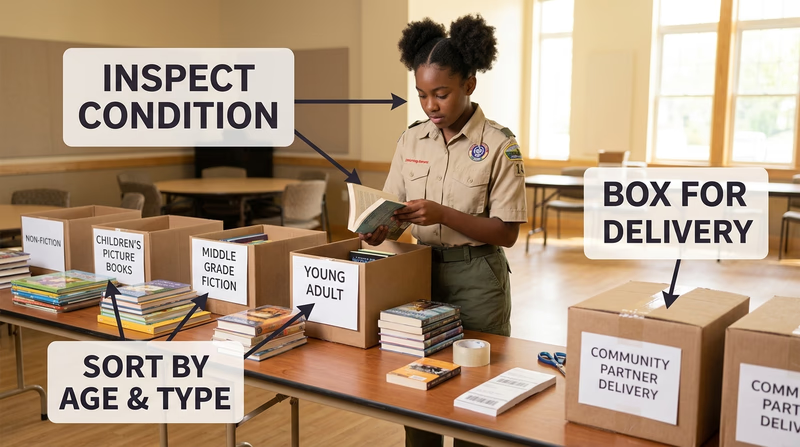
- Sorting: Create simple sections like picture books, middle grade, teen, nonfiction, and adult.
- Rules: Decide how exchanges work before the first person arrives.
- Leftovers: Plan whether extra books go back home or to a donation partner.
A book swap keeps books circulating through a community. The next option goes one step farther by collecting books specifically for people who need them.
Req 6e — Lead a Book Drive
A book drive works best when it solves a specific need. “Collect books” is too broad. “Collect gently used picture books for a family shelter” or “collect middle-grade novels for an after-school program” gives people a clear target and helps the receiving organization get books it can really use.
Before you collect anything, talk with the organization that will receive the books. Ask what ages they serve, what condition they accept, and whether they want fiction, nonfiction, bilingual books, or certain subjects. That conversation should shape your flyer, your collection boxes, and your sorting plan.
🎬 Video: Brag Book (video) — https://youtu.be/W9G0X6gAhwY
Book drive workflow
Plan from need to delivery- Choose the partner first: Know who will receive the books.
- Set a clear request: Ask for specific ages, formats, or subjects.
- Sort and inspect: Remove damaged books and group the usable ones.
- Deliver with records: Count what you collected and note where it went.
A book drive combines literacy, service, and leadership. After exploring these service options, the final badge requirement asks a bigger question: where could reading skills lead you in the future?
Req 7 — Explore Reading Careers
Nearly every career uses reading, but some careers depend on it every single day. Reading is how professionals gather information, understand details, notice mistakes, explain ideas, and make decisions. This requirement asks you to notice that reading is not just a school skill. It is a work skill.
Three careers that strongly use reading
Librarian or library media specialist
These professionals help people find information, evaluate sources, and use collections well. They read reviews, catalog records, policies, databases, and research requests constantly.
Editor or publisher
Editors read with purpose. They look for clarity, structure, grammar, accuracy, and audience fit. If you enjoy spotting what makes writing stronger, this path may interest you.
Technical writer, researcher, or analyst
These jobs often involve reading dense material, turning it into clearer explanations, and making sure details stay accurate. A person who reads carefully can save time, money, and confusion for everyone else.
You could also research careers such as teacher, lawyer, journalist, grant writer, historian, archivist, policy analyst, or intelligence analyst. The key is to show how reading matters in the actual work.
Career research questions
Bring these answers to your counselor discussion- Training and education: What classes, degree, or certifications are expected?
- Experience: What beginner steps help people enter the field?
- Expenses: What does training or college usually cost?
- Prospects: Is the field growing, stable, or competitive?
- Pay and advancement: What might an entry-level worker earn, and what comes next?
Reading can take you into stories, service, and careers — and this badge only scratches the surface. The Extended Learning page points to a few strong next steps if you want to keep going.
Extended Learning
Congratulations
You finished a badge about much more than books. You practiced how to find information, choose worthwhile reading, explain your thinking, use reading in service, and connect reading to real work. Those are lifelong skills, and they keep getting more valuable as the world gets noisier and more crowded with information.
Build a Personal Reading Map
Most readers grow fastest when they can see their own patterns. Start keeping a simple reading map for the next six months. Record what you read, how long it took, what kind of book it was, and one sentence about what stayed with you.
After a month or two, look for trends. Do you mostly choose one genre? Do you finish biographies faster than fantasy? Do short nonfiction articles help you discover bigger topics you want to study later? A reading map turns vague habits into something you can improve on purpose.
Learn to Read Primary Sources
A textbook or article usually tells you what someone else thinks happened. A primary source lets you look closer to the original material — speeches, letters, old newspapers, diaries, photographs, maps, and interviews. Learning to read primary sources helps you ask better questions about evidence, perspective, and bias.
This skill is useful in history, civics, genealogy, and current events. If you want a strong challenge, compare a modern summary of an event with a primary document from that time. The differences can be eye-opening.
Library of Congress — Primary Sources Search original documents, maps, recordings, and photographs to practice reading historical evidence directly. Link: Library of Congress — Primary Sources — https://www.loc.gov/collections/Try Reading in a Community
Reading does not have to stay private. Join or start a small reading group with your patrol, friends, family, or school club. Pick one shared article, short story, poem, or book chapter each meeting. Rotate who chooses the material and who leads the discussion.
A group changes the experience because other readers notice things you miss. One person may focus on theme, another on character, another on writing style, and another on whether the source feels trustworthy. That kind of discussion builds confidence and listening skill at the same time.
Read Across Formats on Purpose
Most people already move between print, screens, and audio. The next step is doing it intentionally. Try reading the same topic in two formats: an article and a podcast transcript, a novel and an audiobook excerpt, or a printed field guide and a digital database. Ask what each format does better.
This is especially useful when schoolwork gets heavy. Sometimes a printed page helps focus. Sometimes an audiobook helps with pacing and pronunciation. Sometimes an article gives a quick overview before you commit to a full book.
Real-World Experiences
Volunteer for a summer reading program
Many public libraries run summer reading programs that need teen volunteers for sign-ins, prize tables, setup, or younger-reader support. This gives you another way to turn reading into service.
Visit a special collection or archive
If a nearby college, museum, or public library has a local history room, rare books room, or archive, visit it. Seeing how information is preserved changes the way you think about books and records.
Attend an author talk or literary festival
Writers often speak at bookstores, schools, libraries, and community festivals. Hearing authors describe their choices can make you a more alert reader.
Start a recommendation shelf at home or in your troop
Create a simple display of books with handwritten recommendation cards. This is a smaller version of the reader’s-advisory work librarians do every day.