Req 1 — Library Skills in Action
This requirement gives you the basic moves every library user needs. You will tour a library, learn how the catalog is organized, search by different clues, find books on the shelves, and understand how a library card works. By the end, you should feel comfortable walking into a library and using it without guessing.
What this page covers
Five practical library skills
- 1a — Tour the library: Notice how the building, collections, and services are organized.
- 1b — Search the catalog: Look up books by author, title, and subject.
- 1c — Pick six books: Use the catalog to choose books from four different types.
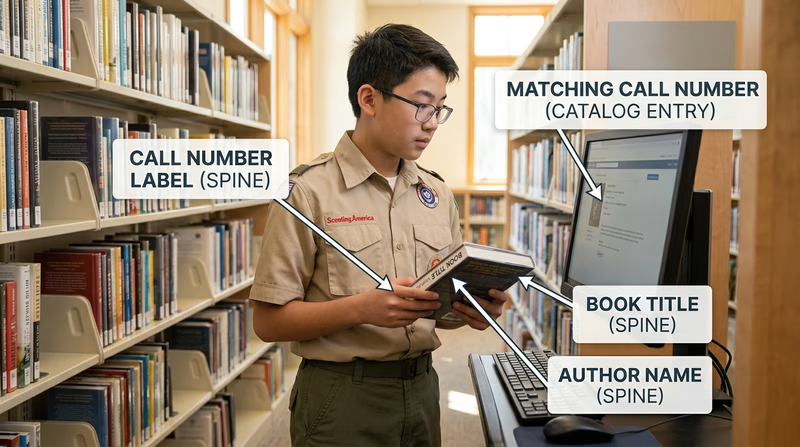
- 1d — Find them on the shelves: Match the catalog record to the physical location.
- 1e — Understand library cards: Learn how borrowing privileges work.
Requirement 1a
A library is more than rows of books. It is a system designed to help people find information, borrow materials, and get help from trained staff. On your tour, pay attention to the layout. Many libraries separate picture books, chapter books, teen books, adult fiction, nonfiction, reference materials, computers, meeting rooms, and special collections so visitors can quickly head to the right area.
Also notice the services. A public library may lend ebooks, audiobooks, movies, museum passes, hotspots, and games. A school library may focus more on research help, classroom support, and age-appropriate collections. Ask what the librarians help people do most often. The answer might include homework help, job searching, printing, genealogy, literacy programs, or story time.
🎬 Video: How Is a Library Organized (video) — https://youtu.be/wm3OYbqWGt4
🎬 Video: Library of Congress Classification (video) — https://youtu.be/Vq_nXCKqvvI?si=GIOeyfCbat453Qtp
Requirement 1b
This is where libraries become powerful. A catalog is an index of what the library owns and where to find it. Old-school card catalogs used drawers of cards. Modern catalogs do the same job on a screen. The search types matter because each one answers a different question.
Search by author
Use this when you already know who wrote the book. This helps when you liked one title and want more by the same person.
Search by title
Use this when you know the exact name or most of it. This is usually the fastest way to confirm whether a library has a specific book.
Search by subject
Use this when you know the topic but not the title. Search terms like “volcanoes,” “World War II,” or “dog training” help you discover multiple books at once.
A good Scout practices all three. If one search gives weak results, try another angle. That habit will help again in Req 5 when you compare different sources about the world around you.
🎬 Video: How to Use a Card Catalog (video) — https://youtu.be/bBoBFioGVJc?si=W5X75XCeu-dxS8if
Requirement 1c
This step turns searching into decision-making. Try to choose books that are genuinely different from one another. For example, you might pick a biography, a science nonfiction book, a novel, and a poetry collection. Then add two more books from any of those categories or from other types such as history, graphic novels, essays, or field guides.
When you search, write down three details for each book: the title, the author, and the call number or shelf location. If your library shows whether the book is checked in, note that too. A catalog search is only half complete until you can actually use the result.
🎬 Video: Locating a Book in a Library (video) — https://youtu.be/yqg41rMDlKA
Requirement 1d
Finding a book on the shelf means translating catalog information into real-world location. Start with the call number. In many public and school libraries, fiction may be shelved alphabetically by the author’s last name, while nonfiction often uses a number system. Read the shelf signs carefully, then narrow down from section to shelf to exact spot.
If you cannot find a book, that is normal. It may be checked out, waiting to be reshelved, placed on a display, or misshelved by another visitor. This is a good moment to ask a librarian for help. Knowing when to ask is part of using a library well, not a sign you failed.
Requirement 1e
A library card is your borrowing account. It tells the library who has checked out an item and when it is due back. It also unlocks digital borrowing, online databases, and sometimes computers, printers, or study room reservations.
Most libraries require proof that you live in the service area, plus a parent or guardian if you are under a certain age. Some school libraries issue student accounts automatically. Policies vary, so ask what documents are needed, how long cards last, and what happens if a card is lost.
A library card matters because it turns the library from a place you visit into a resource you can actually use. It is one of the simplest tools for lifelong learning.
🎬 Video: How Do I...Get a Library Card (video) — https://youtu.be/LOhNkY0yb4s?si=fCdFQINKX1P4wNYJ
When you finish this requirement, you will know how to find books instead of waiting for books to find you. Next, you will use those library skills to choose books worth reading.