Req 2 — Species Around You
A species list for the whole United States is interesting, but a species list for your own area is useful. This requirement helps you move from broad facts to local knowledge: what lives near you, where it is likely to be found, and why.
Big Picture: Distribution Across the United States
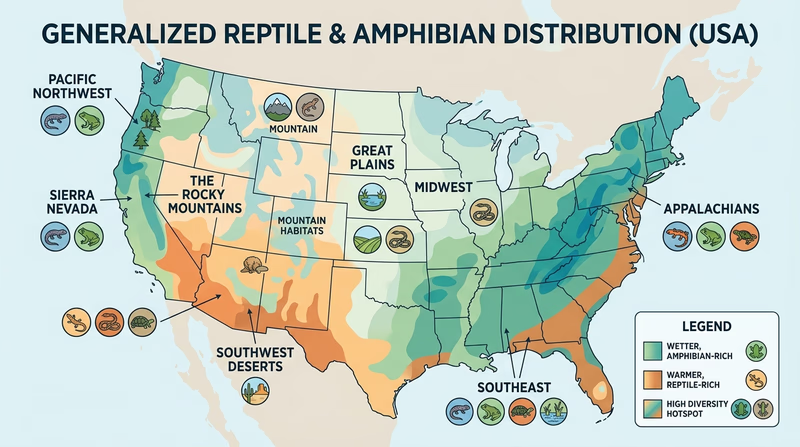
Reptiles and amphibians are not spread evenly across the country. Climate, rainfall, elevation, and habitat shape where each group thrives.
Amphibians
Amphibians usually need moisture. That is why the eastern United States, the Southeast, the Pacific Northwest, and many mountain regions support high amphibian diversity. Frogs and salamanders especially benefit from wetlands, streams, forests, and humid conditions.
Reptiles
Reptiles are generally better suited to dry and warm conditions because their skin does not dry out as easily as amphibian skin. That is why the Southeast, Southwest, and many warm lowland areas support large numbers of lizards, snakes, turtles, and crocodilians.
What “Approximate Number of Species” Means
Your counselor is not expecting you to memorize an exact national total forever. What matters is that you understand the scale and the pattern:
- there are hundreds of reptile species in the United States
- there are hundreds of amphibian species in the United States
- some regions have many more species than others
- a local list is always much shorter than the national list
A Scout in Arizona will likely see a very different set of animals than a Scout in Maine or Oregon.
Build a Local Species List
The second half of this requirement is practical. You need a list of the most common species in your area or state. That list should be realistic. Focus on species that are often reported, not just rare or famous ones.
Good Sources for a Local List
Find Amphibian and Reptile Species in Your Area (website) Use the USGS explorer to see which reptile and amphibian species are recorded in your state or region. Link: Find Amphibian and Reptile Species in Your Area (website) — https://geonarrative.usgs.gov/amphibianreptileexplorer/ Reptiles of the United States (website) Study maps and recent observations to see which reptiles are regularly found near you. Link: Reptiles of the United States (website) — https://www.inaturalist.org/places/united-states#taxon=26036 Amphibians of the United States (website) Compare local amphibian observations, photos, and range information before you make your list. Link: Amphibians of the United States (website) — https://www.inaturalist.org/places/united-states#taxon=20978Also consider state wildlife agencies, local nature centers, park staff, or a merit badge counselor who knows the region well.
How to Make a Useful List
Do not just copy names from a website. Sort them into a form you can discuss.
A Strong Local Species List
Organize it so you can actually use it with your counselor
- Common name: what the species is called locally.
- Type: frog, toad, salamander, turtle, lizard, snake, or crocodilian.
- Where you might find it: pond, creek, rocky hill, neighborhood garden, pine woods, and so on.
- When you are most likely to see or hear it: spring evenings, hot afternoons, after rain, near water at dusk.
- How common it really is: very common, fairly common, seasonal, or occasional.
Example Thinking
Instead of writing only “American bullfrog,” you could write: “American bullfrog — common in permanent ponds and marshes; easiest to hear and see on warm evenings; very common in local wetlands.” That kind of note helps you and proves you understand the species as part of a habitat.
Why Distribution Matters
Once you know where species are likely to live, you stop wasting time searching the wrong places. You also start asking better questions:
- Why are salamanders common in one county but rare in another?
- Why do some turtles show up in ponds while others prefer rivers?
- Why are some frogs heard only in certain seasons?
Those are the same kinds of questions wildlife biologists ask.
Get Ready for Your Counselor Conversation
Bring your list and be prepared to explain:
- the difference between national diversity and local diversity
- why climate and habitat shape geographic distribution
- which species are common near you
- where you would go to look for them
This requirement also sets you up well for Req 4, where local protected and unprotected species matter.