Req 6 — How Snakes Move
A snake can climb, swim, push through grass, and cross sand without a single leg. That looks almost magical until you understand the body parts doing the work.
Watch First, Explain Second
This requirement starts with observation. Before you try to explain snake movement, spend time actually watching one move. Notice whether it is moving across a smooth surface, rough ground, branches, or loose sand. The surface changes the motion.
🎬 Video: How Snakes Move! (They Don't Just Slither!) (video) — https://www.youtube.com/watch?v=7-AKPFiIEEw
🎬 Video: How Do Snakes Move? (video) — https://www.youtube.com/watch?v=aPV0HpPRH2A
The Three Main Parts Doing the Job
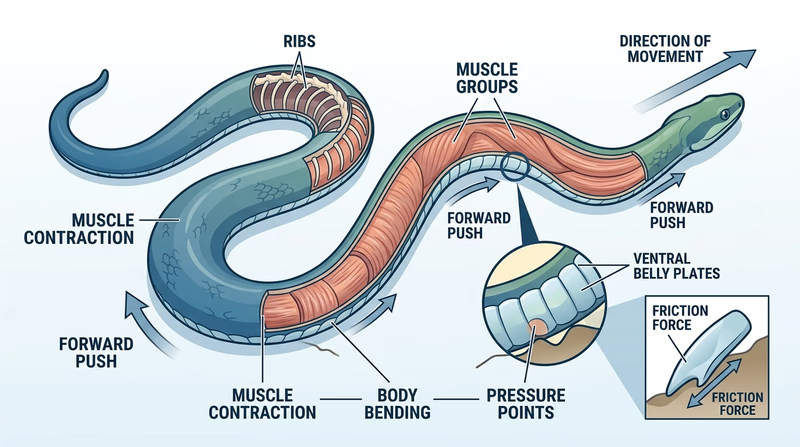
Muscles
A snake has long, powerful muscles running along its body. These muscles contract in sequence, creating waves of movement. Instead of one big push, the body makes many small pushes one after another.
Ribs
Snakes have many ribs attached along much of the body. Those ribs help support the body wall and work with the muscles to control shape, tension, and pushing force. They are part of the snake’s movement system, not just a protective cage.
Belly plates
The wide scales on the underside are called belly plates or ventral scales. These catch against rough spots on the ground. When the muscles pull and the belly plates grip, the snake moves forward instead of just sliding in place.
Common Ways Snakes Move
Lateral undulation
This is the classic side-to-side movement most people picture. The snake forms a series of S-shaped curves and pushes against rocks, grass stems, bumps, or other irregularities in the environment.
Rectilinear movement
This is a straighter, slower movement often used by heavy-bodied snakes like boas or pythons. Sections of the belly move forward in sequence, almost like a tank tread.
Concertina movement
When climbing or moving through a narrow space, a snake may bunch part of its body into loops, anchor itself, then extend forward and pull the rest along.
Sidewinding
Some snakes in sandy habitats lift parts of the body and set them down in a special pattern that works well on loose ground.
🎬 Video: True Facts: How Snakes Move (video) — https://www.youtube.com/watch?v=zFNnx4UgkNI
What to Say to Your Counselor
A strong explanation sounds something like this: the muscles create the force, the ribs help control the body, and the belly plates grip the surface. Together they let a snake push itself forward.
You can make that even stronger by naming the kind of movement you observed and describing what surface the snake was using.
Observation Notes to Bring
Write these down while you watch
- Where the snake was moving: grass, branch, rock, pavement, sand, or water edge.
- What the body shape looked like: tight curves, straight body, bunching, or lifted loops.
- How fast it moved: quick glide, slow crawl, or stop-and-go movement.
- What the surface provided: rough spots, branches, or loose sand.
Because Req 7 focuses on venomous species, this is a good time to practice watching snakes carefully without getting too close.
🎬 Video: Reptile vs Amphibian (video) — https://www.youtube.com/watch?v=GKM_mDDPJh0
🎬 Video: Lifecycle of an Amphibian (Frog) (video) — https://youtu.be/sZnvgGmvuVs?si=3d5-sxPLy1jJbJz_
🎬 Video: How Lizards Reproduce (Video) — https://www.youtube.com/watch?v=ACEpFX2Dnmk
🎬 Video: What Are Oviparous and Viviparous Snakes? (video) — https://youtu.be/KFCfL99rHpw?si=rCqWcKm5S4LBA7zW