Req 2ac — Two Types of Cartridges
A modern rifle cartridge is a self-contained unit that holds everything needed to fire one shot. The two types differ in where their primer is located.
Parts of a Cartridge (Both Types)
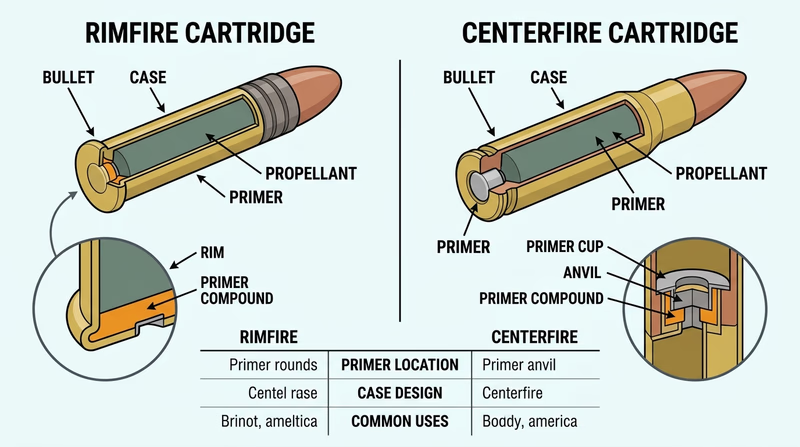
Every cartridge has four parts:
- Case: The brass, steel, or aluminum shell that holds all other components together. It also expands slightly on firing to seal the chamber and contains the pressure.
- Primer: A small, sensitive explosive compound. When struck by the firing pin, it ignites and sends a flash into the propellant.
- Propellant (powder): The chemical charge that burns rapidly when ignited, producing the expanding gas that drives the bullet.
- Bullet: The projectile itself. It is seated in the case mouth and is what actually leaves the barrel and travels to the target.
Type 1: Rimfire
In a rimfire cartridge, the primer compound is distributed inside the thin, folded rim of the case base. When the firing pin strikes the rim, it crushes the rim against the chamber edge and ignites the primer compound.
- Examples: .22 Short, .22 Long Rifle, .17 HMR
- Characteristics: Less expensive to manufacture, but the case cannot be reloaded because the rim is crushed on firing. Generally lower pressure and used for smaller calibers.
- The .22 LR you use in Option A is a rimfire cartridge. It is the most-produced cartridge in history.
Type 2: Centerfire
In a centerfire cartridge, the primer is a separate replaceable cup seated in the center of the case head. The firing pin strikes the center of the case base, detonating the primer cup.
- Examples: .308 Winchester, .30-06 Springfield, 5.56 NATO, 9mm Luger (handgun)
- Characteristics: More reliable ignition, higher pressure tolerance, and the case can often be reloaded multiple times by replacing the spent primer.
- Used for medium and large game hunting, military and law enforcement, and most competitive rifle sports above .22 caliber.
Identifying the Difference
Hold two cartridges side by side: a .22 LR and a .308 Winchester (or any centerfire round). The .22 LR has a smooth, rounded rim with no visible primer in the center. The .308 has a small circle in the center of its base—that circle is the primer.
Why This Matters
Understanding cartridge types helps you:
- Know why you cannot use centerfire ammunition in a .22 rimfire rifle.
- Understand why a misfire response differs (rimfire cases may fail if the rim strike is off-center; centerfire primers are more consistent).
- Discuss cartridge selection intelligently when choosing a rifle.
🎬 Video: Firearm Basics: Parts of a Cartridge — NRApubs — https://www.youtube.com/watch?v=rnkKZuYGH4Y