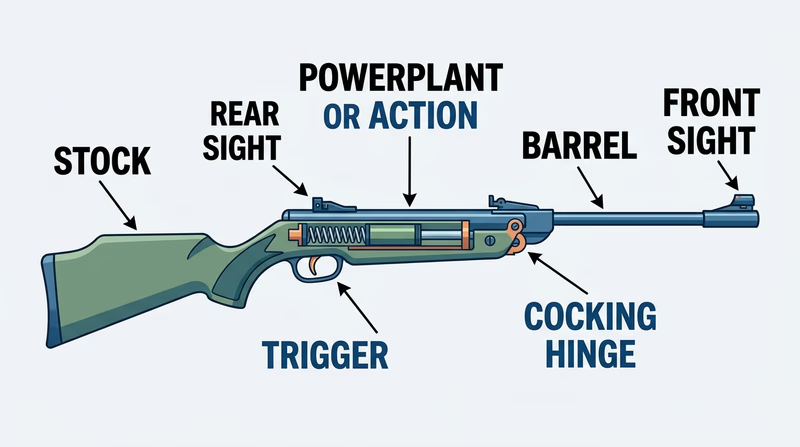
Req 2ba — Three Main Parts of an Air Rifle
Like any rifle, an air rifle consists of three main parts: the stock, the action, and the barrel. The difference is in how the action generates the force to propel the projectile.
The Three Parts
1. Stock
The air rifle stock functions identically to a cartridge rifle stock: it houses the action and barrel, provides cheekweld, and gives the shooter a consistent way to shoulder and aim the rifle. Air rifle stocks are often made of hardwood, beech, or synthetic materials. Competition air rifles often have highly adjustable stocks that accommodate shooters of different sizes.
2. Action (Powerplant)
The “action” of an air rifle is more accurately called its powerplant—the mechanism that generates the air pressure to propel the projectile. There are three common types:
Spring-piston (break-barrel or underlever): Cocking the rifle compresses a spring-driven piston. Pulling the trigger releases the spring, which drives the piston forward rapidly, compressing the air ahead of it and propelling the pellet. Break-barrel designs are the most common type in Scout programs.
Pre-charged pneumatic (PCP): A reservoir of compressed air (filled with a hand pump, diving cylinder, or carbon fiber tank) is regulated to a set pressure. Each shot uses a metered burst of that stored air. These are used in Olympic competition air rifles.
CO₂-powered: A small CO₂ cartridge provides the propellant gas. Common in BB guns (many use this system). Simple and inexpensive, but gas pressure decreases as the CO₂ cylinder empties and in cold weather.
BB guns (often spring or CO₂ powered) and pellet rifles (usually spring-piston or PCP) are both acceptable for Option B, at different distances.
3. Barrel
The barrel of an air rifle channels the projectile from the action to the target. Pellet rifle barrels are rifled (spiral grooves cut inside) to spin-stabilize the pellet and improve accuracy—identical in principle to a cartridge rifle. BB gun barrels are smooth bore (no rifling) because round steel BBs do not benefit from spin.
Putting It Together
When you cock a spring-piston air rifle, you are storing mechanical energy in the compressed spring. When the trigger releases the spring, the piston fires forward, compresses air in the chamber ahead of it, and that air pressure pushes the BB or pellet down the barrel.