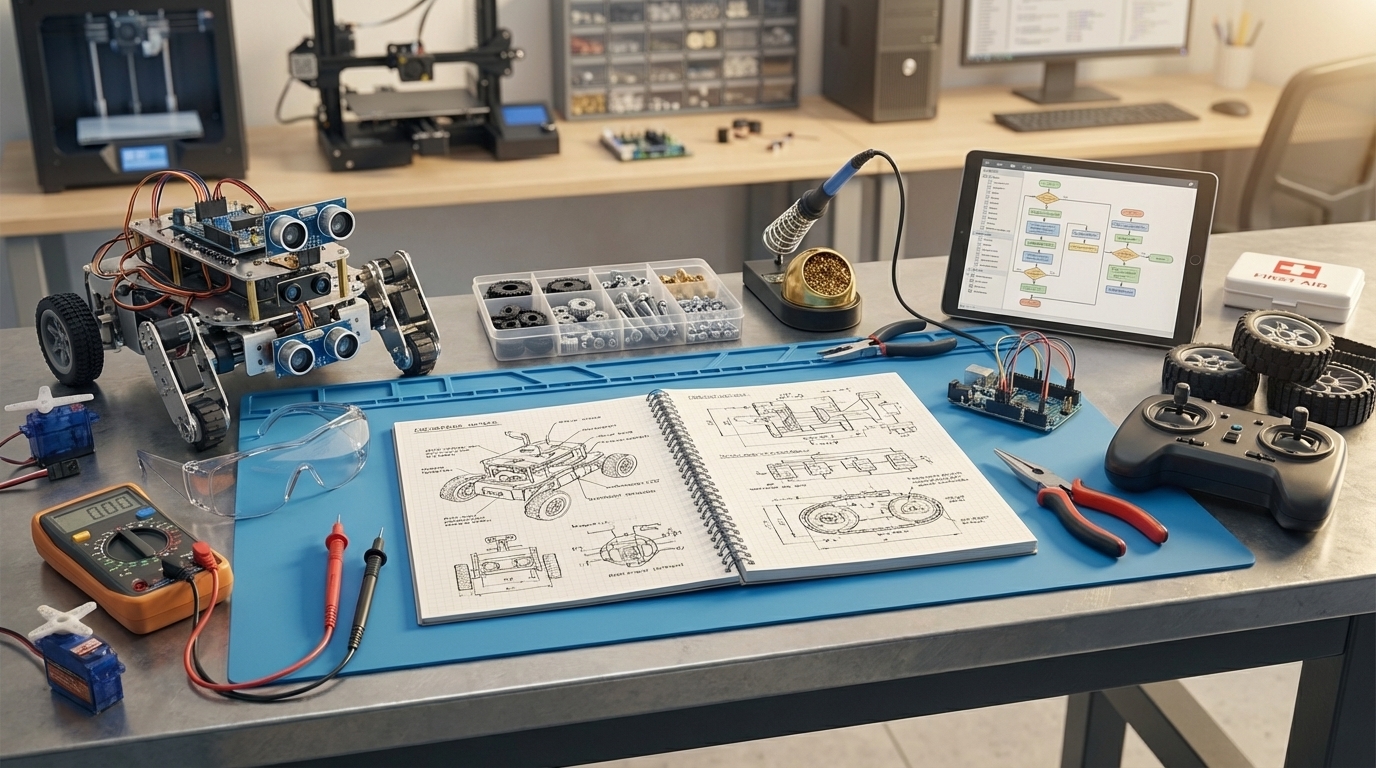
 Getting Started
Introduction & Overview
Robots are machines that sense the world, make decisions, and do work. You already see them in factories, hospitals, warehouses, farms, and even living rooms. Robotics Merit Badge shows you how those machines are designed, programmed, tested, and improved — and then challenges you to build part of that process yourself.
This badge is exciting because it mixes several skills at once. You will think like an engineer, code like a programmer, troubleshoot like a mechanic, and explain your choices like a team leader. By the end, you will not just know what robots are — you will understand why good robots are built on clear goals, safe habits, and careful testing.
Origins and Where We Are Today
Origins
The word robot comes from a 1920 play by Czech writer Karel Čapek. His “robots” were imaginary workers, but the idea caught on fast. By the mid-1900s, inventors were building real machines that could repeat the same motion over and over, which made them useful in factories where speed and consistency mattered.
Early industrial robots were powerful but limited. Most could only follow a set path. If a part was in the wrong place, the robot did not adapt. It just kept moving. That worked for simple jobs, but it was not much like the flexible robots people imagined in science fiction.
Where We Are Today
Modern robots combine motors, sensors, software, and mechanical design. A warehouse robot can map a room. A surgical robot can help a doctor make tiny, precise movements. A competition robot can use a camera or distance sensor to react to changing conditions instead of following the same path every time.
Today, robotics matters because it solves hard problems. Robots handle dangerous jobs, repeat boring work accurately, explore places people cannot easily go, and help humans do tasks with greater precision. That makes robotics one of the clearest examples of how engineering turns ideas into useful tools.
Get Ready!
You do not need a giant humanoid robot to succeed in this badge. A simple machine that senses something, decides what to do, and moves in a useful way is enough to teach the real lessons. Bring curiosity, patience, and a willingness to test ideas more than once.
Kinds of Robotics
Industrial Robotics
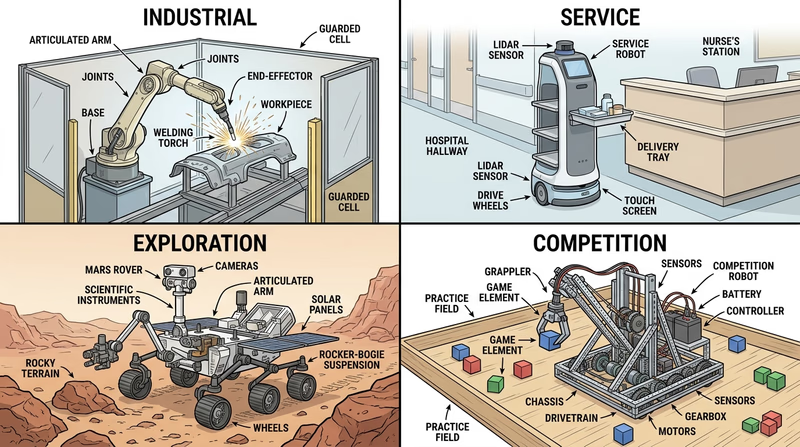
Industrial robots work in factories and production lines. They weld, paint, sort, assemble, and move parts. These robots are usually built for speed, repeatability, and safety inside a controlled workspace.
Service Robotics
Service robots help people outside the traditional factory setting. That includes hospital delivery carts, floor-cleaning robots, agricultural machines, and bomb-disposal robots. The challenge here is dealing with messy, changing environments.
Exploration Robotics
Exploration robots go where people cannot safely or easily go. That might mean deep underwater, inside a collapsed structure, or across another planet. These robots must be tough, energy-efficient, and able to work with limited human control.
Educational and Competition Robotics
This is the kind of robotics many Scouts meet first. Educational robots help you learn design, sensors, programming, teamwork, and troubleshooting. Competition robots add strategy, deadlines, and real pressure — which is why they are such good training for real engineering work.
You have the big picture. Next, start with the skill that every good robotics team uses before turning on the power: safety.