Req 4a — Choose the Mission
A robot project goes wrong fastest when the mission is fuzzy. “Build a cool robot” is not a mission. “Build a robot that drives to a line, stops within 2 inches, and raises a small arm when a button is pressed” is a mission. The clearer the task, the easier it is to design, build, program, and test.
Pick a task that is real and reachable
Your task should be just hard enough to show real robotics skills, but not so huge that you run out of time. A good robotics merit badge project usually has three parts:
- A specific job the robot must accomplish
- At least one sensor that affects behavior
- Programming logic that makes decisions or sequences actions
Examples of strong project ideas include:
- a robot that follows a line and stops at a marked zone
- a robotic arm that sorts two object types by color or position
- a robot that backs away when it senses an obstacle
- a subsystem that raises and lowers an attachment to set positions using a limit switch or encoder
A weak project is one where the sensor is just decoration. If the robot would behave the same way with the sensor unplugged, the task probably needs improvement.
🎬 Video: What Qualifies as a Robot for Robotics Merit Badge? (video) — https://youtu.be/6dYq9bBSaWc?list=PLHGEvyG5wuthXQZzTc-mLwFrP5F6_1Lce
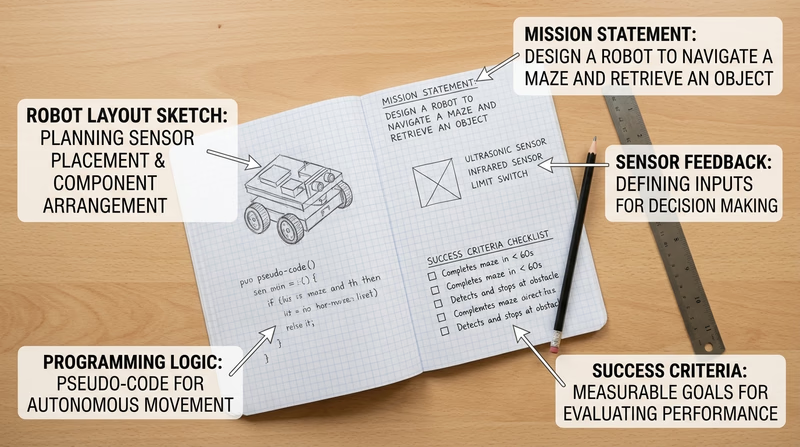
What to record in your engineering notebook
Your notebook does not need to be fancy. It needs to be clear. Write down:
- the task you chose
- why you chose it
- what the robot must sense
- what the robot must decide
- what counts as success
- limits such as time, size, parts, or budget
Try writing a short mission statement like this:
My robot will carry a small object from a start zone to a target zone, stop when a distance sensor detects the wall, and release the object using a servo-controlled arm.
That statement already includes action, sensor feedback, and programming.
Mission definition checklist
Use these questions before you ask for counselor approval
- Clear goal: Can I describe exactly what the robot should do in one or two sentences?
- Sensor role: What input will the robot use to react to the world?
- Program logic: What decision or sequence will the code control?
- Testable result: How will I know whether it succeeded?
- Realistic scope: Can I finish this with the parts, time, and skills I have?
The mission comes first. Next, turn that mission into a design you can actually build.