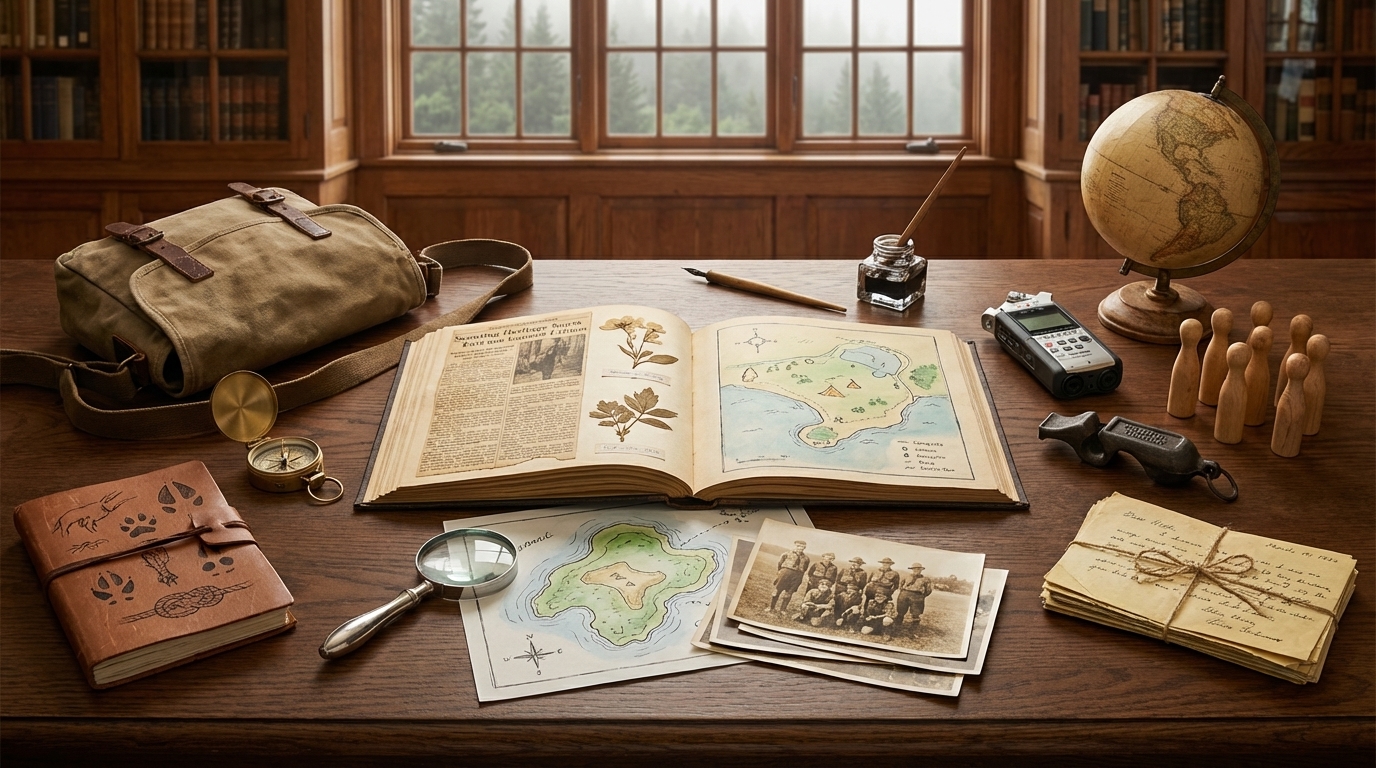
Scouting Heritage Merit Badge — Complete Digital Resource Guide
https://merit-badge.university/merit-badges/scouting-heritage/guide/
Introduction & Overview
Every Scout troop meeting, campout, and jamboree you have ever attended is part of a story that stretches back more than a century. The Scouting Heritage merit badge takes you on a journey through that story — from a small island experiment in England to a worldwide movement that has shaped the lives of hundreds of millions of young people. Along the way, you will meet the people who built Scouting, explore the traditions you carry forward, and discover how your own Scouting experience connects to a much bigger picture.
Then and Now
Then — A Campfire on Brownsea Island
In 1907, a retired British Army officer named Robert Baden-Powell invited 20 boys from different backgrounds to camp on Brownsea Island in Poole Harbour, England. He taught them tracking, observation, first aid, and teamwork — organized into small groups he called “patrols.” That experimental camp became the spark for the worldwide Scouting movement. Within just a few years, Scouting had crossed the Atlantic and taken root in the United States, growing from a handful of troops into one of the largest youth organizations in American history.
Now — A Living Tradition
Today, Scouting America serves millions of young people through Cub Scouting, Scouts BSA, Venturing, Sea Scouts, and Exploring. The core ideas Baden-Powell tested on Brownsea Island — the patrol method, learning by doing, service to others, and the outdoor program — remain at the heart of every Scouting experience. When you tie a bowline, cook over a campfire, or lead a service project, you are practicing skills that connect you to Scouts across generations and around the world.
Get Ready! This badge is about more than memorizing dates and names. It is about understanding why Scouting exists, who made it possible, and how the traditions you practice today came to be. You will research, interview, collect, play, and explore — and by the end, you will see your own Scouting journey as part of something much larger.
What You Will Cover
This guide walks you through every requirement of the Scouting Heritage merit badge:
- The Founder’s Story — Learn about Lord Baden-Powell, his vision, and how Scouting came to America.
- Scouting Pioneers — Meet the leaders who built and shaped Scouting in the United States.
- Scouting Milestones — Explore the key events, publications, and places that defined the movement.
- Programs Through the Years — Trace how Scouting adapted for different ages and interests.
- Experience Scouting History — Visit a jamboree, museum, or historic exhibit firsthand.
- Your Scouting Story — Research your own unit or council, build a memorabilia collection, play a classic Scouting game, and interview former Scouts.
- Careers in Scouting — Explore how Scouting can become a career or a lifelong volunteer commitment.
Next Steps
The journey begins with the man who started it all. Let’s meet Lord Baden-Powell.
Req 1 — Baden-Powell & the Birth of Scouting
This requirement asks you to understand three things: who Baden-Powell was, why he created Scouting, and how the movement spread to America. Below is the background you need to prepare a solid discussion with your counselor.
The Life and Times of Lord Baden-Powell
Robert Stephenson Smyth Baden-Powell (1857-1941) grew up in England and joined the British Army at age 19. He served in India and Africa, where he became famous for his scouting and reconnaissance skills — the military kind, meaning tracking, observation, and survival in the field.
Key moments in his life:
- 1899-1900 — Siege of Mafeking. During the Second Boer War in South Africa, Baden-Powell led a small garrison that held out against a much larger force for 217 days. He famously organized the town’s boys into a cadet corps to carry messages, freeing soldiers for defense. The siege made him a national hero in Britain.
- 1907 — Brownsea Island Camp. Baden-Powell organized an experimental camp for 20 boys on Brownsea Island. He tested ideas about patrol-based learning, outdoor skills, and character development. The camp’s success convinced him that a youth program built on these ideas could work.
- 1908 — Scouting for Boys. He published this handbook in six fortnightly installments. It became a sensation — boys across Britain began forming their own patrols and troops without waiting for adults to organize them.
Why Scouting Was Needed
Baden-Powell saw that many young men in Edwardian England lacked practical skills, physical fitness, and a sense of purpose. Industrialization had moved families into cities, and boys had fewer opportunities to learn outdoor skills or develop self-reliance. He believed a program that combined outdoor adventure, service to others, and a code of honor (the Scout Law) would help young people grow into capable, responsible citizens.
Scouting Comes to America
The most famous version of the story involves William D. Boyce, an American newspaper publisher who got lost in London fog in 1909. A boy — an unknown Scout — guided him to his destination and refused a tip, saying a Scout does not accept payment for a Good Turn. Impressed, Boyce learned about Scouting and incorporated the Boy Scouts of America (BSA) on February 8, 1910.
But Scouting’s American roots go deeper. Daniel Carter Beard had already founded the Sons of Daniel Boone (1905), and Ernest Thompson Seton had created the Woodcraft Indians (1902) — both youth programs with ideas very similar to Scouting. When the BSA was formed, Beard and Seton brought their organizations into the new movement, and both served as early leaders. You will learn more about these men in Requirement 2a.
The Origins of Cub Scouting
Baden-Powell noticed that younger boys wanted to join Scouting too, but the program was designed for older youth. In 1916, he created the Wolf Cubs program in Britain for boys ages 8-10, based in part on Rudyard Kipling’s The Jungle Book. In the United States, the BSA launched its own Cub Scouting program in 1930, adapted for American youth with a family-centered approach and den meetings.
Preparing for Your Discussion
When you talk with your counselor, be ready to cover:
- Baden-Powell’s background — his military career, the Siege of Mafeking, and the Brownsea Island camp.
- His reasons for creating Scouting — the needs of young people in his time, and the principles he built the program around.
- How Scouting reached America — the Boyce story, the earlier youth programs of Beard and Seton, and the founding of the BSA in 1910.
- Cub Scouting’s origins — the Wolf Cubs in Britain and the launch of Cub Scouting in America.
Official Resources
🎬 Video: Baden Powell - Father of Scouting, Origins of Scouting (video) — https://www.youtube.com/watch?v=tn9S4qB-fdw&list=PLeqxtqwBBzS-Z290oRp20bqnDqXZkSb3j&index=1
Req 2a — Choose Two Scouting Leaders
You need to pick two of the nine Scouting leaders listed below. For each person you choose, you will prepare a short biographical summary and explain how they helped Scouting develop and grow in the United States.
Your Options
- Req 2a1 — Daniel Carter Beard: Founded the Sons of Daniel Boone and became the first National Scout Commissioner. A rugged outdoorsman who shaped Scouting’s wilderness identity.
- Req 2a2 — William D. Boyce: The businessman who incorporated the Boy Scouts of America in 1910 after a chance encounter with a Scout in London fog.
- Req 2a3 — Waite Phillips: An Oklahoma oil baron who donated the land that became Philmont Scout Ranch — Scouting’s most famous high-adventure base.
- Req 2a4 — Ernest Thompson Seton: A naturalist and author who founded the Woodcraft Indians and served as the BSA’s first Chief Scout. Brought nature lore and woodcraft traditions into the Scouting program.
- Req 2a5 — James E. West: The BSA’s first Chief Scout Executive, who built the organization’s professional structure and led it for 32 years.
- Req 2a6 — “Green Bar Bill” Hillcourt: The Danish-born Scouter who wrote three editions of the Scout Handbook and championed the patrol method for decades.
- Req 2a7 — Frederick Russell Burnham: The American-born scout and adventurer whose real-world reconnaissance skills in Africa directly inspired Baden-Powell’s vision for Scouting.
- Req 2a8 — Dr. Charles Eastman: A Dakota Sioux physician and author who helped shape the BSA’s early outdoor and campcraft programs, bridging Native American traditions and Scouting.
- Req 2a9 — Edgar Robinson: A YMCA leader who was instrumental in the BSA’s early organization and helped bring the Scouting movement to a national audience.
How to Choose
Pick the two people who interest you most. There is no wrong combination. Here are some ways to think about it:
- Interested in the founding story? Boyce, Beard, and Seton are the three men most directly involved in creating the BSA.
- Interested in adventure and the outdoors? Burnham, Phillips, and Beard each brought a spirit of frontier exploration to Scouting.
- Interested in how the organization was built? West and Robinson shaped the BSA’s national structure and growth.
- Interested in Scouting’s program and traditions? Hillcourt, Seton, and Eastman each left a lasting mark on what Scouts actually do.
Start with the first option, or jump directly to any person using the navigation menu.
Req 2a1 — Daniel Carter Beard
Who Was Daniel Carter Beard?
Daniel Carter Beard (1850-1941) was an illustrator, author, outdoorsman, and one of the founding figures of the Boy Scouts of America. Born in Cincinnati, Ohio, Beard grew up exploring the woods and rivers of Kentucky and Ohio, developing a lifelong love of nature and frontier skills.
Key facts for your biographical summary:
- Early career: Beard was a successful illustrator and writer. He illustrated books by Mark Twain, including A Connecticut Yankee in King Arthur’s Court. He also wrote The American Boy’s Handy Book (1882), a popular guide to outdoor skills and crafts.
- Sons of Daniel Boone: In 1905, Beard founded the Sons of Daniel Boone, a youth organization focused on woodcraft, camping, and frontier skills. This group was one of the direct predecessors of the BSA.
- Joining the BSA: When the Boy Scouts of America was incorporated in 1910, Beard merged the Sons of Daniel Boone into the new organization. He was named National Scout Commissioner — a position he held for the rest of his life.
- His influence on Scouting: Beard championed the rugged outdoor character of American Scouting. He believed that camping, pioneering, and wilderness skills were essential to building strong young men. His emphasis on the American frontier tradition helped distinguish American Scouting from its British roots.
Preparing Your Summary
When you discuss Beard with your counselor, cover:
- His background as an illustrator and outdoorsman
- The Sons of Daniel Boone and how it merged into the BSA
- His role as National Scout Commissioner
- How he shaped the outdoor and frontier identity of American Scouting
Official Resources
🎬 Video: Daniel Carter Beard - BSA Founder (video) — https://www.youtube.com/watch?v=GIaIyxfuLCQ&list=PLeqxtqwBBzS-Z290oRp20bqnDqXZkSb3j&index=2
Req 2a2 — William D. Boyce
Who Was William D. Boyce?
William Dickson Boyce (1858-1929) was an American newspaper publisher, entrepreneur, and explorer. He is credited with incorporating the Boy Scouts of America, making him one of the most important figures in the founding of the organization.
Key facts for your biographical summary:
- Business career: Boyce built a media empire based in Chicago, publishing several newspapers and a weekly magazine. He was a successful businessman and an adventurous traveler who led expeditions to remote parts of the world.
- The Good Turn in the fog: The most famous story in Scouting history involves Boyce getting lost in heavy London fog in 1909. An unknown boy — a Scout — guided him to his destination and refused a tip, explaining that Scouts do not accept payment for doing a Good Turn. Inspired, Boyce sought out the Scouting movement’s headquarters to learn more.
- Incorporating the BSA: On February 8, 1910, Boyce filed incorporation papers for the Boy Scouts of America in Washington, D.C. This date is celebrated as the founding of the BSA.
- His role after founding: Unlike Beard or Seton, Boyce did not stay deeply involved in the day-to-day operations of Scouting. He provided initial support and then moved on to other ventures. But without his action, the BSA might not have been founded when it was.
Preparing Your Summary
When you discuss Boyce with your counselor, cover:
- His background as a newspaper publisher and entrepreneur
- The story of the Good Turn in the London fog
- His role in incorporating the BSA on February 8, 1910
- How his single act of incorporation launched the organization, even though he was not involved in its long-term management
Official Resources
🎬 Video: William D. Boyce - BSA Founder (video) — https://www.youtube.com/watch?v=Ulhu9fefMo4&list=PLeqxtqwBBzS-Z290oRp20bqnDqXZkSb3j&index=3
Req 2a3 — Waite Phillips
Who Was Waite Phillips?
Waite Phillips (1883-1964) was an Oklahoma oil businessman and philanthropist whose extraordinary generosity gave Scouting one of its greatest treasures: Philmont Scout Ranch.
Key facts for your biographical summary:
- Business career: Phillips made his fortune in the Oklahoma oil industry. He and his brothers, including Frank Phillips (founder of Phillips Petroleum), were among the most prominent oilmen of the early twentieth century. Waite built his own company and accumulated vast wealth and land holdings in New Mexico.
- Philmont Scout Ranch: In 1938, Phillips donated 35,857 acres of his New Mexico ranch to the BSA, along with his Philtower office building in Tulsa, Oklahoma (to help fund the ranch’s operations). In 1941, he donated an additional 91,538 acres. The property, renamed Philmont Scout Ranch, became the BSA’s premier high-adventure base and the largest youth camp in the world.
- His vision: Phillips believed that the wilderness experience would build character in young people. He wanted Scouts to experience the rugged beauty of the Sangre de Cristo Mountains — hiking, camping, and learning to be self-reliant in wild country.
- A lasting legacy: Today, more than 25,000 Scouts and leaders participate in Philmont’s backpacking programs each year. The ranch covers over 140,000 acres and remains one of the most transformative experiences in all of Scouting.
Preparing Your Summary
When you discuss Phillips with your counselor, cover:
- His background in the Oklahoma oil industry
- His donations of land and a Tulsa office building to the BSA
- The creation of Philmont Scout Ranch and its significance to Scouting
- His belief in the power of wilderness experiences for youth development
Official Resources
🎬 Video: Waite Phillips - BSA Benefactor and Donor of Philmont (video) — https://youtu.be/QiKK97PQ7Us
Req 2a4 — Ernest Thompson Seton
Who Was Ernest Thompson Seton?
Ernest Thompson Seton (1860-1946) was a British-born, American-raised naturalist, wildlife artist, author, and youth leader. He was the BSA’s first Chief Scout and brought a deep love of nature and woodcraft into the Scouting program.
Key facts for your biographical summary:
- Naturalist and author: Seton was one of the most famous naturalists of his era. He wrote and illustrated dozens of books about wildlife, including Wild Animals I Have Known (1898). His animal stories and detailed illustrations inspired generations of young people to explore the natural world.
- The Woodcraft Indians: In 1902, Seton founded the Woodcraft Indians (later the Woodcraft League of America), a youth organization based on Native American traditions, outdoor skills, and nature study. The program used campfire councils, nature observation, and a system of “coups” (honors earned for skills) — ideas that directly influenced the Scouting program.
- Chief Scout of the BSA: When the BSA was organized in 1910, Seton became its first Chief Scout, a ceremonial leadership role. He helped write the first version of the Boy Scout Handbook and shaped the early program’s emphasis on nature lore, campcraft, and outdoor skills.
- Departure from the BSA: Seton and the BSA’s leadership eventually disagreed about the direction of the organization. Seton favored a nature-centered, woodcraft-based program, while others pushed for a more military-style structure. He left the BSA in 1915 but continued his Woodcraft League and nature education work for the rest of his life.
Preparing Your Summary
When you discuss Seton with your counselor, cover:
- His career as a naturalist, author, and wildlife artist
- The Woodcraft Indians and how that program influenced Scouting
- His role as the BSA’s first Chief Scout
- How he shaped the nature lore and campcraft traditions in American Scouting
Official Resources
🎬 Video: Ernest Thompson Seton - BSA Founder (video) — https://youtu.be/-azpLxf8wpA?si=tiMSbrOyFEHx0L9u
Req 2a5 — James E. West
Who Was James E. West?
James Edward West (1876-1948) was the first Chief Scout Executive of the Boy Scouts of America — the professional head of the organization. He served in that role for 32 years (1911-1943), longer than any other person, and is largely responsible for building the BSA into the massive national organization it became.
Key facts for your biographical summary:
- Overcoming adversity: West was orphaned at age six and grew up in institutions, including a home for children with disabilities (he had tuberculosis of the hip as a child and walked with a limp for life). Despite these challenges, he earned a law degree from National University Law School and became a successful attorney and advocate for children’s welfare.
- Appointed Chief Scout Executive: In 1911, the BSA’s executive board hired West to lead the organization professionally. He was 34 years old. Over the next three decades, he transformed the BSA from a small, loosely organized movement into a highly structured national institution.
- Building the organization: Under West’s leadership, the BSA grew from about 61,000 members in 1911 to over 1.5 million by the time he retired. He established national standards for troop operations, created the professional Scouting staff system, developed the merit badge program, and built relationships with civic, religious, and educational institutions across the country.
- A complicated legacy: West was an effective administrator, but his top-down management style sometimes clashed with volunteer leaders who preferred a more grassroots approach. His disagreements with Seton and Beard over the direction of the program are well documented. Still, there is no question that West built the organizational infrastructure that allowed Scouting to reach millions of young people.
Preparing Your Summary
When you discuss West with your counselor, cover:
- His challenging childhood and how it shaped his commitment to youth
- His appointment as the first Chief Scout Executive
- How he built the BSA’s organizational structure, membership, and national programs
- The growth of Scouting under his 32-year tenure
Official Resources
🎬 Video: James E. West - BSA Founder (video) — https://youtu.be/cpIpdHl4cug
Req 2a6 — "Green Bar Bill" Hillcourt
Who Was “Green Bar Bill” Hillcourt?
William “Green Bar Bill” Hillcourt (1900-1992) was a Danish-born Scouter, writer, and educator who became one of the most influential figures in the history of American Scouting. He earned his nickname from the green patrol leader bars that symbolize the patrol method — the heart of his lifelong mission.
Key facts for your biographical summary:
- From Denmark to America: Born Vilhelm Hans Bjerregaard Jensen in Aarhus, Denmark, Hillcourt became a Scout in Denmark as a teenager. He was so passionate about Scouting that he moved to the United States in 1926 specifically to work at the BSA’s national office.
- The Scout Handbook: Hillcourt wrote or co-wrote three editions of the Boy Scout Handbook — the 6th (1959), 8th (1972), and 9th (1979) editions. These handbooks shaped the Scouting experience for millions of boys and are among the best-selling books in American publishing history.
- Champion of the patrol method: Hillcourt believed passionately that the patrol method — small groups of Scouts led by youth — was the core of what made Scouting work. He spent decades promoting patrol-based Scouting through his writing, training courses, and personal example. When the BSA experimented with other program models in the early 1970s, Hillcourt led the effort to return to patrol-method Scouting.
- Fieldbook and training: Beyond the handbook, Hillcourt wrote the Scout Field Book and created influential training materials for Scoutmasters. He was a fixture at Wood Badge courses and national events, always teaching the fundamentals of good Scouting.
Preparing Your Summary
When you discuss Hillcourt with your counselor, cover:
- His origins in Denmark and his decision to dedicate his life to Scouting in America
- His authorship of three editions of the Scout Handbook
- His lifelong advocacy for the patrol method
- How his writing and training influenced generations of Scouts and Scoutmasters
Official Resources
🎬 Video: Green Bar Bill Hillcourt Biography (video) — https://www.youtube.com/watch?v=ZJofraVDGuA
Req 2a7 — Frederick Russell Burnham
Who Was Frederick Russell Burnham?
Frederick Russell Burnham (1861-1947) was an American-born frontiersman, military scout, and adventurer whose extraordinary real-world reconnaissance skills directly inspired Baden-Powell to create the Scouting movement.
Key facts for your biographical summary:
- The American frontier: Burnham grew up in Minnesota and spent his youth on the American frontier during the final decades of westward expansion. He learned tracking, survival, and observation skills from Native American scouts and experienced frontiersmen. By his twenties, he was considered one of the finest scouts in the American West.
- Adventures in Africa: In the 1890s, Burnham traveled to southern Africa, where he served as a scout during the Matabele Wars and the Second Boer War. His abilities in tracking, reconnaissance, and operating behind enemy lines were legendary. The British Army gave him the rank of Major and called him the “King of Scouts.”
- Meeting Baden-Powell: Burnham and Baden-Powell served together in Africa. Baden-Powell was deeply impressed by Burnham’s skills and by the American frontier scouting tradition. Their friendship and Burnham’s example were a direct influence on Baden-Powell’s decision to create a youth program based on scouting skills — observation, tracking, woodcraft, and self-reliance.
- Promoting Scouting in America: After the BSA was founded, Burnham became one of its earliest and most visible supporters. He served on the BSA’s National Council and used his fame to promote Scouting to the American public.
Preparing Your Summary
When you discuss Burnham with your counselor, cover:
- His background on the American frontier and the skills he developed there
- His service as a military scout in Africa
- His friendship with Baden-Powell and how his skills inspired the Scouting program
- His support for the BSA after its founding
Official Resources
🎬 Video: Artifact of the Week - History of Neckerchiefs and Frederick Russell Burnham (video) — https://youtu.be/fg91BoeZde8
Req 2a8 — Dr. Charles Eastman
Who Was Dr. Charles Eastman?
Dr. Charles Alexander Eastman (Ohiyesa) (1858-1939) was a Dakota Sioux physician, author, and one of the most prominent Native American public figures of the early twentieth century. He played a significant role in shaping the outdoor and campcraft traditions of the early BSA.
Key facts for your biographical summary:
- Two worlds: Eastman was raised in the traditional Dakota way until age 15, learning woodcraft, tracking, and survival skills from his elders. He then pursued a Western education, eventually earning a medical degree from Boston University in 1890 — one of the first Native Americans to do so.
- Author and advocate: Eastman wrote eleven books, including Indian Boyhood (1902) and The Soul of the Indian (1911), which introduced white American audiences to Native American philosophy, traditions, and outdoor skills. His writing was widely read and highly influential.
- Role in early Scouting: Eastman was involved with the BSA from its earliest years. He helped establish summer camps and contributed his knowledge of outdoor skills, nature lore, and campcraft to the developing Scouting program. He was one of the founders of the Camp Fire Club of America and worked closely with Ernest Thompson Seton on programs that brought Native American outdoor traditions into youth organizations.
- Bridging cultures: Eastman’s unique position — deeply rooted in Dakota traditions and highly educated in Western institutions — allowed him to serve as a bridge between cultures. He helped Scouting incorporate respect for nature, observation skills, and outdoor living practices drawn from Native American heritage.
Preparing Your Summary
When you discuss Eastman with your counselor, cover:
- His upbringing in the Dakota tradition and his Western education
- His career as a physician and his influential books
- His contributions to the BSA’s early outdoor and campcraft programs
- How he bridged Native American traditions and the Scouting movement
Official Resources
🎬 Video: Dr. Charles Eastman (video) — https://www.youtube.com/watch?v=xzW4DLLuLoc
Req 2a9 — Edgar Robinson
Who Was Edgar Robinson?
Edgar M. Robinson (1867-1951) was a YMCA executive and organizational leader who played a crucial behind-the-scenes role in the founding and early structure of the Boy Scouts of America.
Key facts for your biographical summary:
- YMCA background: Robinson was a senior leader at the YMCA (Young Men’s Christian Association), one of the largest youth-serving organizations in America at the time. His experience managing youth programs at a national scale gave him expertise that the fledgling BSA desperately needed.
- Bringing Scouting together: In the BSA’s earliest days, several competing Scouting organizations existed in the United States. Robinson was instrumental in uniting these groups — including Boyce’s BSA incorporation, Beard’s Sons of Daniel Boone, Seton’s Woodcraft Indians, and various YMCA-sponsored Scout troops — under a single national organization.
- Organizational architect: Robinson helped design the BSA’s early administrative structure, including the relationship between the national office, local councils, and volunteer leaders. His YMCA experience provided a proven model for managing a large, decentralized youth organization.
- Connecting institutions: Robinson used his extensive network of YMCA contacts to introduce Scouting to churches, schools, civic groups, and community organizations across the country. This network of sponsoring institutions became a key part of how Scouting grew so rapidly in its early years.
Preparing Your Summary
When you discuss Robinson with your counselor, cover:
- His background as a YMCA executive
- His role in uniting competing Scouting groups into one national organization
- How he helped design the BSA’s early administrative structure
- His use of institutional networks to spread Scouting rapidly
Official Resources
🎬 Video: Edgar Robinson (video) — https://www.youtube.com/watch?v=PuIILshyM2k
Req 2b — Choose Two Scouting Milestones
You need to pick two of the four milestones below. For each one, you will discuss its significance to the Scouting movement with your counselor.
Your Options
- Req 2b1 — Brownsea Island: The site of Baden-Powell’s 1907 experimental camp — the event that launched the worldwide Scouting movement.
- Req 2b2 — The First World Scout Jamboree: The 1920 gathering in London that brought Scouts from around the world together for the first time and declared Baden-Powell “Chief Scout of the World.”
- Req 2b3 — Scouts BSA Handbook: The guidebook that has defined the Scouting experience for over a century, evolving through many editions to reflect each era.
- Req 2b4 — Scout Life Magazine: Scouting’s magazine for young people, published continuously since 1911 under the names Boys’ Life and now Scout Life.
How to Choose
All four milestones are fascinating. Pick the two that interest you most:
- Interested in origins? Brownsea Island is where it all began.
- Interested in Scouting as a worldwide movement? The First World Scout Jamboree showed that Scouting transcends borders.
- Interested in the program itself? The Handbook is the single most important document in Scouting.
- Interested in Scouting culture and media? Scout Life magazine has been connecting Scouts to their movement for over a century.
Req 2b1 — Brownsea Island
What Happened on Brownsea Island?
On August 1, 1907, Robert Baden-Powell brought 20 boys to Brownsea Island, a small wooded island in Poole Harbour on the southern coast of England. Over the next eight days, he ran an experimental camp that tested the ideas he would soon publish in Scouting for Boys. That camp is recognized as the birthplace of the worldwide Scouting movement.
Why It Matters
- The patrol system was born here. Baden-Powell divided the boys into four patrols — Wolves, Bulls, Curlews, and Ravens — each led by a boy. This small-group, youth-led structure became the patrol method, the foundation of every Scout troop since.
- Learning by doing. The camp’s program was hands-on: tracking, observation, first aid, woodcraft, fire-lighting, cooking, and lifesaving. Baden-Powell taught through games, challenges, and real activities — not lectures. This approach became a hallmark of Scouting.
- Boys from different backgrounds. Baden-Powell deliberately chose boys from different social classes — some from wealthy families, some from working-class backgrounds. He wanted to prove that Scouting could unite young people across social divisions. By all accounts, the experiment succeeded.
- A spark that caught fire. The Brownsea Island camp was only eight days long and involved only 20 boys, but its impact was enormous. Within a year, Scouting for Boys was published and boys across Britain were forming their own patrols. Within a few years, the movement had spread to dozens of countries.
Discussing Brownsea Island with Your Counselor
Focus on significance — not just what happened, but why it mattered. Key points to cover:
- The camp tested the patrol method, outdoor skills, and character-building program that became Scouting
- It brought together boys from different social classes, demonstrating Scouting’s unifying power
- Its success led directly to the publication of Scouting for Boys and the explosive growth of the movement
- It remains a symbolic touchstone for Scouts worldwide — the place where it all started
Official Resources
🎬 Video: Artifact of the Week - Brownsea Island (video) — https://www.youtube.com/watch?v=HWPZkK5YL2k
Req 2b2 — First World Scout Jamboree
What Was the First World Scout Jamboree?
In the summer of 1920, more than 8,000 Scouts from 34 countries gathered at Olympia in London, England, for the First World Scout Jamboree. It was the first large-scale international gathering of Scouts, and it demonstrated that Scouting had grown from a British experiment into a truly global movement.
Why It Matters
- Scouting went international. Just 13 years after Brownsea Island, Scouts from across Europe, the Americas, Asia, and Africa came together. The Jamboree proved that the values and methods of Scouting transcended national borders, languages, and cultures.
- “Chief Scout of the World.” On the final night of the Jamboree, the assembled Scouts spontaneously proclaimed Baden-Powell “Chief Scout of the World” — a title he carried for the rest of his life. It was a deeply emotional moment that recognized his role in creating a worldwide brotherhood.
- The Jamboree tradition. The 1920 Jamboree established a tradition that continues to this day. World Scout Jamborees have been held roughly every four years, most recently in South Korea (2023). They bring together tens of thousands of Scouts from over 150 countries for camping, service, cultural exchange, and fellowship.
- A post-war statement of unity. The First World Jamboree took place just two years after the end of World War I. Scouts from nations that had recently been at war camped together, shared meals, and competed in games as friends. The Jamboree was a powerful statement that young people could build bridges across the divisions of their elders.
Discussing the First Jamboree with Your Counselor
Focus your discussion on significance:
- The Jamboree demonstrated that Scouting was a worldwide movement, not just a British one
- The naming of Baden-Powell as “Chief Scout of the World”
- The powerful symbolism of international unity so soon after World War I
- How the Jamboree tradition continues today and what it means for world Scouting
Official Resources
🎬 Video: Artifact of the Week - World Scout Jamborees Part 01 (video) — https://www.youtube.com/watch?v=8p-SalnhA4Q
🎬 Video: Artifact of the Week - World Scout Jamborees Part 02 (video) — https://www.youtube.com/watch?v=JjdgmAKqUS4
Req 2b3 — Scouts BSA Handbook
What Is the Scouts BSA Handbook?
The Scouts BSA Handbook (originally the Boy Scout Handbook) is the official guidebook for Scouts. First published in 1911, it has been revised through multiple editions and is one of the best-selling books in American history, with well over 40 million copies printed. For more than a century, it has been the single most important tool for teaching Scouting skills and values.
Why It Matters
- The program in your hands. The Handbook is not just a reference book — it is the Scouting program in printed form. It teaches knots, first aid, camping, cooking, citizenship, leadership, and the Scout Law. Every Scout who has earned a rank has used this book.
- A mirror of each era. Each edition of the Handbook reflects the time it was written. Early editions emphasized frontier survival skills, military-style drills, and patriotism. Later editions shifted toward environmental awareness, leadership development, and inclusion. Comparing editions side by side reveals how American society and the Scouting program have evolved together.
- Key editions and authors:
- 1st Edition (1911): Heavily influenced by Ernest Thompson Seton and based on Baden-Powell’s Scouting for Boys. Focused on woodcraft, nature study, and citizenship.
- 6th, 8th, and 9th Editions (1959, 1972, 1979): Written by William “Green Bar Bill” Hillcourt, who used these editions to reinforce the patrol method and outdoor skills.
- Later editions continued to update the program, adding content on environmental stewardship, diversity, and modern safety practices.
- A shared experience. The Handbook creates a common language and shared set of skills for all Scouts. Whether your troop meets in Maine or Montana, the Handbook ensures that a Scout who earns First Class rank in one place has demonstrated the same skills as a Scout somewhere else.
Discussing the Handbook with Your Counselor
Focus on its significance, not just its contents:
- The Handbook has been the primary tool for teaching Scouting skills for over a century
- Its many editions reflect how Scouting and American society have changed over time
- Key authors like Seton and Hillcourt shaped the Handbook — and through it, the experience of millions of Scouts
- It creates a shared standard and common language across all of Scouting
Official Resources
🎬 Video: NSM History of the Scout Handbook (video) — https://www.youtube.com/watch?v=X2njF0Sv5q8&t=2s
🎬 Video: Artifact of the Week - First Scout Handbook (video) — https://www.youtube.com/watch?v=JaGjYXkcyLU&t=2s
Req 2b4 — Scout Life Magazine
What Is Scout Life Magazine?
Scout Life — known as Boys’ Life from 1911 to 2021 — is the official magazine of Scouting America for youth members. It has been published continuously for over a century, making it one of the longest-running youth publications in the United States.
Why It Matters
- A connection between Scouts nationwide. Before the internet, Boys’ Life was the primary way Scouts across the country stayed connected to the broader Scouting movement. Every month, the magazine delivered adventure stories, how-to articles, comics, jokes, and news from the world of Scouting directly to Scouts’ mailboxes.
- A publishing milestone. Boys’ Life was first published in 1911, just one year after the BSA was founded. The BSA acquired the magazine in 1912. At its peak, it reached millions of subscribers, making it one of the most widely read youth magazines in American history.
- Content that mirrors the times. Like the Handbook, the magazine evolved with the decades. Early issues focused on adventure stories, patriotism, and outdoor skills. Later issues incorporated science, technology, environmental awareness, and stories reflecting the growing diversity of Scouting’s membership.
- The name change. In 2021, the magazine was renamed Scout Life to reflect Scouting America’s inclusive membership — all youth, not just boys. The name change marked a significant moment in Scouting’s evolution while preserving the magazine’s mission of entertaining and educating young Scouts.
- Famous contributors. Over the years, Boys’ Life / Scout Life has featured work by notable authors, illustrators, and cartoonists. The “Think and Grin” joke page and “Scouts in Action” feature have been reader favorites for decades.
Discussing Scout Life with Your Counselor
Focus on the magazine’s role in the Scouting program:
- It has served as a nationwide connection between Scouts for over a century
- Its content has evolved to reflect changes in Scouting and American society
- The 2021 name change from Boys’ Life to Scout Life reflects Scouting’s growth and inclusivity
- It is one of the longest-running youth publications in the United States
Official Resources
🎬 Video: Artifact of the Week - Boys' Life to Scout Life (video) — https://www.youtube.com/watch?v=R55NMMY21TM
🎬 Video: The Story of Boys' Life / Scout Life (video) — https://www.youtube.com/watch?v=OIyZwBnlF5c
Req 3 — How Scouting Grew for Every Age
Scouting started as a single program for older boys. Over the decades it grew into a family of programs that serves youth of every age and interest. This page gives you the background you need to have a strong discussion with your counselor.
Cub Scouting (1930)
When Scouting took off in 1910, younger boys immediately wanted to join — but the program was built for teenagers. After years of local experiments, the BSA officially launched Cub Scouting in 1930. The early program drew on Baden-Powell’s Wolf Cubs in Britain and centered on family involvement, with dens meeting in homes under the guidance of den mothers.
Cub Scouting has evolved constantly. The Pinewood Derby arrived in 1953 and became one of Scouting’s most recognizable traditions. The program shifted to a year-round adventure-based curriculum and, in 2018, welcomed girls for the first time. Today, Cub Scouting serves youth from kindergarten through 5th grade (roughly ages 5–10).
Scouts BSA (1910)
This is the original program — the direct descendant of Baden-Powell’s vision and the patrol method tested at Brownsea Island. Built around outdoor skills, advancement, service, and youth leadership, it has been the core of American Scouting since the BSA’s founding.
The program has adapted through successive editions of the Handbook, updating skills, adding environmental stewardship, and broadening participation. In 2019, girls were welcomed and the program was renamed from “Boy Scouts” to “Scouts BSA.” It serves youth ages 11–17.
Exploring (1949 / reorganized 1998)
Exploring began as the BSA’s senior program for older Scouts with career interests. In 1998 it was reorganized under Learning for Life, a BSA affiliate, and became a career-focused program with Explorer Posts sponsored by businesses, fire departments, hospitals, law enforcement agencies, and other organizations.
Today, Exploring offers career-themed experiences in fields like aviation, medicine, engineering, and the arts. It is open to all youth ages 10–20 regardless of gender and is one of Scouting’s most directly career-oriented programs.
Venturing (1998)
Venturing was created to give older youth (ages 14–20) a high-adventure, co-ed Scouting experience. It grew out of earlier programs like Explorer Scouting and the Varsity Scout program. Venturing crews are youth-led and focus on activities like backpacking, climbing, sailing, and shooting sports. Venturers can earn the Summit Award, the program’s highest honor. Venturing has been co-ed from its founding.
Other Programs Worth Knowing
- Sea Scouts (1912): One of the oldest specialized Scouting programs, focused on sailing, boating, and maritime skills. Sea Scout Ships operate on lakes, rivers, and coasts across the country.
- Order of the Arrow (1915): Scouting’s honor camping society, founded by E. Urner Goodman. It recognizes Scouts who best exemplify the Scout Oath and Law and promotes service and camping.
Preparing for Your Discussion
When you meet with your counselor, be ready to explain:
- How each program was created to serve a specific age group or interest
- How the programs have changed over time — especially in who can participate
- The common thread connecting all Scouting programs: the Scout Oath, the Scout Law, and learning by doing
- How the BSA adapted to keep Scouting relevant across generations
Official Resources
🎬 Video: Legacy Video Scouting History Timeline (video) — https://youtu.be/p8DUnLSK3Zo?si=ImcKI8FOY2CrZYue
🎬 Video: Artifact of the Week - Development of Cub Scouting (video) — https://youtu.be/p8DUnLSK3Zo?si=xIdh_FcI2SZ8JQ4a
🎬 Video: Artifact of the Week - Sea Scouts (video) — https://youtu.be/FxKOogN-oiU?si=dqO2hetBuV0FoTXg
🎬 Video: Legacy Video Scouting History Timeline (video) — https://youtu.be/KavSY2fFb-4?si=BmKsD_8QHVTJ-pGd
Req 4 — Choose a Scouting History Experience
Requirement 4 moves you from reading and discussion into hands-on experience. You will choose one of three options and connect with Scouting history in a real, personal way.
Your Options
Option A — Jamboree or High Adventure Journal
Attend a Scouting America National Jamboree, World Scout Jamboree, or a national high-adventure base (Philmont, Northern Tier, Florida Sea Base, or Summit Bechtel Reserve). Keep a day-by-day journal and report what you did, saw, and learned. This option requires significant advance planning and travel but pairs naturally with a trip you may already have scheduled.
Option B — National Scouting Museum Visit
Write to or visit the National Scouting Museum and report on its role in Scouting. The museum has collections at Philmont Scout Ranch in New Mexico and at Summit Bechtel Reserve in West Virginia. If you cannot visit in person, a virtual tour and online research can fulfill the requirement.
Option C — Local Scouting History Visit
Visit a local museum with a Scouting exhibit, or meet with a recognized Scouting historian or memorabilia collector in your council. This is often the most accessible option because it does not require long-distance travel — just a connection to someone who knows your council’s history.
How to Choose
| Consideration | Option A | Option B | Option C |
|---|---|---|---|
| Travel required | Yes — national event or base | In person or virtual | Local — your council area |
| Planning lead time | Months (event registration) | Moderate (visit or write) | Short (schedule a meeting) |
| Best if you are already… | Going to Jamboree or a HA base | Visiting Philmont or Summit | Looking for a flexible, nearby option |
| Output | Journal + oral/written report | Short report on museum’s role | Short report on what you learned |
Most Scouts will find Option C the easiest to schedule. If you already have a Jamboree or high-adventure trip coming up, Option A lets you double up. Option B works well if you can visit Philmont or Summit, or if you prefer a virtual-tour approach from home.
Req 4a — Jamboree or High Adventure Journal
This option lets you experience Scouting history firsthand at one of the movement’s most significant gatherings or sites.
What Qualifies
Scouting America National Jamboree
The National Jamboree brings tens of thousands of Scouts together at Summit Bechtel Reserve in West Virginia. Held roughly every four years, it features camping, activities, service projects, arena shows, and patch trading. If you have an upcoming Jamboree on your calendar, this is a natural fit.
World Scout Jamboree
Organized by the World Organization of the Scout Movement (WOSM), the World Jamboree draws Scouts from more than 150 countries and is held every four years in a different host nation. Attending connects you to the global Scouting community that Baden-Powell envisioned — a powerful link to the history you studied in Requirement 1.
National High-Adventure Bases
Scouting America operates four national high-adventure bases, each with its own history:
- Philmont Scout Ranch (Cimarron, New Mexico) — Backpacking in the Sangre de Cristo Mountains, donated by Waite Phillips in 1938.
- Northern Tier (Ely, Minnesota / Atikokan, Ontario) — Canoeing in the Boundary Waters and Quetico.
- Florida Sea Base (Islamorada, Florida) — Sailing, snorkeling, and marine ecology in the Florida Keys.
- Summit Bechtel Reserve (Glen Jean, West Virginia) — Climbing, mountain biking, zip lines, and home of the National Jamboree since 2013.
Keeping Your Journal
The requirement specifically asks for a journal. Practical tips:
- Write every day. Even a few sentences each evening will capture details you would otherwise forget.
- Record what you did, saw, and learned. Include activities, people you met, challenges, highlights, and surprises.
- Collect supporting materials. Photos, program guides, brochures, maps, patches, and postcards all strengthen your report.
- Look for heritage connections. At Philmont, think about Waite Phillips and the ranch’s origins. At a Jamboree, think about the first National Jamboree in 1937 or the first World Jamboree in 1920. These connections tie your personal experience back to the history you have been studying.
Your Report
When you return, prepare a report for your counselor covering:
- Where you went and when
- What you did each day (your journal is the source)
- What you saw that connected to Scouting history or heritage
- What you learned about yourself, about Scouting, or about other Scouts you met
You may present this as an oral report, a written report, or a combination supported by photos and documents.
Official Resources
🎬 Video: 100 Years of the World Scout Jamboree (video) — https://youtu.be/cpbtEAtIlWc?si=T4QAeuUnWo_uy9PT
🎬 Video: Scouting America High Adventure Overview (video) — https://youtu.be/EbC5b5dyBo0?si=0iu96JjlTcPaVrjq
Req 4b — National Scouting Museum Visit
The National Scouting Museum is the official museum of Scouting America, dedicated to preserving and sharing the history of the Scouting movement in the United States. It houses one of the most extensive collections of Scouting artifacts in the world.
Where It Is
The museum has collections at two sites:
- Philmont Scout Ranch (Cimarron, New Mexico) — The main museum facility, located at Scouting’s premier high-adventure base. If you visit Philmont for a trek or for Requirement 4a, the museum is right on the property.
- Summit Bechtel Reserve (Glen Jean, West Virginia) — A museum experience at the home of the National Jamboree.
What You Will Find
The collections include original Baden-Powell artifacts, early BSA documents and publications, historic uniforms and patches, camping equipment from every era, photographs, artwork (including Norman Rockwell paintings commissioned for Scouting), and memorabilia spanning more than a century. Many items connect directly to the people and milestones you studied in Requirements 1 and 2.
Visiting in Person
If you can visit either location, plan to spend at least a couple of hours exploring the exhibits. Take notes on:
- Artifacts that connect to people or events from earlier requirements
- How the exhibits trace Scouting’s growth and evolution
- Items that surprise you or that you had not seen before
Writing to the Museum
The requirement also allows you to “write” to the museum. You can:
- Contact the museum through Scouting America’s website to request information about the collections and exhibits
- Explore the virtual tour of the Philmont museum (see Official Resources below)
- Research the museum’s mission using online resources and Scouting publications
Your Report
Your counselor wants to hear your opinion on the museum’s role in Scouting. Think about these angles:
- Preserving history. Why is it important to save and display artifacts from Scouting’s past?
- Educating Scouts. How does the museum help Scouts and leaders understand where their traditions come from?
- Inspiring the future. How might seeing the history of Scouting motivate current and future Scouts?
- Connecting generations. How does the museum link today’s Scouts to the millions who came before them?
Official Resources
🎬 Video: National Scouting Museum at Summit Bechtel Reserve Virtual Tour (video) — https://www.youtube.com/watch?v=QU8IcMvygmc&list=PLeqxtqwBBzS_SXfxztRYSvmUzirJSZ1SU&index=8
Req 4c — Local Scouting History Visit
This is often the most accessible of the three options for Requirement 4. You do not need to travel to a national site — you can find Scouting history right in your own community.
Where to Look
Local Museums and Exhibits
Many local and regional museums include Scouting-related displays, especially in communities with a long Scouting tradition. Check:
- Your local history museum or county historical society
- Your council’s service center or camp — many councils maintain display cases of historic patches, photos, and memorabilia
- Libraries with local history collections
- State or regional museums that may feature Scouting in their youth history or civic life exhibits
Scouting Historians and Collectors
Every council has members who have spent decades collecting patches, uniforms, handbooks, photos, and other memorabilia. Your council may officially recognize certain individuals as Scouting historians. To find them:
- Ask your Scoutmaster or district executive
- Contact your council office
- Attend a council event where collectors trade or display memorabilia (many councils host “Scout-O-Ramas” or similar gatherings)
What to Look For
Whether you visit a museum or a collector, pay attention to:
- How uniforms have changed over the decades — styles, colors, patches, and insignia all tell a story
- Historic patches and badges — council shoulder patches (CSPs), jamboree patches, and Order of the Arrow flaps often reflect local history and national Scouting events
- Photographs — old troop photos reveal changes in Scouting culture, activities, and participation
- Handbooks and publications — compare older editions of the Scout Handbook or Boys’ Life (now Scout Life) to what you use today
- Camp memorabilia — items from your council’s camps may connect to Requirement 5, where you will research your own Scouting community’s history
Your Report
Give a short report to your counselor covering:
- What you visited or who you spoke with
- The most interesting or surprising things you saw or learned
- How the items or stories connected to the broader history of Scouting America
- What the experience taught you about how Scouting has changed — or stayed the same — over time
Req 5 — Research Your Scouting Community
This requirement brings Scouting history home. Instead of studying national figures and events, you will uncover the story of your own Scouting community.
Choose Your Topic
Pick one:
- Your troop (or crew, pack, or ship). When was it chartered? Who started it? What is its sponsoring organization? What traditions make it unique?
- Your council. When was it formed? Has it merged with other councils? What camps does it operate? Who are its notable leaders?
- Your summer camp. When was the land acquired? Who built the original facilities? What traditions does the camp have? How has it changed over the years?
- Your Order of the Arrow lodge. When was it founded? What is the lodge name and totem? What traditions does it maintain? How has membership changed?
How to Research
The requirement gives you several approved methods. Here are practical tips for each:
Internet and Library Search
- Your council’s website may have a history page or archived newsletters
- Search for your council name or troop number plus “history” online
- Check your local library’s community history section — some libraries keep files on local organizations, including Scout troops
- Newspaper archives (like Newspapers.com) may have old articles about your unit or council
Interviews
- Talk to longtime leaders in your troop — Scoutmasters, committee members, and Eagle Scout mentors often know decades of history
- Ask your district executive or council staff for contacts who go way back
- Seek out older Eagle Scouts from your troop — they may have stories and photos no one else remembers
- Bring a notebook or, with permission, record the conversation so you do not lose details
Site Visits
- Visit your council office and ask to see old records, photos, or memorabilia
- Walk your summer camp and look for historic markers, old structures, or dedication plaques
- Visit the site where your troop first met, if it is still accessible
Presenting Your Research
You can deliver your findings in any of these formats:
- Oral report — Walk your counselor through what you found in a conversation
- Written report — A few pages covering your topic’s history, key people, and milestones
- Presentation — Slides with photos, timelines, and key facts
- Video — A short documentary combining interviews, photos, and narration
Whatever format you choose, cover:
- When and how your topic (unit, council, camp, or lodge) was founded
- Key people in its history
- How it has changed over the years
- What traditions or stories make it unique
- Your sources — where you got your information
Planning note: The people you interview for this requirement must be different from those you interview for Requirement 8. Decide early who you will talk to for each requirement so there is no overlap.
If you completed Requirement 4c by visiting a local exhibit or historian, some of what you learned there may also inform your research here — but this requirement asks for your own deeper investigation and a formal report.
Req 6 — Build a Memorabilia Collection
This requirement asks you to gather items from your own Scouting experience — and optionally from family or friends — and tell the story behind them. It is a hands-on way to connect your personal history to the broader Scouting heritage you have been studying.
What Counts as Memorabilia?
Almost anything connected to Scouting can be part of your collection.
Patches and Insignia
- Merit badge patches — especially your first earned badge or your favorite
- Council shoulder patches (CSPs) — yours and any from other councils you have visited
- Jamboree, camporee, and event patches
- Order of the Arrow flaps and activity patches
- Rank badges and progress toward Eagle
- Temporary patches from camp, high adventure, or special events
Other Scouting Items
- Neckerchiefs and slides
- Camp t-shirts
- Handbooks — especially older editions from family members
- Photos from campouts, service projects, courts of honor, or camp
- Pinewood Derby cars
- Camping gear with a story behind it (your first mess kit, a compass handed down from a grandparent)
- Certificates, award cards, and letters
- Troop flags, patrol flags, or totems
Borrowed Items
With permission, you can include items from family members or friends who were in Scouting. Older items are especially interesting because they show how Scouting has changed over the decades. If you cannot borrow an item in person, photographs are perfectly acceptable.
Organizing Your Collection
There is no required format, but organizing your items will make your presentation stronger:
- Group items by theme — patches together, photos together, keepsakes together
- Arrange items chronologically — from your earliest Scouting memory to the present, or from the oldest borrowed item to the newest
- Label items — a note card explaining what each item is, when it is from, and why it matters to you adds depth and shows preparation
What to Share with Your Counselor
When you present your collection, be ready to talk about:
- What each item is and when it is from
- The story behind it — where you got it, what you were doing when you earned or received it
- What you learned — about the item itself, about Scouting history, or about the person it once belonged to
- Connections to earlier requirements — Does an item connect to a person from Requirement 2a, a milestone from Requirement 2b, or the community history you researched in Requirement 5? Drawing those links shows your counselor that the pieces of this badge fit together.
Official Resources
🎬 Video: Scouting Memorabilia Collection - Philmont License Plates (video) — https://www.youtube.com/watch?v=njI2Wb4sAEw&t=1s
🎬 Video: Philmont Recognition Patches (video) — https://www.youtube.com/watch?v=2u8drmz3T-s&t=7s
Req 7 — Recreate an Old-Time Scout Game
This requirement has three parts: find a game, make the equipment, and teach and play it with other Scouts.
Classic Scouting Games
Baden-Powell included several games in Scouting for Boys and used them at the Brownsea Island camp. Here are some well-known examples:
Stalking Games
- Deer Stalking: One Scout (the “deer”) stands blindfolded in a clearing. Other Scouts try to approach without being heard. If the deer hears a stalker, they point in the direction of the sound and that Scout is out. These games teach silent movement and observation.
- Scout’s Nose: Scouts are blindfolded and must identify objects by smell or touch — testing observation skills without sight.
Tracking and Observation Games
- Kim’s Game: Based on Rudyard Kipling’s novel Kim. A number of objects are displayed on a tray for one minute, then covered. Scouts must list as many as they can remember. This game was a favorite of Baden-Powell’s and trains memory and observation.
- Tracking Signs: Scouts lay trail signs (arrow shapes made from sticks and stones) for another patrol to follow through the woods. The trailing patrol must read the signs and reach the destination.
Relay and Teamwork Games
- Knot Relay: Patrols race to tie a series of knots correctly. The first patrol to finish with all knots tied properly wins.
- First Aid Relay: Patrols race to complete a first aid scenario — bandaging, carrying a patient, and answering questions. Combines Scouting skills with teamwork.
Compass and Estimation Games
- Compass Relay: Each Scout in a patrol takes a compass bearing and walks a set number of paces, then passes the compass to the next Scout. The patrol that ends closest to the target point wins.
Finding and Choosing a Game
You have two paths:
- Pick from the merit badge pamphlet. The Scouting Heritage pamphlet lists several games with instructions.
- Find one on your own. Search Scouting for Boys, old editions of the Scout Handbook, or the official resources below. Get your counselor’s approval before proceeding.
Reproducing the Equipment
“Reproduce the equipment” means you make or gather whatever is needed to play the game. This might include:
- A tray and objects for Kim’s Game
- Blindfolds for stalking games
- Trail sign materials (sticks, stones, chalk) for tracking games
- Rope for knot relays
- Compasses for navigation games
- First aid supplies for first aid relays
The equipment does not need to be elaborate. Use what you have and keep it simple — that is how Scouts in 1907 did it.
Teaching and Playing the Game
You must both teach and play the game with other Scouts. Plan to do this at a troop meeting, campout, or patrol activity:
- Explain the game’s history. Tell the other Scouts where the game comes from and how it connects to early Scouting.
- Teach the rules clearly. Demonstrate if possible.
- Play the game. Make sure everyone participates and has fun.
- Adapt as needed. If something is not working, adjust the rules on the fly — that is what a good game leader does.
Official Resources
Troop Games - Large Area (website) A collection of Scout troop games designed for large outdoor areas — great for finding active games to teach. Link: Troop Games - Large Area (website) — https://troopleader.scouting.org/activities/troop-games/troop-games-large-area/ Troop Games - Small Space (website) Scout troop games that work in small indoor or outdoor spaces — useful if your meeting location is limited. Link: Troop Games - Small Space (website) — https://troopleader.scouting.org/activities/troop-games/troop-games-small-space/ Troop Games - Pre-Meeting (website) Quick games and activities for the pre-meeting gathering period — many of these are based on classic Scouting observation and skill games. Link: Troop Games - Pre-Meeting (website) — https://troopleader.scouting.org/activities/troop-games/pre-opening-gathering-period-activities/Req 8 — Interview Former Scouts
This is one of the most personal requirements in the badge. You will hear firsthand how Scouting shaped real lives over decades — and you will likely be surprised by what people remember and value.
Finding People to Interview
You need at least three people, all over age 40, all different from anyone you interviewed for Requirement 5.
Good candidates include:
- Parents, grandparents, uncles, aunts, or family friends who were Scouts
- Adult leaders in your troop, district, or council
- Members of your sponsoring organization (church, civic club, VFW post)
- Neighbors, teachers, coaches, or co-workers of your parents who were Scouts
- Eagle Scouts in your community — many councils maintain Eagle Scout directories
Preparing Your Questions
Good interviews start with good questions. Here is a starting set you can adapt:
Background
- When and where were you a Scout?
- How old were you when you joined? How long were you involved?
- What rank did you achieve?
Experiences
- What was your most memorable Scouting experience?
- Did you attend summer camp? What was it like?
- Did you go to a jamboree, high-adventure base, or other major event?
- What was your favorite merit badge? Why?
Impact
- How has Scouting influenced your life since you left the program?
- What skills or values from Scouting do you still use today?
- Is there something from Scouting that shaped your career, your family life, or your community involvement?
- If you could tell today’s Scouts one thing about Scouting, what would it be?
Differences
- How was Scouting different when you were young compared to today?
- What stayed the same?
Conducting the Interview
- Ask permission to take notes or record the conversation
- Listen more than you talk. Let the person tell their stories — follow up on interesting details
- Take notes during or immediately after the interview so you do not forget important details
- Be respectful of time. Most interviews will take 15-30 minutes
Sharing What You Learned
When you report to your counselor, cover:
- Who you interviewed — name, age, when they were in Scouting
- Key stories — the most interesting or meaningful experiences they shared
- Impact on their lives — specific ways Scouting influenced them as adults
- Common themes — patterns you noticed across all three (or more) interviews
- What surprised you — anything you did not expect to hear
Req 9 — Choose Careers or Volunteer Service
This final requirement asks you to look ahead. You must choose one of two options that explore how your Scouting knowledge could become a career or a lifelong volunteer commitment.
Your Options
- Req 9a — Explore Scouting Careers: Research a career related to Scouting — training, education, salary, job duties, and what makes it interesting. This path is about professional Scouting and related fields.
- Req 9b — Explore Scouting Volunteering: Research how you could serve Scouting as a volunteer at the unit, district, council, or national level. This path is about giving back as a lifelong Scouter.
How to Choose
- Interested in making Scouting your job? Option A explores careers where you get paid to serve young people through Scouting — as a District Executive, Scout Executive, camp director, or in a related field like outdoor education or youth development.
- Interested in staying involved as a volunteer? Option B explores the many ways adults give their time to Scouting — as Scoutmasters, committee members, merit badge counselors, camp staff, and leaders at every level of the organization.
Req 9a — Careers Related to Scouting
Careers Related to Scouting
“Careers related to Scouting” is broader than you might think. Here are several paths to consider:
Professional Scouter
This is the most direct career path. Scouting America employs professional staff at the district, council, regional, and national levels.
- District Executive: Works directly with volunteers and units to grow and support Scouting in a geographic district. This is the most common entry-level professional position.
- Scout Executive / Council CEO: The top professional leader of a local council, responsible for staff, budgets, fundraising, and programs.
- National staff: Positions at Scouting America’s national office in Irving, Texas, covering program development, marketing, finance, and more.
Camp and Outdoor Education
- Camp Director: Manages a Scout camp or outdoor education center. Responsible for staff, facilities, programs, and safety.
- Program Director / Activities Director: Leads specific program areas at a camp — aquatics, shooting sports, nature, climbing, etc.
- Outdoor Education Instructor: Works for a school, camp, or nonprofit teaching outdoor skills, environmental science, and adventure activities.
Related Fields
- Youth Development Professional: Works for organizations like the YMCA, Boys & Girls Clubs, 4-H, or other youth-serving nonprofits.
- Nonprofit Management: Running or managing any mission-driven organization that serves communities.
- Park Ranger / Recreation Manager: Works for state or national parks, managing outdoor recreation and education programs.
What to Research
The requirement asks you to investigate specific details about one career:
| Topic | What to Find Out |
|---|---|
| Training and education | What degree or certification is required? Is there on-the-job training? |
| Costs | What does the education cost? Are there scholarships or employer-paid training? |
| Job prospects | Are positions available? Is the field growing? |
| Salary | What is the starting salary? What can experienced professionals earn? |
| Job duties | What does a typical day or week look like? |
| Career advancement | What is the promotion path? Where can this career lead? |
Research Methods
- Internet search: The Scouting America careers page (see Official Resources) is an excellent starting point for professional Scouter positions.
- Interview: Ask your District Executive, Scout Executive, or camp director about their career path. Most professional Scouters are happy to talk about their work.
- Site visit: Visit your council service center or a Scout camp to see where professionals work.
Your Discussion with Your Counselor
Be prepared to share:
- Which career you researched and why you chose it
- The specific details you found (training, salary, duties, etc.)
- What about this career makes it interesting to you — or does not appeal to you
- How the skills and values from Scouting Heritage connect to this career
Official Resources
Become a Professional Scouter (website) Scouting America's official careers page with information about professional Scouting positions, qualifications, and how to apply. Link: Become a Professional Scouter (website) — https://www.scouting.org/careers/become-a-professional-scouter/Req 9b — Serve as a Scouting Volunteer
Scouting Runs on Volunteers
Every troop meeting, campout, court of honor, and summer camp program depends on volunteers. Scouting America is one of the largest volunteer-powered organizations in the country. Understanding the volunteer landscape will help you see how you could give back at every stage of your life.
Volunteer Roles at Every Level
Unit Level (Troop, Pack, Crew, Ship)
- Assistant Scoutmaster: Helps lead the troop program, mentors Scouts, and supports the Scoutmaster. Often the first adult volunteer role former Scouts take on.
- Merit Badge Counselor: Teaches and evaluates Scouts on specific merit badges. If you earn Scouting Heritage, you already have deep knowledge you could share.
- Committee Member: Handles logistics, fundraising, transportation, and other support functions that keep a unit running.
- Scoutmaster / Cubmaster / Crew Advisor: The lead adult volunteer responsible for the unit’s program and youth development.
District Level
- District Committee Member: Serves on committees for activities, camping, advancement, training, or membership.
- Roundtable Staff: Helps plan and run monthly roundtable meetings where unit leaders share ideas and get support.
- Commissioner: A volunteer who visits and supports multiple units, helping them deliver a quality program.
Council Level
- Camp Staff: Works at a Scout camp during the summer — often one of the first volunteer (or paid) roles young adults take.
- Council Committee or Board Member: Helps set policy, raise funds, and guide the council’s overall direction.
- Training Staff: Teaches courses like Introduction to Outdoor Leader Skills, Wood Badge, and other leader training.
Regional and National Level
- National Jamboree Staff: Helps plan and run the National Jamboree.
- National Committee Member: Serves on committees that shape program, policy, or training at the national level.
- Order of the Arrow Adviser: Supports the youth-led OA lodge, chapter, section, or national organization.
Training Needed
Most volunteer positions require some form of training:
- Youth Protection Training: Required for all volunteers. Completed online, renewed every two years.
- Position-Specific Training: Each role (Scoutmaster, Committee Chair, etc.) has its own training course, usually available online and in person.
- Wood Badge: An advanced leadership course for experienced volunteers. Considered the “gold standard” of Scouting leadership training.
- National Camping School: Specialized training for camp staff and program directors.
Expenses
Most volunteer roles involve minimal personal cost:
- Registration fee: Annual registration with Scouting America
- Uniform: The cost of a leader uniform
- Training: Most training is free or low-cost; Wood Badge has a course fee
- Travel: Depending on the level, you may travel to district, council, or national events
Setting Goals
The requirement asks you to think about short-term and long-term goals. Here is a framework:
Short-term (next 1-5 years):
- Serve as a den chief, JASM (Junior Assistant Scoutmaster), or OA lodge officer while still a youth member
- Work as summer camp staff
- Complete NYLT (National Youth Leadership Training)
Long-term (as an adult):
- Register as an Assistant Scoutmaster or merit badge counselor
- Complete Wood Badge
- Serve on your district or council committee
- Mentor future Eagle Scouts
Official Resources
🎬 Video: Why Do You Volunteer? (video) — https://youtu.be/uJUwdk9xDKM?si=NkoLxlpy4bB1S-Y4
Extended Learning
Congratulations!
You have earned the Scouting Heritage merit badge. You now know the story of how Scouting began, who built it, how it has evolved, and how it continues to shape lives. But the story is not over — it is still being written, and you are part of it. Every campout you attend, every service project you lead, and every younger Scout you mentor adds a new chapter.
Deep Dive: The Scout Oath and Law Through History
The Scout Oath and Scout Law are the foundation of every Scouting program worldwide, but they have not always been worded exactly as they are today.
The Scout Oath was first published by Baden-Powell in Scouting for Boys (1908) and adapted for American Scouting in 1910. The core promise — duty to God and country, helping other people, and keeping oneself physically strong, mentally awake, and morally straight — has remained remarkably consistent for over a century.
The Scout Law has seen more changes. Baden-Powell’s original law had nine points. The BSA adopted a twelve-point law: Trustworthy, Loyal, Helpful, Friendly, Courteous, Kind, Obedient, Cheerful, Thrifty, Brave, Clean, and Reverent. The specific wording of each point has been refined over the decades, but the values they express have endured.
What makes this remarkable is that the Oath and Law were not imposed by any government or institution — they are a voluntary code that millions of young people have chosen to live by, generation after generation. Understanding their history helps you appreciate them not just as words to recite, but as a living tradition.
Deep Dive: Scouting’s Role in American History
Scouting has intersected with major events in American history more often than most people realize:
- World War I and II: Scouts sold Liberty Bonds, collected scrap metal, and served as messengers and first aiders on the home front. The BSA’s wartime service campaigns demonstrated the organization’s national reach and civic commitment.
- The Civil Rights era: Scouting’s record during the Civil Rights movement is complex. Some councils were racially segregated for decades, while others were integrated early. The BSA officially desegregated in the 1970s. Understanding this history honestly is part of understanding Scouting Heritage.
- Space exploration: Many astronauts were Scouts, including Neil Armstrong (Eagle Scout), who carried a World Scout Badge to the moon. The BSA created the Space Exploration merit badge in response to the space race.
- National service: Scouts have participated in community service on a massive scale — from disaster relief to conservation projects. The BSA’s Good Turn for America program has generated hundreds of millions of hours of community service.
Exploring these connections shows that Scouting is not just a youth activity — it is woven into the fabric of American civic life.
Deep Dive: World Scouting and the Global Movement
Scouting is the world’s largest youth movement, with over 57 million members in more than 170 countries and territories. The World Organization of the Scout Movement (WOSM) coordinates the global movement, while each country has its own national Scouting organization.
Despite cultural differences, Scout movements around the world share core elements: the patrol method, outdoor programs, community service, and a code of values. Attending a World Jamboree — or even corresponding with Scouts in another country — gives you a window into how universal Scouting’s ideals really are.
Real-World Experiences
Visit a World Scout Jamboree
Tour Philmont's Museums and Historic Sites
Attend Your Council's Anniversary or Heritage Event
Explore Your Summer Camp's History
Start a Troop Heritage Project
Organizations and Resources
The international body that coordinates Scouting worldwide. Explore the global movement, learn about World Jamborees, and find Scout organizations in other countries.
Organization: World Organization of the Scout Movement (WOSM) — https://www.scout.org
The official museum of Scouting America, with collections at Philmont Scout Ranch and Summit Bechtel Reserve. Explore Scouting’s history through artifacts, art, and exhibits.
Organization: National Scouting Museum — https://www.philmontscoutranch.org/museums/
An organization for collectors of Scouting memorabilia, including patches, uniforms, and historic items. A great resource if Requirement 6 sparked a collecting interest.
Organization: International Scouting Collectors Association (ISCA) — https://www.scouttrader.org
Scouting’s national honor society, founded in 1915. The OA has its own rich history of traditions, service, and leadership that connects directly to Scouting Heritage.
Organization: Order of the Arrow — https://oa-bsa.org
Scouting America’s official history page with timelines, milestones, and key facts about the organization’s development.
Organization: Scouting America — About Our History — https://www.scouting.org/about/history/