 Getting Started
Introduction & Overview
Scuba diving lets you do something humans were never built to do on our own: breathe underwater long enough to explore a different world. In this badge, you will learn that scuba is not just about cool gear or colorful fish. It is about judgment, training, teamwork, and respect for an environment that can be amazing and unforgiving at the same time.
A good diver stays curious and disciplined. You notice small problems early, follow the plan, and never treat safety like an extra. That mindset will matter in every requirement that follows.
Then and Now
Then
For most of human history, underwater exploration was short, shallow, and risky. Ancient divers collected sponges, pearls, and shells by holding their breath. Later, heavy diving helmets and surface-supplied air hoses let people work underwater longer, but those systems were bulky and expensive.
Modern scuba changed everything in the 1940s, when Jacques Cousteau and Emile Gagnan helped develop the Aqua-Lung. A diver could now carry compressed air on their back and move freely underwater. That turned diving from a specialized job into something ordinary people could learn.
Now
Today, scuba diving supports recreation, science, conservation, photography, rescue work, archaeology, and industry. Divers map reefs, study shipwrecks, inspect bridges, film marine life, and remove trash from underwater habitats. At the same time, training standards and equipment are much better than they used to be.
Even with all that progress, scuba still depends on the same basic truth: the underwater world does not forgive carelessness. Good divers rely on preparation, buddy awareness, slow decision-making, and respect for limits.
Get Ready!
This badge is one of the most hands-on experiences in Scouting. You will talk about first aid, practice emergency thinking, earn a real certification, and connect classroom knowledge to real dives. Come ready to listen carefully, practice patiently, and ask questions when something does not make sense.
Kinds of Scuba Diving
Pool and Confined-Water Training
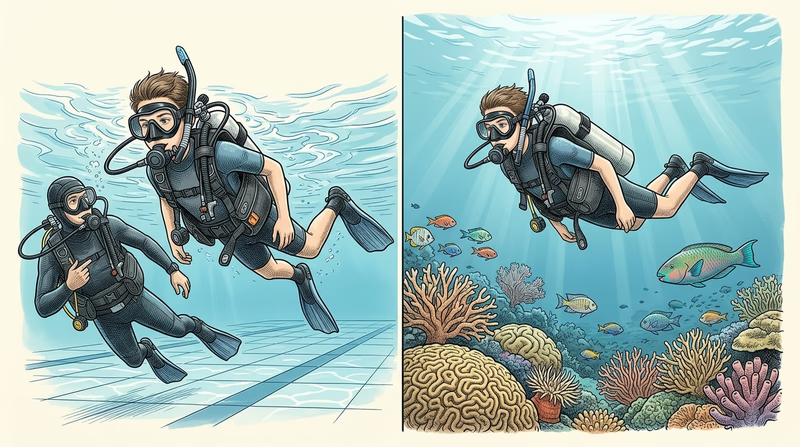
Every diver starts in a controlled setting. Pools and calm confined-water sites let you learn mask clearing, buoyancy control, regulator recovery, buddy checks, and emergency procedures without currents, waves, or low visibility adding extra pressure.
Open-Water Recreational Diving
This is what most people picture first: reef dives, lake dives, quarry dives, boat dives, and vacation dives. Recreational open-water divers explore for fun, usually within training limits, while using the buddy system and standard safety procedures.
Cold-Water and Low-Visibility Diving
Not every dive happens in tropical blue water. Many divers train in lakes, quarries, rivers, and coastal water where visibility is limited and temperatures are low. These dives require extra attention to exposure protection, communication, navigation, and comfort.
Drift and Boat Diving
Some dives happen where the water is moving. In a drift dive, the current carries divers along while they stay together and follow the plan. Boat diving adds its own skills too: entries, exits, timing, seasickness management, and awareness around propellers and ladders.
Scientific, Conservation, and Professional Diving
Some divers count fish, study coral health, recover artifacts, inspect structures, or teach new students. You will explore some of those career paths in Req 6, but it helps to know from the start that scuba can be a tool for service and science, not just recreation.
Next Steps
The first requirement builds the safety foundation for the entire badge. You will look at diving-specific emergencies, then connect that knowledge to CPR skills you can demonstrate with your counselor.