Extended Learning
Congratulations
You have finished a badge that asks you to observe carefully, work patiently, and think in three dimensions. Those are not small skills. They are the same habits that help artists design monuments, build maquettes, shape public spaces, and communicate ideas without using a single sentence.
If sculpture grabbed your attention, you do not have to stop here. There are many ways to keep learning—through materials, public art, history, digital tools, and communities of makers.
Learn to Read Form, Not Just Subject
Beginning sculptors often focus first on what a piece shows: a face, a bird, a hand, a spiral, a monument. More experienced viewers also look at how the form works. Where is the weight? Where does the eye travel? Which surfaces catch light? Where does the negative space open up around the object?
Try this with any sculpture you see next:
- walk around it instead of staying in one place
- squint and notice the biggest silhouette shapes
- look for where the form feels balanced or intentionally off-balance
- ask whether texture is supporting the idea or distracting from it
That habit will improve your own artwork because you will start making decisions on purpose instead of only reacting to the subject.
Study Maquettes and Armatures
Many large sculptures begin as something small. A maquette is a small model used to test an idea before building the full piece. An armature is the internal support that helps a sculpture hold its shape while you work.
Those two ideas are worth studying because they solve real problems. A maquette helps you test pose, proportion, and overall design before investing more time and material. An armature helps weak areas—like necks, legs, wings, or extended arms—stay stable while the form develops.
Even if you only make small projects right now, thinking like a sculptor who plans structure will make your work stronger.
Explore Public Art as a Community Voice
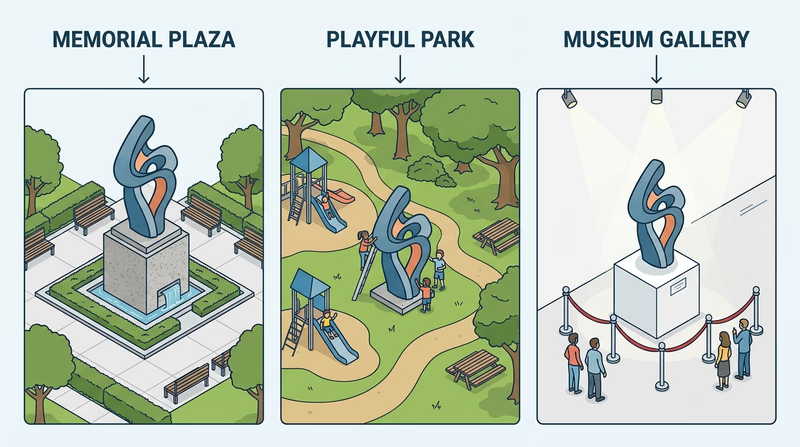
Public sculpture does more than decorate a space. It can honor history, invite play, challenge a community, or give a place its identity. A memorial asks people to remember. A sculpture in a park may invite climbing, touching, or gathering. A sculpture outside a library, courthouse, or school can signal what that place values.
The next time you see public art, ask questions such as:
- Why was this placed here?
- Who was meant to see or use it?
- Does it feel welcoming, solemn, surprising, or playful?
- How would the meaning change if it were moved indoors or outdoors?
That kind of thinking connects directly to what you practiced in Req 2c.
Try Digital and Traditional Methods Together
You do not have to choose between hand tools and technology. Many modern artists sketch on paper, model in clay, scan or photograph the form, adjust it digitally, and then return to physical materials. Others start digitally and then print a model for casting or finishing by hand.
Trying both approaches can teach you what each one does best. Clay teaches touch, pressure, and immediate response. Digital tools make rotating, scaling, and revising easier. Both teach form.
Real-World Experiences
Visit a sculpture garden or park
Outdoor sculpture changes with weather, distance, and movement. Notice how scale and setting affect your experience differently than indoor work.
Take a community studio class
Many art centers offer clay modeling, figure sculpture, mold making, or mixed-media construction classes for beginners.
Watch an artist demo or open studio
Seeing how a sculptor organizes tools, stages a project, and fixes mistakes teaches lessons that are hard to get from finished artwork alone.
Sketch sculptures in a museum
Quick drawings of major shapes, silhouettes, and negative spaces will sharpen your eye even if you do not consider yourself a strong drawer.
Try a maquette challenge
Build three tiny versions of the same idea with different poses or proportions. You will learn fast which design reads best in three dimensions.
Organizations
International Sculpture Center
Supports sculptors through publications, community, events, and resources focused specifically on sculpture practice.
National Sculpture Society
Promotes sculpture through exhibitions, education, and opportunities to study contemporary and traditional approaches.
National Sculptors' Guild
Highlights working sculptors and public art while showing how sculpture connects with galleries, collectors, and installations.
Sculpture Magazine
A publication connected to the sculpture world that can help you discover artists, exhibitions, materials, and current conversations.