Extended Learning
Congratulations!
You have covered safety, law, wildlife conservation, hands-on shooting fundamentals, and looked ahead to where these skills can take you. Shotgun Shooting is one of the few merit badges where the knowledge you built carries direct consequences in the real world—safe gun handling is not a test topic, it is a life skill. The four fundamentals of position, mount, vision, and movement will serve you whether you shoot trap next weekend or hunt waterfowl twenty years from now.
The Extended Learning section is for Scouts who want to go further: deeper concepts, competition pathways, real-world experiences, and the organizations that connect serious shooters with serious opportunities.
Dig Deeper
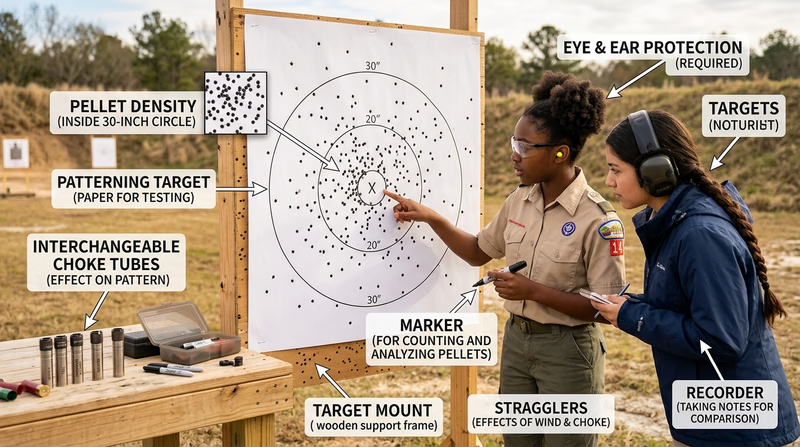
Choke and Pattern: The Science of Spread
The choke at the muzzle end of the barrel controls how tightly the shot column stays together as it travels downrange. Understanding choke is what separates a beginning shooter from an intermediate one.
- Cylinder (no constriction): Widest spread. Useful at very close range.
- Improved Cylinder: Slight constriction. Good for close-range clays and upland birds flushing nearby.
- Modified: Moderate constriction. The most versatile choice for general hunting and sporting clays.
- Full: Tight constriction. Keeps the pattern dense at longer distances. Standard for trap shooting and pass shooting at waterfowl.
To see your choke’s effect, shoot a pattern board: fire at a large sheet of paper at 40 yards and count the pellet holes inside a 30-inch circle. The percentage of pellets inside the circle defines the choke’s performance.
Shotshell Reloading
Many competitive shotgun shooters reload (handload) their own ammunition to reduce cost and customize performance. Reloading involves resizing the hull, replacing the primer, measuring powder, inserting a wad, adding shot, and crimping the hull closed. It requires a reloading press, published load data, and meticulous attention to measurement. Reloading is an excellent technical hobby that deepens your understanding of how shotshells work—but it is not a shortcut. Careless reloading is a leading cause of squib fires and other malfunctions.
Wingshooting: Shooting at Live Birds
Everything you learned on the trap range translates directly to hunting flying birds. The target is smaller, faster, and unpredictable—but the four fundamentals are identical. Wingshooting adds variables: wind, terrain, vegetation, and the ethical requirement to identify your target before firing. Many experienced shooters say that breaking 20 out of 25 clays on a trap line correlates well with consistent success in the field.
How Lead and Steel Shot Differ
Federal law requires non-toxic shot (steel, bismuth, or tungsten) for all waterfowl hunting. Steel shot is lighter and harder than lead, which means it patterns differently: steel pellets do not deform, so patterns are tighter and more uniform, but each pellet carries less energy. Hunters compensate by using larger shot sizes (e.g., No. 2 steel instead of No. 4 lead). Understanding the ballistic differences between shot materials is essential for any serious waterfowl hunter.
Try This Next
Join or Visit a Local Gun Club
Shoot All Three Clay Target Disciplines
Try the Other Option
Enter a Youth Competition
Start a Shooting Log
Pattern Your Shotgun
Organizations and Resources
The largest firearms training and education organization in the United States. Offers youth programs, club affiliations, competitions at all levels, instructor certifications, and scholarships for competitive shooters.
Organization: National Rifle Association (NRA) — https://www.nra.org/
The national governing body for Olympic and Paralympic shooting sports. Manages the Junior Olympic Development Program, which feeds into the national team pipeline. Shotgun events — trap and skeet — are core Olympic disciplines.
Organization: USA Shooting — https://www.usashooting.org/
Governs registered trap shooting in the United States. Hosts the Grand American — the world’s largest trap shooting event — held annually in Sparta, Illinois. Youth programs and state-level competition are widely available.
Organization: Amateur Trapshooting Association (ATA) — https://www.shootata.com/
Governs registered skeet shooting. Hosts the World Skeet Championships annually. Offers a classification system that matches you against shooters of similar skill.
Organization: National Skeet Shooting Association (NSSA) — https://www.mynssa.com/
Governs sporting clays competition. Sporting clays is one of the fastest-growing shotgun sports, and NSCA events range from local club shoots to the national championship.
Organization: National Sporting Clays Association (NSCA) — https://www.mynsca.com/
The largest youth clay target program in the country. Team-based, coach-led, and available to middle and high school students. Disciplines include trap, skeet, sporting clays, and international formats.
Organization: Scholastic Clay Target Program (SCTP) — https://www.sssfonline.org/sctp
The nation’s largest youth shooting sports program, with clubs in nearly every county. Covers shotgun along with rifle, pistol, archery, and muzzleloading. An excellent entry point for younger Scouts.
Organization: 4-H Shooting Sports — https://4-hshootingsports.org/
The premier organization for muzzleloading sport and history. Hosts the annual National Championship at Friendship, Indiana. Publishes Muzzle Blasts magazine. Essential for Scouts who chose Option B and want to go deeper.
Organization: National Muzzle Loading Rifle Association (NMLRA) — https://www.nmlra.org/
Beyond hunting regulations, many state agencies offer mentored hunting programs, hunter education clinics, and partnerships with local clubs — a resource for connecting shooting sports with conservation.
Organization: State Fish and Wildlife Agencies — https://www.fishwildlife.org/afwa-inspires/member-list