Req 1a — Projectiles and Why They Demand Respect
A projectile is any object propelled forward by a force. In a shotgun, that force is rapidly expanding gas from burning propellant inside a shotshell. When the trigger is pulled, a charge of pellets (shot) exits the muzzle at roughly 1,100 to 1,300 feet per second. A slug—a single solid projectile sometimes fired from a shotgun—can exceed 1,600 feet per second. Once shot leaves the barrel, you have zero control over where it goes.
Why a Shotgun’s Projectiles Are Unique
Unlike a rifle, which fires one bullet, a shotgun fires hundreds of pellets in a single shot. Those pellets spread outward in a cone-shaped pattern as they travel. This spread is what makes a shotgun effective against fast-moving birds and clay targets—but it also means more projectiles are in the air with each trigger pull.
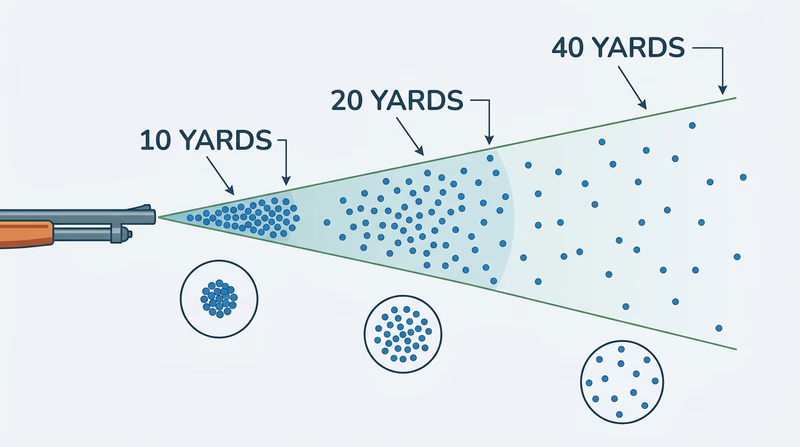
Key consequences of high-speed projectiles from a shotgun:
- Penetration: Even small birdshot can penetrate skin, eyes, and thin walls at close range. Larger shot sizes and slugs penetrate far deeper.
- Range: Birdshot can travel over 200 yards. Buckshot and slugs remain dangerous at much greater distances.
- Spread: The shot pattern widens with distance, increasing the area affected by a single pull of the trigger.
- Ricochet: Shot pellets can bounce off water, rocks, and hard surfaces in unpredictable directions.
- No recall: Every pellet that leaves the barrel is permanently beyond your control.
Approved Locations Matter
“Approved locations” means places specifically designed and designated for shooting:
- Backstops, berms, and overhead baffles contain projectiles safely. Shooting ranges are engineered for this purpose.
- Range safety officers enforce rules so everyone follows the same procedures at the same time.
- Scouting America’s National Range and Target Activities Manual defines what qualifies as an approved range for Scout shooting activities. Your counselor will only work with you at a location that meets these standards.
Shooting anywhere else—a backyard, an open field without proper containment, or an unapproved area—puts people, animals, and property at risk.
The Counselor Conversation
Your counselor wants to hear a clear definition of “projectile” in your own words and specific reasoning about why speed and energy make firearms different from other tools. Explain the physics—energy increases with the square of velocity—and connect that directly to the need for approved, supervised locations.