Req 2A-a — Principal Parts and Action Types
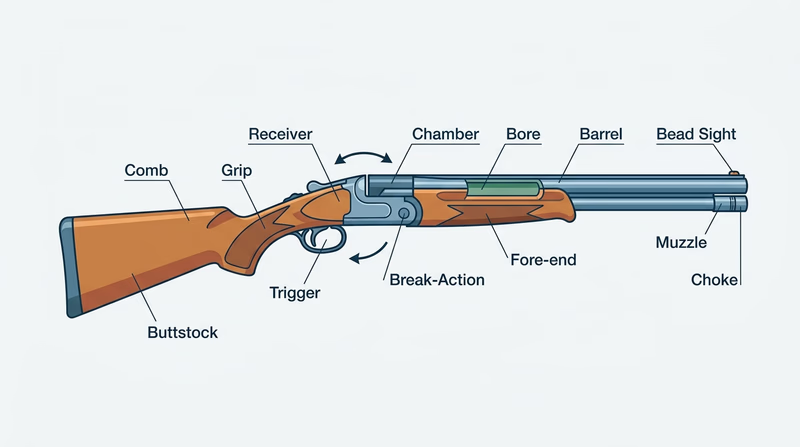
Every shotgun, regardless of action type, has three main groups of parts: the stock, the action (or receiver), and the barrel. Understanding these groups gives you the vocabulary to discuss any shotgun you encounter.
The Three Main Groups
Stock
The stock is the part you hold. It includes:
- Buttstock: Fits against your shoulder. The shape and length of the buttstock determine how the gun mounts and how recoil is transmitted to your body.
- Comb: The top edge of the buttstock where your cheek rests. Comb height affects where your eye lines up with the barrel.
- Grip (or wrist): Where your trigger hand wraps around the stock behind the receiver.
- Fore-end (or forend): The part your support hand holds under the barrel. On a pump-action, the fore-end slides back and forth to cycle the action.
Action (Receiver)
The action houses the firing mechanism—the trigger, hammer or striker, safety, and the mechanism that loads and ejects shells. The action type defines how the gun operates (see below).
Barrel
The barrel is the long tube through which shot travels. Key features include:
- Chamber: The rear section of the barrel where the shotshell sits before firing.
- Bore: The interior diameter of the barrel, measured as “gauge.”
- Choke: A constriction at the muzzle end that controls how tightly the shot pattern stays together. Common chokes range from cylinder (no constriction, widest spread) to full (tight constriction, narrowest spread).
- Bead sight: A small bead at the muzzle end used as a visual reference. Some shotguns have a second mid-bead for alignment.
Action Types
Break-Action (Hinge-Action)
The barrel hinges open at the receiver, exposing the chamber for loading and unloading. Break-actions come in two forms:
- Single-shot: One barrel, one shot. Simple, reliable, and the lightest option. Common at Scout camps.
- Over-under (O/U): Two barrels stacked vertically, each with its own chamber. The standard for competitive trap, skeet, and sporting clays.
- Side-by-side (SxS): Two barrels arranged horizontally. Traditional for upland hunting.
How it works: Push the top lever, break the gun open, insert shells, close the gun. After firing, open the gun to extract or eject the spent hull.
Pump-Action
The shooter manually slides the fore-end rearward and forward to eject the spent hull and chamber the next round. Pump-actions hold multiple shells in a tubular magazine under the barrel.
How it works: Load shells into the magazine tube. Slide the fore-end forward to chamber the first round. Fire. Slide the fore-end back to eject the hull, then forward to chamber the next round. Repeat.
Semi-Automatic (Autoloader)
The gun uses gas pressure or recoil energy from the fired shell to eject the spent hull and chamber the next round automatically. The shooter only needs to pull the trigger for each shot.
How it works: Load shells into the magazine tube. The first round is chambered manually. After each shot, the action cycles automatically—ejecting the spent hull and loading the next shell.
The Counselor Conversation
Be ready to identify all three groups of parts on an actual shotgun (or a diagram) and explain what each part does. Then name and describe at least two action types, including how shells are loaded, fired, and ejected in each.