Req 2B-b — Principal Parts and How They Work
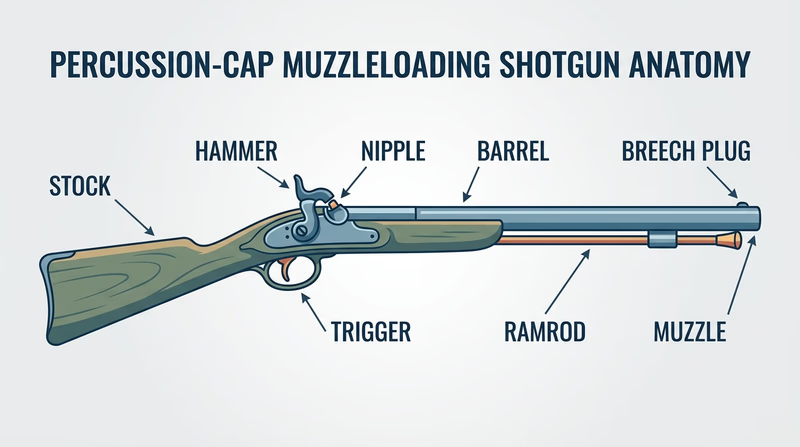
A muzzleloading shotgun shares the same three major groups as a modern shotgun—stock, action, and barrel—but several parts are unique to the muzzleloading design.
Stock
- Buttstock: Fits against your shoulder, just like a modern shotgun. Muzzleloader stocks are often made of walnut or maple.
- Comb: The top edge of the buttstock where your cheek rests.
- Wrist (grip): The narrow section behind the action where your trigger hand grips.
- Fore-end (forend): Held by the support hand. On many muzzleloading shotguns, the forend is secured to the barrel by wedge pins or barrel bands.
Barrel
- Muzzle: The open end of the barrel where you load the charge from the front.
- Bore: The interior of the barrel. Muzzleloading shotguns have smoothbore barrels (no rifling). Bore diameter corresponds to gauge, just as in modern shotguns.
- Breech plug: A threaded plug that seals the rear end of the barrel. The main powder charge sits in front of it.
- Touch hole / drum and nipple: On a percussion-cap muzzleloader, the nipple is a small metal post threaded into the drum (or directly into the barrel) at the breech. The percussion cap sits on top of the nipple. When the hammer strikes the cap, flame travels through the nipple’s flash channel into the powder charge.
Action / Lock
The “lock” is the firing mechanism of a muzzleloader:
- Hammer: A heavy, spring-loaded arm that strikes the percussion cap on the nipple. The hammer has two positions: half-cock (a safety position where the hammer is pulled partway back and should not fall if the trigger is pulled) and full-cock (the firing position).
- Trigger: Releases the hammer from full-cock.
- Lock plate: The metal plate on the side of the stock that houses the internal spring and tumbler mechanism.
Ramrod
A long rod (usually wooden or fiberglass) stored under the barrel in a channel called the ramrod thimbles. The ramrod is used to push the powder charge, wads, and shot down the barrel during loading, and to seat them firmly against the breech plug. It is an essential tool, not an accessory.
How They Work Together
- Powder is poured down the muzzle.
- Wads and shot are pushed down on top of the powder with the ramrod.
- A percussion cap is placed on the nipple.
- The hammer is pulled to full-cock.
- The trigger is pulled, releasing the hammer.
- The hammer strikes the cap, sending flame through the nipple into the powder.
- The powder ignites, and expanding gases drive the wads and shot out of the barrel.
The Counselor Conversation
Be ready to point to each part on an actual muzzleloading shotgun (or diagram) and explain what it does. Pay special attention to the nipple, hammer positions (half-cock vs. full-cock), and the ramrod—these are the parts unique to muzzleloading.