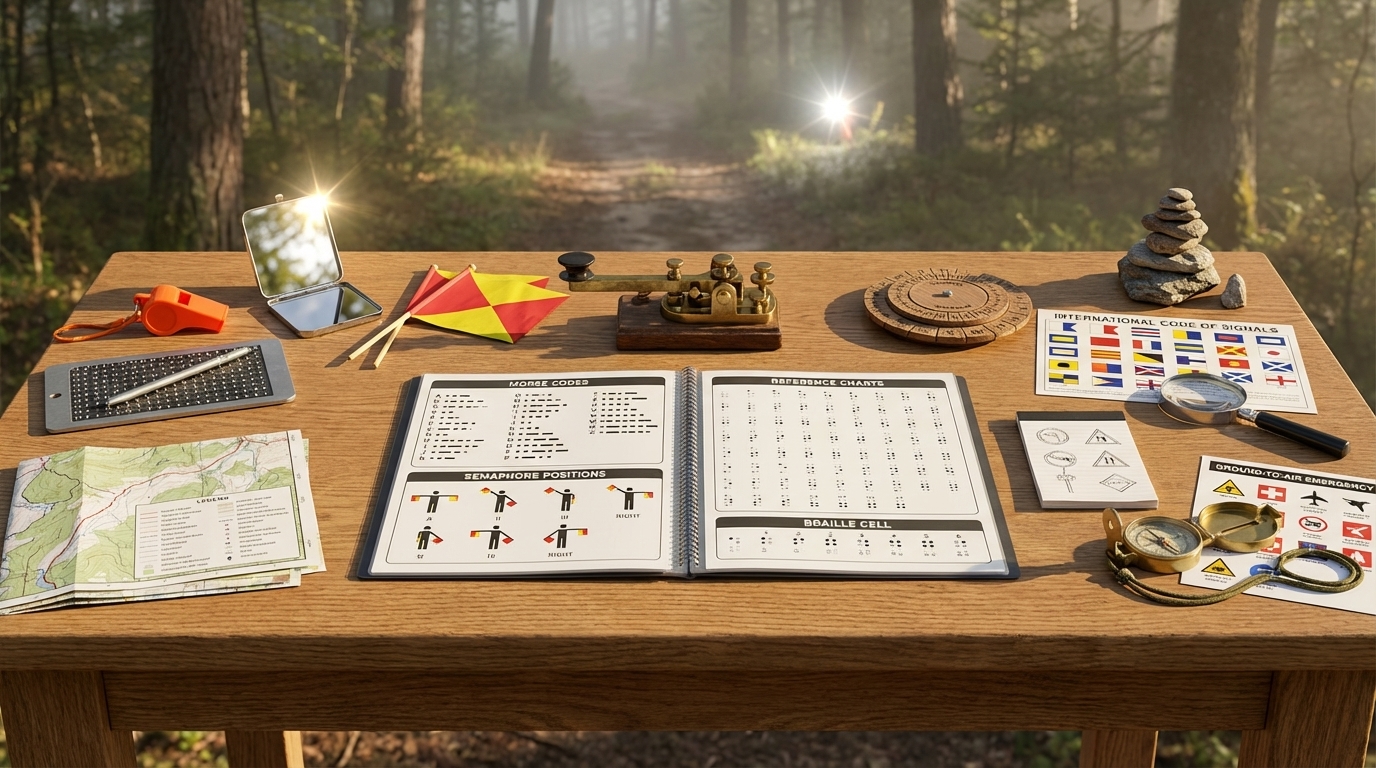
 Getting Started
Introduction & Overview
Overview
Humans have been finding clever ways to share information across distance, darkness, and noise for as long as civilization has existed. The Signs, Signals, and Codes merit badge takes you on a tour of those systems—from the dots and dashes of Morse code to the raised dots of braille, from waving semaphore flags to building your own secret cipher. Along the way you’ll practice hands-on skills, explore why different systems exist, and come away with a new appreciation for the language all around you.
Then and Now
Then
Before phones or radios existed, people needed ways to send messages quickly and reliably. Ancient Greeks used fire beacons on hilltops. Sailors developed elaborate flag systems. The military invented hand signals so soldiers could coordinate silently under fire. In 1836, Samuel Morse and Alfred Vail developed a code of dots and dashes that made long-distance electrical telegraphy practical—and within decades messages could cross continents in seconds.
Now
Many of those same systems are still in active use. Coast Guard vessels fly nautical signal flags. Aircraft carrier decks still rely on precise hand signals where radio chatter is impossible. Referees blow whistles and wave arms to manage play on every sports field. And digital encryption—the modern descendant of secret codes—protects every password and credit card number you use online. Knowing how these systems work makes you a more aware, more capable communicator.
What You’ll Practice
This badge combines knowledge and skill in equal measure. Here’s a quick map of what’s ahead:
- Communication history and theory — why societies develop shared signals (Req 1)
- Emergency signaling — how to attract rescuers when it counts most (Req 2)
- Morse code and ASL — two landmark communication systems, each practiced hands-on (Req 3)
- Semaphore and nautical flags — flag-based systems still used on ships and airfields (Reqs 4a–4c)
- Braille — communication by touch, grounded in real history (Req 5)
- Sound signals and Scout signals — from foghorns to patrol hand signals (Req 6)
- Trail signs — marking and following a real outdoor trail (Req 7)
- Specialized signal systems — sports, heavy equipment, aircraft carriers, cycling, and more (Req 8)
- Symbols and everyday life — traffic signs, maps, emoticons, and your own design (Req 9)
- Cryptography — the history and craft of secret codes (Req 10)
Get Ready!
Each section of this guide prepares you for a specific requirement with background knowledge, practical tips, and clear preparation steps. Read it through, practice the hands-on parts, and you’ll be ready to demonstrate your skills with confidence.