Req 2 — Distress Signals That Get You Found
Why Emergency Signaling Is Different
When you’re lost or injured in the wilderness, cell service is usually the first thing to go. Emergency signaling relies on signals that can be seen or heard from a distance—by a searching aircraft, a rescue boat, or a helicopter crew scanning the terrain below. The goal is simple: make yourself impossible to miss.
Every outdoor traveler should understand these signals before they ever need them. Knowing what to do in the first hour after getting lost dramatically improves rescue outcomes.
Signals for Airborne Search-and-Rescue
Rescue aircraft scan large areas quickly, so your signal must be visible from the air. Here are the main types—bring illustrations or drawings to show your counselor:
Ground-to-Air Symbols
International ground-to-air signals use body positions and patterns you can form on the ground with rocks, logs, or trampled vegetation. The standard signals include:
| Symbol | Meaning |
|---|---|
| V | Require assistance |
| X | Require medical assistance |
| → | Traveling in this direction |
| F | Need food and water |
| LL | All is well |
| N | No / Negative |
| Y | Yes / Affirmative |
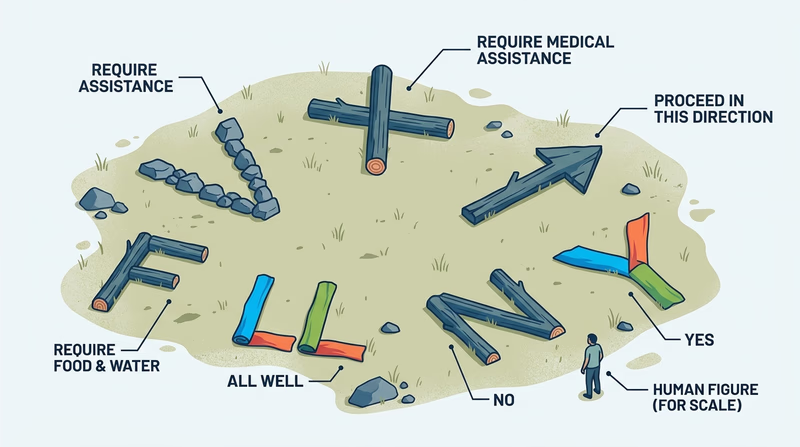
Make these symbols large—at least 10 feet across—and use high-contrast materials against the ground. Dark rocks on snow, or bright cloth on dark soil, work well.
Signal Mirror
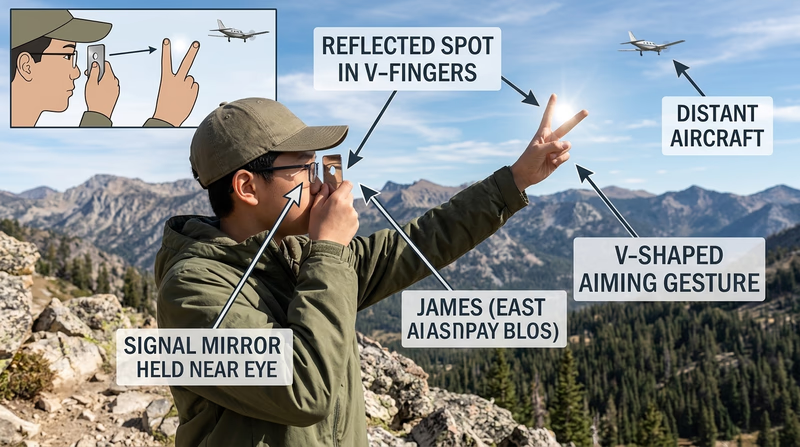
A signal mirror is one of the most effective long-range daylight signals. Even on a partly cloudy day, a mirror flash can be seen up to 10 miles away by aircraft. Use a dedicated signal mirror with a sighting hole if possible, or improvise with any reflective surface.
How to use a signal mirror:
- Hold the mirror near your eye.
- Extend your other arm and create a “V” with two fingers aimed at the aircraft.
- Tilt the mirror until the reflected sun lands in the “V.”
- Flash slowly three times—the universal distress signal.
Fire and Smoke
Three fires or three smoke columns in a triangle pattern is an internationally recognized distress signal. During daylight, black smoke (from burning rubber or plastic if available) stands out against a bright sky. At night, flames are visible from miles away.
Whistle
Three blasts of a whistle is the universal distress signal for sound. A good rescue whistle (not your voice) can be heard up to a mile away with little effort. Blow three times, pause, repeat.
Bright Clothing and Color Panels
Bright orange and red are the most visible colors against natural terrain. Spread a brightly colored tarp, jacket, or space blanket in an open area to create a visual target visible from the air.
Flashlight or Headlamp
At night, use your flashlight to signal SOS in Morse code: · · · — — — · · · (three short flashes, three long, three short). Flash slowly enough that the pattern is clear. You’ll learn more about SOS in Requirement 3.
Preparing Your Illustrations
The requirement asks you to illustrate these signals with photos or drawings. Good options:
- Sketch each ground-to-air symbol with dimensions shown
- Photograph yourself demonstrating mirror signaling
- Draw the three-fire triangle pattern from an aerial perspective
- Create a comparison chart of daytime vs. nighttime signals
You don’t need to be an artist—clear, labeled diagrams communicate better than vague sketches.
Before Your Counselor Meeting
- Can explain why emergency signaling matters when electronics fail
- Can describe and sketch the six main ground-to-air symbols
- Know how to use a signal mirror
- Know the three-fire distress signal
- Know the whistle distress signal (three blasts)
- Have illustrations or drawings ready to show