Req 4b — Semaphore Flags vs. Nautical Flags
Two Flag Systems, Two Different Purposes
Both semaphore flags and nautical flags are used in maritime environments, but they work in completely different ways. Confusing the two is a common mistake—this page will help you explain the distinction clearly.
Semaphore Flags
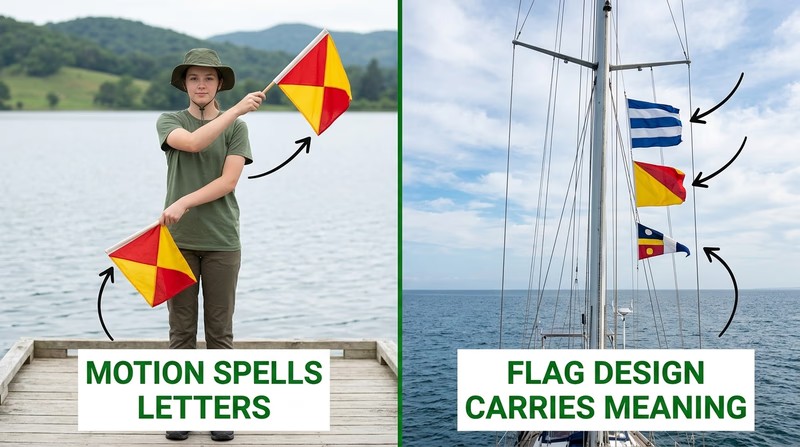
Semaphore flags are tools for sending letters. The flags themselves carry no meaning. What matters is the position of the person’s arms. Each arm angle corresponds to a letter of the alphabet, and you spell out words letter by letter.
Key characteristics of semaphore flags:
- Used to spell messages in real time by arm movement
- The flag color and design don’t encode meaning—only the position does
- Flags are typically small, square, and easy to hold in one hand
- Standard naval color scheme: red and yellow divided diagonally
- Scouting/land use: often blue and white or red and white
- Requires a trained sender and receiver who both know the alphabet positions
Think of semaphore flags like the keys on a keyboard—the keyboard key has a letter printed on it, but it’s pressing the key (making the position) that sends the information.
Nautical (Signal) Flags
Nautical flags—also called the International Code of Signals—are a set of 40 distinct flags (26 letter flags, 10 numeral pennants, and 4 substitute flags) where each flag has a fixed, pre-agreed meaning. Certain combinations of two or three flags form standardized messages that any vessel can look up in the International Code of Signals book.
Key characteristics of nautical flags:
- Each flag has its own specific design, color pattern, and meaning
- Flown from masts and halyards rather than waved by hand
- Can be used without real-time communication—a flag combination raised on the mast conveys a message that any passing ship or port authority can read
- Used by commercial shipping, navies, coast guards, and private vessels worldwide
Important Single-Flag Signals
Many individual nautical flags carry important standalone messages:
| Flag | Letter | Standalone Meaning |
|---|---|---|
| Alpha (A) | A | “I have a diver down; keep clear.” |
| Bravo (B) | B | “I am carrying dangerous cargo.” |
| Charlie (C) | C | “Yes / Affirmative.” |
| Delta (D) | D | “Keep clear; I am maneuvering with difficulty.” |
| Golf (G) | G | “I require a pilot.” |
| Hotel (H) | H | “I have a pilot on board.” |
| November (N) | N | “No / Negative.” |
| Oscar (O) | O | “Man overboard.” |
| Quebec (Q) | Q | “My vessel is healthy; request clearance.” |
| Victor (V) | V | “I require assistance.” |
| Whiskey (W) | W | “I require medical assistance.” |
| X-ray (X) | X | “Stop carrying out your intentions and watch for my signals.” |
Warning Flags
Nautical flags are also used in weather warning systems at ports and marinas:
| Display | Meaning |
|---|---|
| Small-craft advisory pennant | Winds 18–33 knots expected |
| Gale warning (two pennants) | Winds 34–47 knots expected |
| Storm warning (square red flag) | Winds 48–63 knots expected |
| Hurricane warning (two square red flags) | Winds 64+ knots expected |
The Core Difference
| Semaphore Flags | Nautical Flags | |
|---|---|---|
| How meaning is encoded | Arm positions (not the flag design) | The specific flag design and combination |
| How displayed | Waved/held by a person in motion | Hoisted stationary on a mast or halyard |
| Who must be present | Two trained people, both know the alphabet | Any vessel with the code book can decode |
| Primary use | Real-time message spelling | Pre-coded messages, status, and warnings |
🎬 Video: Nautical & Sailing Flags Meanings, International Code of Signals — Flagsbook — https://www.youtube.com/watch?v=gGOtPA8sNJA