Req 5 — Reading and Writing Braille
What Is Braille?
Braille is a tactile writing system—a system you read with your fingertips instead of your eyes. It was created by Louis Braille, a French teenager who lost his sight at age three in a workshop accident. In 1824, at age 15, he adapted a military communication system called “night writing” (developed by Charles Barbier for soldiers to read orders in the dark) into what became the standard tactile alphabet used worldwide today.
Barbier’s original system used 12 raised dots arranged in two columns of six. Louis Braille recognized that the cell was too tall to feel with one fingertip, so he reduced it to six dots arranged in a two-wide, three-tall grid—the standard braille cell still used today.
How Braille Is Read
Each braille cell is a rectangle of six dot positions arranged like this:
· ·    (dot positions 1 and 4 — top row)
· ·    (dot positions 2 and 5 — middle row)
· ·    (dot positions 3 and 6 — bottom row)
A letter is represented by which of these six positions have a raised dot. Because any combination of six dots can be raised or flat, the system can represent 64 possible characters—more than enough for the full alphabet, punctuation, and numbers.
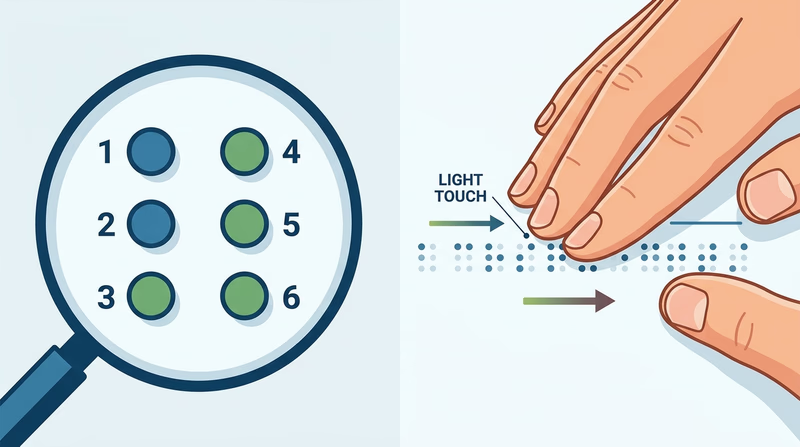
The reading technique: A braille reader lightly passes the pads of their fingertips (usually the index fingers of both hands) horizontally across the line of cells. The touch should be light and moving—pressing down hard actually reduces sensitivity. Experienced readers can read at over 100 words per minute this way.
Why Braille Matters
Without braille, a person with sight impairment would have no independent access to written material—no books, no menus, no labels, no instructions. Braille gives:
- Independence: the ability to read privately, at your own pace, without assistance
- Literacy: access to the same written information sighted people take for granted
- Employment: workplaces use braille labels, technical manuals, and accessibility tools
- Navigation: elevator buttons, public signage, ATMs, and medicine labels all use braille
Today braille appears everywhere from elevator floors to braille-printed playing cards to braille sheet music.
Requirement 5a — Read Braille
Learning the Braille Alphabet
You can complete 5a either by sight (reading a braille chart and visually identifying the raised-dot pattern) or by touch (actually feeling the dots with your fingertips on a braille page or embossed printout).
The braille alphabet for letters A–J (all use only the top two rows of the cell):
| Letter | Dots raised |
|---|---|
| A | 1 |
| B | 1, 2 |
| C | 1, 4 |
| D | 1, 4, 5 |
| E | 1, 5 |
| F | 1, 2, 4 |
| G | 1, 2, 4, 5 |
| H | 1, 2, 5 |
| I | 2, 4 |
| J | 2, 4, 5 |
Letters K–T add dot 3 to the corresponding A–J pattern. Letters U–Z use the bottom row of the cell in various ways.
Decoding a Six-Word Message
For the six-word decoding task:
- Find or create a braille message (braille translation tools online can convert any text).
- Identify each cell by its dot pattern using a reference chart.
- Write out the decoded letters and words.
If decoding by touch, practice on embossed braille paper—printer embossing services and some libraries can produce this.
Req 5a Readiness
- Can identify each braille letter that spells my name (by sight or touch)
- Can decode a braille message at least six words long
Requirement 5b — Write Braille
Creating Your Braille Message
You have several options for creating a braille message:
Option 1: Write it out using a braille chart. Draw the six-dot cell grid for each letter, filling in the raised dots. Present the chart as your braille message. This is the simplest approach and works fine for the requirement.
Option 2: Use a braille translation tool. Many websites (such as the American Foundation for the Blind’s tools or dedicated braille converters) will translate any English text into a printable braille graphic. Print the result and bring it to your counselor.
Option 3: Use a braille slate and stylus. A braille slate is a small metal template; the stylus presses dots into paper. Braille is written right-to-left when using a slate so it reads left-to-right when turned over. This is the most authentic method and shows real understanding of the system.
Option 4: Use braille-embossing software. If your school or library has a braille embosser, you can produce an actual tactile braille document.
Choose a message that means something to you—your name and patrol, a Scout motto, or a short meaningful sentence.
Req 5b Readiness
- Have created a braille message at least six words long
- Can explain what method I used to create it
- Ready to share with my counselor and explain how to decode it
Putting It All Together
Braille is a reminder that communication systems are designed by people for people—they evolve when someone sees a problem and finds a better solution. Louis Braille was a teenager when he created his system, and it has given independent literacy to millions of people around the world ever since.
When you talk with your counselor, be ready to explain both the technique (how the six-dot cell works and how it’s read) and the significance (why independent access to written language matters to people with sight impairments).