Req 6 — Sound Signals and Silent Scout Signals
This requirement covers two complementary signal systems: sound signals that work across distance and without line of sight, and silent Scout signals that allow a patrol or troop to maneuver quietly in the field. They solve different problems—6a is about knowledge and comparison, 6b is about demonstration.
Requirement 6a — Sound Signals
Six Sound-Only Signals in Use Today
You need to describe six real, currently-used sound signals. Here are eight good examples to choose from—pick six and be prepared to describe each one clearly:
1. Fog Horn / Ship’s Horn Ships sound fog horns in reduced visibility as required by international maritime regulations. One prolonged blast (4–6 seconds) means “I am under way on a power vessel.” Multiple blasts communicate other status messages. The sound carries far over water even when visibility is near zero.
2. Train Horn / Locomotive Whistle Trains sound specific patterns at road crossings: two long, one short, one long (- - · -). These patterns are standardized by regulation and warn pedestrians and drivers at crossings where a visual signal alone isn’t reliable.
3. Emergency Vehicle Sirens Police, fire, and ambulance vehicles use distinctive electronic sirens to clear traffic. Different patterns (wail, yelp, pierce) have different meanings to trained drivers. Air-horn blasts may accompany the siren at intersections.
4. Tornado/Civil Defense Siren Outdoor warning sirens sound a steady rising-and-falling tone to alert people of severe weather or other public emergencies. One long steady tone may mean “all clear.”
5. Smoke Alarm / Carbon Monoxide Alarm Smoke detectors emit a piercing beep pattern (typically three beeps, pause, three beeps) standardized nationally. Carbon monoxide alarms use a different pattern to distinguish the danger. These are one of the most common life-saving sound signals in everyday life.
6. Distress Whistle (Three Blasts) Three short blasts on a whistle is the universal outdoor distress signal—recognized in wilderness search and rescue, boating, and outdoor education contexts. A rescue whistle carries farther than a shout with far less energy.
7. Buoy Bell / Whistle Buoy Navigational buoys in harbors and shipping channels use bells, whistles, or horns powered by wave action to signal their location in fog. Mariners listen for these when visibility drops.
8. Factory/School Bell or Buzzer School bells, factory shift buzzers, and fire alarm bells in buildings are simple but effective sound signals that communicate “start,” “stop,” “evacuate,” or “change” to large numbers of people simultaneously.
Pros and Cons: Sound Signals vs. Other Types
Your counselor will want a genuine pros-and-cons comparison. Here’s a framework:
Advantages of sound signals:
- Work in darkness, fog, smoke, or when line-of-sight is blocked
- Cover a wide area simultaneously without aiming
- Require no special training to recognize simple alerts (alarm = leave the building)
- Can be heard around corners and through obstacles
- Often impossible to ignore (sirens, alarms)
Disadvantages of sound signals:
- Direction is hard to pinpoint accurately (where is the siren coming from?)
- Noise pollution in urban environments reduces their effectiveness
- Cannot convey complex information quickly—limited to simple alerts
- Hearing-impaired individuals may not receive them
- Sound carries in all directions—can’t target one person without broadcasting widely
- Weather and terrain affect range significantly
Req 6a Readiness
- Can describe six different sound-only signals used today
- Can explain the pros and cons of sound signals vs. visual or other signals
- Ready to discuss which situations favor sound over light or coded signals
🎬 Video: Colregs Sound Signals - Rule 34 Manoeuvring and Warning Signals — Get Lost Sailing & Powerboat Training — https://www.youtube.com/watch?v=364HF22NeTs
Requirement 6b — Silent Scout Signals
Why Silent Signals?
Silent Scout signals let a patrol move, react, and coordinate without making a sound. This is valuable in orienteering, stalking games, Scout craft exercises, and any situation where staying quiet matters. The signals must be agreed upon in advance and visible to everyone in the group—they require clear line of sight from the signaler to each person.
The Standard Scout Silent Signals
The badge pamphlet describes these core signals. Practice them until each motion is crisp and unambiguous:
| Signal | How to Make It | Meaning |
|---|---|---|
| Scout Sign (Attention) | Raise right hand with three fingers extended, palm forward | “Be silent and pay attention to me” |
| Gather / Come Here | Raise arm straight up, circle hand | “Everyone come to me” |
| Line Up | Extend arm horizontally, palm flat | “Form a line” |
| Half-Circle / Semicircle | Swing arm in a wide arc | “Form a half-circle around me” |
| Single File | Extend arm straight back, index finger pointing | “Fall into single-file line” |
| Follow Me | Move extended arm forward in a sweeping motion | “Follow me in this direction” |
| Go That Way | Point with extended arm in the direction of travel | “Move in that direction” |
| Hurry Up | Rapid circles with hand raised | “Move faster / urgency” |
| Stop | Raise arm with open palm facing outward | “Halt / stop where you are” |
| Get Down | Lower hand palm-down, pushing toward ground | “Crouch down / take cover” |
| Disregard / Never Mind | Wave both arms crossed overhead | “Cancel that signal / ignore last instruction” |
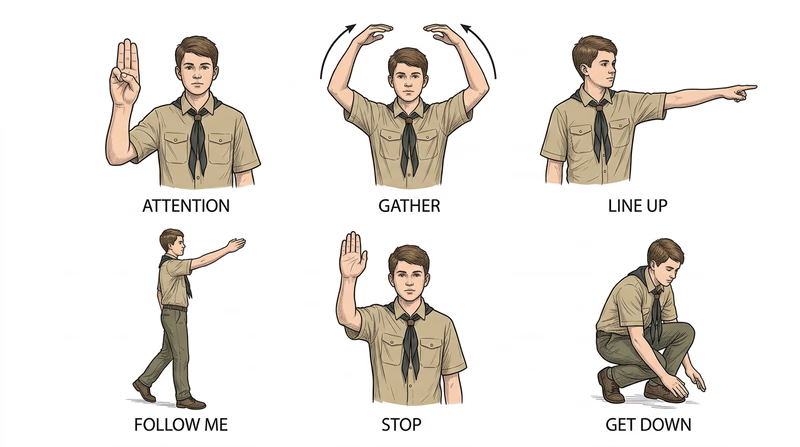
You need to demonstrate six of these. Choose six that feel natural together—for example, Attention, Follow Me, Stop, Spread Out, Get Down, and Gather covers common patrol maneuver situations well.
Demonstrating With Your Patrol
For the counselor demonstration, you’ll use the signals to direct real movement of your patrol or troop. Here’s how to prepare:
- Practice each signal until it’s smooth and confident—hesitation confuses the group.
- Run through a short scenario with your patrol: give the attention signal, then lead them through a sequence of movements using only silent signals.
- Make sure everyone in your patrol knows the signals before the demonstration—they need to respond correctly for it to work.
Req 6b Readiness
- Know at least six silent Scout signals and can describe each one
- Can make each signal clearly and confidently
- Have practiced with my patrol so they respond correctly
- Ready to demonstrate directing patrol movement using only silent signals