Req 9 — Symbols in Daily Life
Symbols Everywhere You Look
A symbol is a visual shorthand—a shape, color, or icon that carries an agreed meaning without words. You encounter hundreds of them every day: the red circle on your phone’s battery indicator, the peace symbol on a t-shirt, the recycling arrows on a bottle, the heart emoji in a text. Symbols work because they cross language barriers, communicate instantly, and take up almost no space.
Before diving into the sub-requirements, the parent requirement asks you to do two things:
1. Collect 10 everyday symbols. Think beyond traffic signs—everyday life is full of symbols from multiple categories:
- Recycling and environmental symbols
- Medical and pharmacy symbols (caduceus, red cross, Rx)
- Technology icons (Wi-Fi signal, Bluetooth, USB, play/pause/stop)
- Religious and cultural symbols
- Currency symbols ($, €, £, ¥)
- Hazard symbols (skull and crossbones, biohazard, radiation)
- Laundry care symbols on clothing tags
- Map symbols
- Sports logos and team symbols
Bring your list of 10 to the counselor meeting. Be ready to name each symbol, explain what it means, and say where you’d see it in real life.
2. Design your own symbol. Create something original—a symbol that represents a concept, value, group, or idea that matters to you. Sketch it clearly, give it a name, and be prepared to explain what it means and why you made the design choices you did.
Requirement 9a — Traffic Signs
Traffic signs use three systems to communicate: shape, color, and symbol or text. Even without reading, drivers can understand sign messages from these cues.
Sign Shapes and Their Meanings
| Shape | Meaning |
|---|---|
| Octagon | Stop |
| Triangle (inverted) | Yield |
| Diamond | Warning |
| Rectangle (vertical) | Regulatory |
| Rectangle (horizontal) | Guide / informational |
| Pentagon | School zone |
| Circle | Railroad crossing |
Ten Traffic Signs to Know
| Sign | Description | Meaning |
|---|---|---|
| Stop | Red octagon, white text | Come to a complete stop before the stop line |
| Yield | Red and white inverted triangle | Give right-of-way to crossing traffic |
| Speed Limit | White rectangle, black numerals | Maximum speed in miles per hour |
| Do Not Enter | Red circle, white horizontal bar | Do not enter this road from this direction |
| No U-Turn | White rectangle, U with red slash | U-turns prohibited |
| Railroad Crossing (round yellow) | Yellow circle, black X and R-R | Railroad crossing ahead |
| School Zone | Yellow-green pentagon | Reduced speed ahead near school |
| Slippery When Wet | Yellow diamond, car with squiggly lines | Road surface becomes slick in wet conditions |
| Pedestrian Crossing | Yellow or fluorescent yellow-green diamond, walking figure | Pedestrians may cross here |
| Dead End | White rectangle, black text | Road ends; no through traffic |
For your counselor meeting, bring photos, printed images, or a drawing of your 10 signs. Point to each one and explain its meaning and what action a driver should take.
Requirement 9b — Topographic Map Legend
What Is a Map Legend?
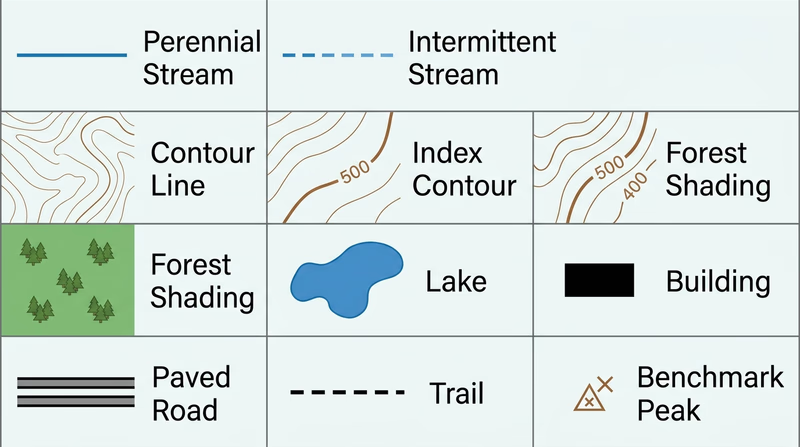
A map legend (also called a map key) is a small box printed on the map that explains what each symbol, color, and line pattern means. Without the legend, a map is just a puzzle. With the legend, every mark on the map communicates specific real-world information.
A topographic map uses symbols to represent the physical landscape in a compact, standardized way. You might see:
- Blue for water features (streams, lakes, swamps)
- Green for forests and vegetation
- Brown contour lines showing elevation changes
- Black for roads, trails, and structures
- Red or purple for overprints like survey boundaries
Ten Common Topographic Map Symbols
| Symbol | What It Represents |
|---|---|
| Blue solid line | Perennial stream (flows year-round) |
| Blue dashed line | Intermittent stream (seasonal) |
| Contour lines (brown) | Lines of equal elevation—how steep the terrain is |
| Index contour (thicker brown) | Every fifth contour line, labeled with elevation |
| Green shading | Forest/woodland |
| Blue filled shape | Lake or pond |
| Black rectangle or square | Building |
| Double parallel black lines | Paved road |
| Dashed black line | Trail |
| Triangle with dot | Survey benchmark / mountain peak |
Use a USGS topographic map (available free at nationalmap.gov) or a printed topo map for this exercise. Having a real map open during your counselor discussion makes it more concrete and interesting.
Requirement 9c — Text Symbols and Emoticons
Why Text Symbols Exist
Written language lacks the emotional cues of face-to-face speech: no tone of voice, no facial expression, no body language. A message like “Sure, sounds great” can be enthusiastic or sarcastic depending on context. Text symbols—and especially emoji—add that emotional layer back into written messages.
Text symbols also let people communicate quickly and expressively within character limits and on small keyboards. An emoji can replace a whole sentence of emotional context.
Origins: From Emoticons to Emoji
The earliest text symbols were ASCII emoticons—combinations of standard keyboard characters:
:-)— happy:-(— sad:-P— joking/sticking out tongue;-)— winking
These were invented in the early 1980s because typed text could be misread as serious when it was actually joking. Over time, dedicated emoji (originally developed in Japan in the late 1990s) replaced ASCII emoticons and became standardized across all devices through the Unicode standard.
Today there are over 3,600 officially standardized emoji, and new ones are added every year through a formal proposal process.
Choosing Your Ten Symbols
Pick symbols that are genuinely meaningful to you—your counselor discussion should reflect your real experience with digital communication. After you present them, challenge your counselor (or a parent or guardian) to identify what each one means. Pay attention to any gaps or misunderstandings—that’s the interesting part of the discussion.
Tip: mix a few universally understood emoji (😂, 👍, ❤️) with a few that are more contextual or generational (🧢, 💀, 🫡). The contrast between what you understand and what your counselor recognizes makes for a great conversation about how symbols evolve with communities.