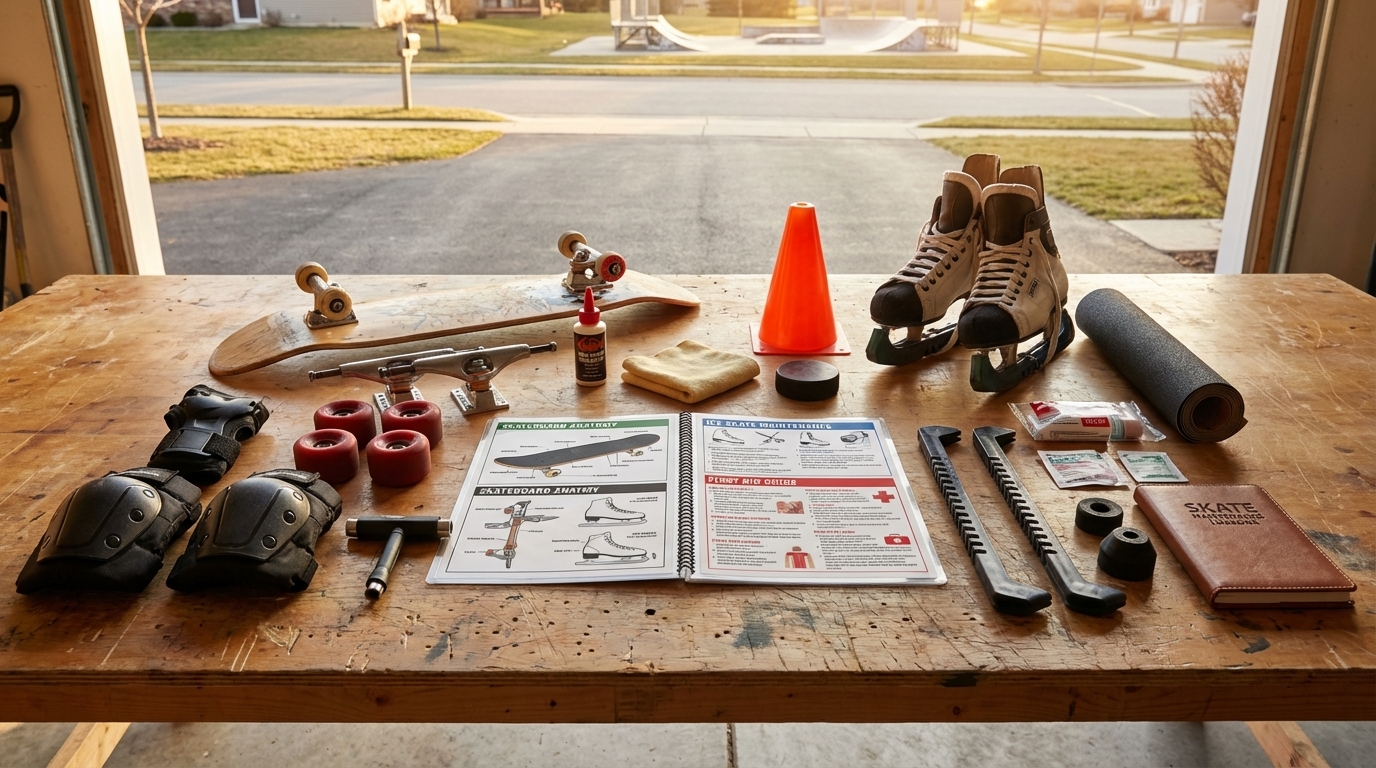
 Getting Started
Introduction & Overview
Skating comes in many forms — gliding across a frozen pond, cruising a roller rink, blading along a bike path, or dropping into a skate park halfpipe — but they all share one thing: the exhilarating feeling of moving under your own power on a thin layer between you and the ground. The Skating merit badge lets you dive deep into whichever discipline speaks to you while building the safety awareness, technical knowledge, and physical skill every skater needs.
Whether you are a first-timer lacing up rented ice skates or a skateboarder already landing kickflips, this guide will help you understand the requirements, prepare your counselor conversation, and pick up technique tips along the way.
Then and Now
Then — A History on Wheels and Blades
Skating is one of the oldest forms of human-powered transportation. The earliest ice skates were carved from animal bones and strapped to the feet with leather thongs — archaeologists have found examples dating back more than 3,000 years in Scandinavia and the Netherlands. People used bone skates to travel quickly across frozen lakes and canals during northern European winters long before roads were plowed or horses were common.
By the 1700s, iron-bladed skates allowed longer, faster glides. The first indoor ice rink opened in London in 1876, using refrigeration technology to create artificial ice year-round. Figure skating became an Olympic sport at the 1908 London Games — the first winter sport to appear at the Olympics.
Roller skating arrived in the mid-1700s when a Belgian inventor rolled into a party on wooden-spooled devices strapped to his shoes and crashed into a mirror. Quad skates (four wheels in a rectangular pattern) became popular in the 1870s, and roller rinks boomed in the early 20th century. In-line skates, which place wheels in a single row mimicking an ice blade, were commercially introduced by Rollerblade in the early 1980s and sparked an outdoor skating craze.
Skateboarding was born in the late 1950s when California surfers attached wooden boards to roller skate trucks so they could “surf” the streets on flat days. By the 1970s, urethane wheels and empty swimming pools had ignited the vertical skating revolution. Street skating exploded in the 1980s and 1990s, and in 2021 skateboarding debuted as an Olympic sport at the Tokyo Games.
- Purpose: Transportation, recreation, sport, art
- Mindset: A timeless urge to slide, glide, and defy gravity
Now — Four Disciplines, One Badge
Today, skating is a global culture. Millions of recreational ice skaters hit the rink each winter. Roller derby has become a worldwide competitive sport. Inline skating is a favorite fitness tool in cities around the world. Skateboarding attracts tens of millions of participants globally and has spawned an entire creative subculture of video, photography, fashion, and music.
Modern equipment is lighter, safer, and more precise than anything skaters dreamed of a generation ago. Helmets now meet rigorous safety standards. Boot materials blend stiffness and comfort. Skateboard decks are engineered from layered Canadian maple for the perfect flex. And coaching resources — including videos, clinics, and apps — make it easier than ever to progress quickly.
- Purpose: Fitness, freedom, creativity, competition, community
- Mindset: Pick your discipline, respect the gear, skate smart, and keep pushing your limits
Get Ready! Every skater started exactly where you are now. The skills build on each other, the falls teach you as much as the wins, and the joy of finally nailing a technique you have been working on is worth every bit of effort. Let’s get rolling!
Kinds of Skating
The Skating merit badge covers four distinct disciplines. Before you choose, here is a quick overview of each.
Option A — Ice Skating
Ice skating takes place on a frozen surface — either an indoor arena or a natural outdoor body of water. Ice blades are precision tools: hockey blades are flat for speed and lateral movement; figure skate blades have a toe pick and a slight curve (rocker) for jumps and spins; speed skate blades are long and nearly flat for maximum velocity. The Ice Skating option (Option A) takes you from basic safety and equipment knowledge through forward and backward skating, stops, crossovers, and race safety. It is fourteen subrequirements built on progressive skill development.
Option B — Roller Skating
Roller skating uses four wheels arranged in two pairs on a “quad” skate. The classic quad design is stable and forgiving, making it a popular choice for beginners and rink skaters. The Roller Skating option (Option B) covers safety, skate care, forward and backward techniques, crossovers, slalom patterns, spins, and sport skills like dribbling a basketball on skates — thirteen subrequirements that build coordination and rink confidence.
Option C — In-Line Skating
In-line skates place three to five wheels in a single row, creating a profile similar to an ice blade. This design is faster and more aggressive than quad skates and is the platform used for aggressive skating, speed skating, and fitness inline. Option C covers safety gear, skate care, forward and backward techniques, the heel brake stop, crossovers, swizzles, the mohawk turn, downhill slaloms, and street skills — sixteen subrequirements that make you a well-rounded inline skater.
Option D — Skateboarding
Skateboarding is unique among the four options: it blends technical knowledge (history, anatomy, maintenance), practical skills (push, stop, carve, ollie, drop-in), and creative expression (tricks from five categories). Option D is fourteen subrequirements, with the final requirement asking you to demonstrate three tricks from five possible trick categories. If you are interested in skate parks, street skating, or vert ramps, this is your option.
Next Steps
Every option in Requirement 2 requires working under the supervision of an experienced adult, so start thinking about who your skating counselor will be and whether they have experience in your chosen discipline. Before you pick your option, make sure you complete Requirement 1 — the hazard awareness and first-aid knowledge that applies to all four disciplines.