Req 2d5 — Street vs. Vert Styles
The Two Main Styles
Street Skateboarding
Street skating is performed on flat ground and urban obstacles — stairs, ledges, curbs, handrails, gaps, and banks. The goal is to use creative footwork and tricks to navigate and interact with these features. Street skating originated in real city environments and retains that identity even in purpose-built skate parks with street-style sections. Tricks like kickflips, grinds, slides, and manual pads dominate street skating. Street skateboarding was one of the two formats contested at the Olympics.
Vertical (Vert) Skateboarding
Vert skating takes place on large curved ramps — halfpipes and full pipes — where the skating surface transitions from a flat bottom to a near-vertical (or fully vertical) wall. Skaters build speed on the flat bottom, transition up the curved wall, and become airborne above the lip (coping). In the air, they perform grabs, rotations, and inverted tricks before landing back in the transition. Vert skating demands courage, timing, and aerial awareness. Tony Hawk’s 900 (two-and-a-half aerial rotations) performed at the 1999 X Games is one of the most famous vert tricks in history.
Common Skatepark Features
| Feature | Description |
|---|---|
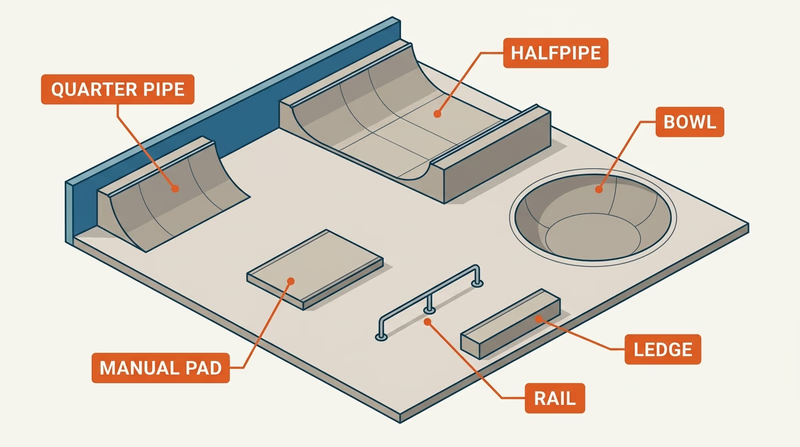
| Quarter pipe | A quarter-circle curved ramp with one vertical wall; foundation of vert skating |
| Halfpipe | Two quarter pipes facing each other; skaters ride back and forth between them |
| Bowl / pool | A curved, enclosed skating surface resembling an empty swimming pool; allows 360° transitions |
| Bank / wedge ramp | A flat angled ramp (no curved transition); good for speed and approach |
| Manual pad | A low, flat-topped platform used for manual (wheelie) tricks |
| Rail | A metal or PVC cylindrical bar used for grind and slide tricks |
| Ledge | A low, flat-topped concrete or metal surface used for grind and slide tricks |
| Spine | Two back-to-back quarter pipes sharing a top coping; allows transfer tricks between them |
| Funbox | A multi-sided box structure featuring rails, ledges, and angled sides |
| Stairs and gap | A stair set with a landing area; used for ollie-over and trick-down tricks |
Official Resources
No official resources are listed in the requirements for this subrequirement.