Req 9 — Sailing Terms and Sailboat Types
This final requirement ties the badge together. By now, you have worked through safety, boat parts, weather, wind, maneuvers, and seamanship. Here, you prove that you can speak the language of sailing and compare different kinds of boats in a way that shows real understanding.
Sailing terms worth knowing well
You should be comfortable with terms like port, starboard, bow, stern, leeward, windward, mast, boom, rudder, tiller, sheet, halyard, and tack. These words matter because sailing depends on fast, clear communication.
The points of sail
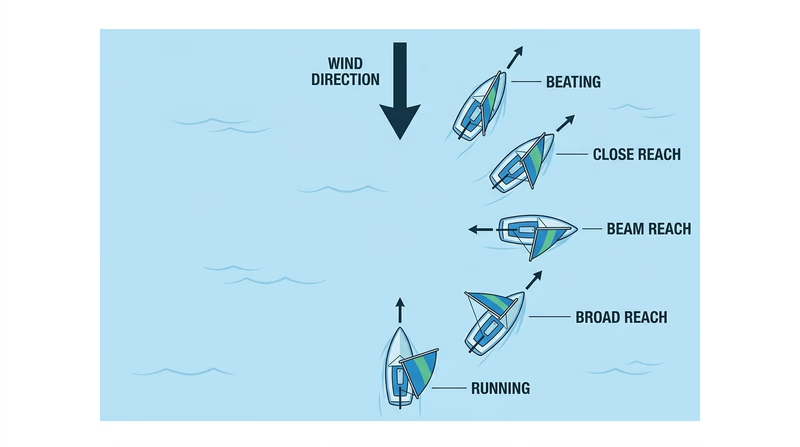
The pamphlet notes five basic points of sail: beating, close reach, beam reach, broad reach, and running. These names describe the angle at which the wind approaches the boat.
Beating
Also called sailing upwind at an angle. The boat cannot point straight into the wind, so it works upwind in zigzags by tacking.
Close reach
A fast and efficient point of sail with the wind coming from forward of the beam, but not as close to the wind as beating.
Beam reach
The wind comes from the side. Many sailors find this one of the easiest and most balanced points of sail.
Broad reach
The wind comes from behind at an angle. The boat can move quickly, but sail control still matters.
Running
The wind comes mostly from behind. This feels simple, but it requires attention because accidental jibes can happen if the boom crosses unexpectedly.
How to Explain the Points of Sail
A simple structure for your counselor discussion
- Say where the wind is coming from relative to the boat.
- Describe how the sails are usually trimmed compared with other points of sail.
- Mention one handling challenge such as tacking upwind or avoiding an accidental jibe while running.
Types of sailboats in use today
Dinghies
Small, usually light, often open boats used for training, racing, and short recreational sailing. They are responsive and great for learning.
Keelboats
Keelboats use a fixed keel for stability. They are often heavier and may feel steadier than dinghies, but they still require sail trim, rules knowledge, and good weather judgment.
Cat-rigged boats
A cat-rigged boat usually carries one sail. This can simplify sail handling for beginners.
Sloop-rigged boats
A sloop usually has a mainsail and a jib. Many training and cruising boats use this rig. It gives sailors more sail-control options, but also more lines and tasks to manage.
Racing boats and cruising boats
Some sailboats are built for speed and fast adjustments. Others are designed for comfort, stability, or carrying more people and gear.
🎬 Video: What's the Best Sailboats for Beginners? — Practical Sailor — https://www.youtube.com/watch?v=wy13QKapiq4
You have finished the core badge flow. The next page looks beyond the requirements and shows where sailing can take you after the badge is done.