Req 6 — Responsibility, SMART Style & Avalanche
Requirement 6 covers the three safety codes that every snow sport participant — beginner or expert, skier or snowshoer — must understand and follow. Know them cold before you head to the mountain.
Requirement 6a
The Your Responsibility Code is the foundational code of conduct at ski areas across North America. It sets the rules of the mountain — the same way traffic laws set the rules of the road. Every skier, snowboarder, and snowshoer is expected to know it and follow it.
The Seven Elements
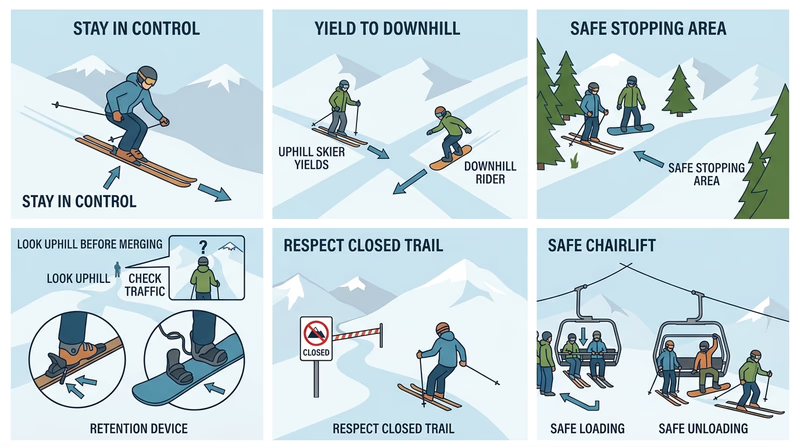
1. Always stay in control and be able to stop or avoid other people or objects. You are responsible for where you go and how fast you travel. If you cannot stop before hitting someone or something, you are going too fast for your ability or the current conditions.
2. Remember that people ahead of you (or below you) have the right of way. It is your responsibility to avoid them. The person downhill from you has no idea you are coming. They cannot dodge you. You must watch for them and route around them — always.
3. Do not stop in any place where you obstruct a trail or are not visible from above. Stopping at the bottom of a blind rise, in a narrow chute, or right below a terrain feature puts you in the path of someone who cannot see you. Always stop where others can see you from above.
4. Whenever starting downhill or merging into a trail, look uphill and yield to others. Entering a slope is like pulling onto a highway — you yield to traffic already on the road. Look uphill before you push off.
5. Use safety devices to help prevent runaway equipment. Ski brakes, leashes, and retention straps keep your skis and snowboard from flying downhill when you fall. A runaway ski can travel at high speed and seriously injure someone.
6. Observe all posted signs and warnings. Keep off closed trails and out of closed areas. Closed signs exist because an area is dangerous — avalanche risk, thin snowcover, drops, or cliff edges. Ignoring closure signs puts you and rescue workers in danger.
7. Know how to load, ride, and unload safely prior to using any lift. Chairlift accidents happen during loading and unloading. Watch what others do, ask for help your first time, and know where the stop buttons are.
Why Every Person Must Follow This Code
Snow sport areas concentrate many people of varying skill levels on the same terrain. Without a shared set of rules, collisions and injuries multiply. Following the Code is not just courteous — it is how you protect yourself and every other person on the mountain.
Official Resources
🎬 Video: Your Responsibility Code (video) — https://youtu.be/euGO92z4MnM
Requirement 6b
SMART Style is the safety program specifically developed for terrain parks, halfpipes, and freestyle features. Standard Your Responsibility Code rules apply everywhere on the mountain, but terrain parks add additional risks — people launching into the air, features that can cause head and neck injuries, and traffic coming from multiple directions. SMART Style addresses those specific risks.
The SMART Style Points
Look before you leap. Before you hit any jump, rail, or feature, scope it from the side first. Walk up to the feature and look at the landing zone. Is it clear? Are there other riders in the air or landing? Is the snow in good shape? Never hit a feature blind. If the feature is new to you, watch others ride it first.
Easy style it. Start with features that match your current skill level. Do not attempt the largest jump or the most difficult feature first. Snow parks are built with progression in mind — start small, build confidence, and work your way up gradually as your skills improve.
Respect gets respect. Wait your turn. Terrain parks have a one-at-a-time rule: one person uses a feature at a time. Clear the landing zone quickly after your run so the next rider can go. Do not cut in line. Look out for other park users — including beginners who may not know where to stand.
Why SMART Style Matters
Terrain parks and halfpipes are the most injury-dense locations at any ski resort. Head and spine injuries from bad landings or collisions are serious and sometimes permanent. SMART Style exists to reduce these risks by establishing predictable, respectful behavior for everyone using freestyle terrain.
Official Resources
🎬 Video: SMART Style Safety Program (video) — https://youtu.be/4Y7lCN7SKiY
Requirement 6c
Avalanches kill more than 25 people in the United States each year, and the vast majority are triggered by the victims themselves or their companions. Most avalanche deaths happen in the backcountry — areas outside ski resort boundaries — but avalanche awareness applies wherever you travel in mountainous winter terrain.
When Avalanches Happen
Avalanches are most likely when:
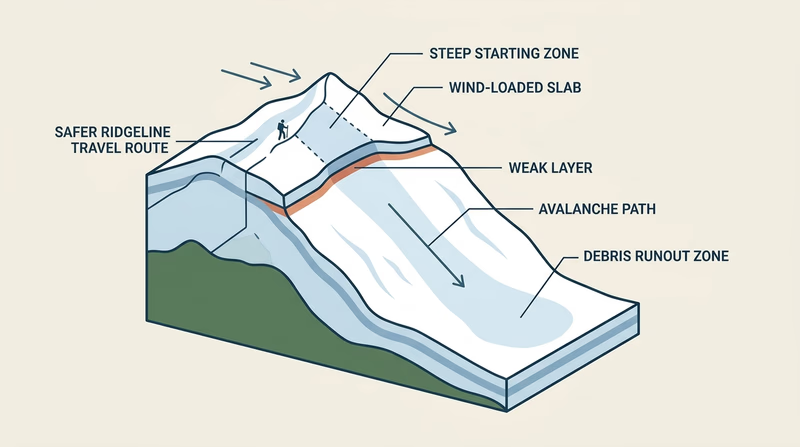
- Slopes are steep — Most fatal avalanches run on slopes between 30 and 45 degrees. Slopes in the 38–42 degree range are particularly dangerous.
- New snow has fallen recently — Heavy snowfall in the 24–72 hours before loading creates unstable layers.
- Layers within the snowpack are unstable — Weak layers (faceted snow, buried surface hoar) can collapse under additional load, triggering a slide on the slab above.
- You hear warning signs — Cracking sounds in the snow as you travel, a “whumpf” sound (the sound of a weak layer collapsing), or visible avalanche debris nearby all indicate dangerous conditions. Take these seriously and retreat.
Before You Go
- Check the avalanche forecast at avalanche.org or your regional avalanche center. The forecast rates danger from 1 (Low) to 5 (Extreme). Above a rating of 3 (Considerable), backcountry travel requires heightened caution or should be avoided.
- Carry beacon, probe, and shovel if traveling in avalanche terrain. These three tools — and the training to use them — are the minimum standard for backcountry travel. A beacon (transceiver) emits a signal that companions can use to locate you if buried. A probe confirms exact burial location. A shovel is required to dig you out.
- Travel with partners and tell someone your route and expected return time.
In Avalanche Terrain
- Travel one person at a time through exposed terrain while others watch from a safe spot.
- Stay on ridgelines when possible to avoid being caught in a slide path.
- Avoid the runout zone below steep slopes after heavy snowfall.
If Caught in an Avalanche
- Try to escape to the side of the slide if possible.
- Discard poles and fight to stay on the surface with a swimming motion.
- Just before the snow stops moving, cover your face with your arms and try to create an air pocket in front of your mouth and nose. Once snow settles, it sets like concrete — you will not be able to move.
- Stay calm to conserve air. Wait for rescuers to find you by beacon signal.
Individual Responsibility
Every backcountry traveler is responsible for:
- Checking the forecast before every trip.
- Carrying and knowing how to use beacon, probe, and shovel.
- Making conservative decisions when conditions are uncertain.
- Never traveling in avalanche terrain without a trained partner.
Even at ski resorts, avalanche control work (ski patrol triggering controlled slides) keeps in-bounds terrain safer — but closed signs must be respected. Ski area boundaries exist partly to keep you away from avalanche paths that have not been controlled.
Official Resources
🎬 Video: How to Reduce Avalanche Risk (video) — https://youtu.be/_f-vEc5LTFM
You have covered all of the safety codes and precautions. Now it is time to choose your snow sport and start the skills requirements.