Req 7d8 — Trail Techniques
These four techniques represent the core movement skills of snowshoeing. Each addresses a different terrain challenge you will encounter on almost any real-world snowshoe outing.
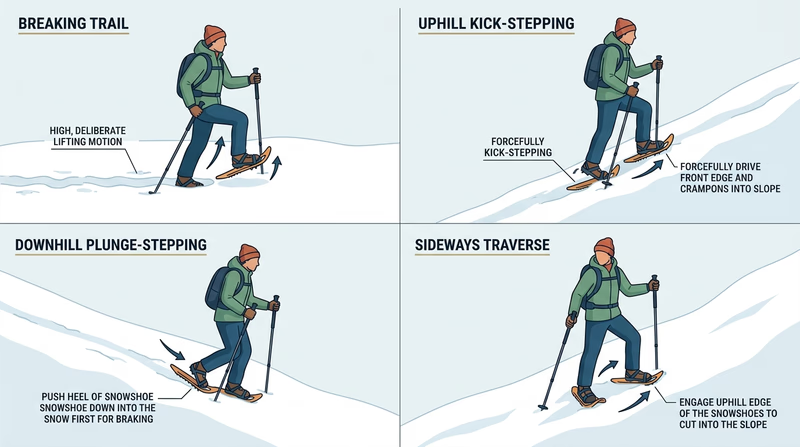
Breaking Trail
“Breaking trail” means being the first person through untracked snow — you are packing down the surface for yourself and anyone following.
Technique:
- Take deliberate, even steps. Lift your foot high enough to clear the snow with each step — do not shuffle.
- Plant your snowshoe firmly and let your weight settle before taking the next step.
- Keep a steady pace. Breaking trail is more tiring than following a packed path — rotate who leads in a group to share the effort.
- Use your trekking poles for balance and to test snow depth or firmness ahead.
- Aim for moderate terrain first. Deep, unbroken powder on steep terrain is exponentially harder than packed flats.
Climbing Uphill
Direct ascent (low angle): For gentle to moderate inclines, walk directly up the fall line with a slightly wider stance than on flat terrain. Lean slightly forward from the ankles — this presses the toe crampons into the snow for traction. If your snowshoes have heel lifts, flip them up to reduce calf strain.
Kick-step (steep terrain): On steeper slopes, kick the toe of the snowshoe into the slope to create a step, then stand on it and kick the next step. This is the same technique mountaineers use with crampons. Push the toe of the snowshoe into the slope firmly before trusting it with your full weight.
Sidestep: When a direct ascent is too steep or the snow too hard for kick-stepping, sidestep: stand sideways to the slope and step the uphill snowshoe into the hill, then bring the lower foot alongside. Repeat. This is slower but more secure on hard or icy slopes.
Traveling Downhill
Direct descent (gentle terrain): Walk directly down the fall line with a wide stance and slightly bent knees. Lean slightly back to weight the heel crampons for grip. Keep your weight over the entire snowshoe to prevent the toe from catching.
Plunge stepping (steeper terrain): Drive your heel into the slope aggressively with each step, essentially “punching” it in to create a platform. This engages the heel crampons maximally and creates a secure step. Keep knees bent and weight slightly back.
Sidestep descent: For very steep or icy slopes, face sideways and step down one step at a time, the same as the uphill sidestep in reverse.
Avoid running or uncontrolled slides — snowshoes do not have release bindings, and a fall or tumble with snowshoes on a steep slope can cause twisted ankles or worse.
Traversing
A traverse is moving across a slope diagonally rather than straight up or down.
Technique:
- Keep the uphill edges of your snowshoes pressed into the slope for grip.
- Lean your upper body slightly uphill.
- Take short, deliberate steps.
- Use trekking poles planted uphill for stability.
Traversing reduces the effective steepness of terrain and is often the safest way to gain or lose elevation on moderate to steep slopes.
Official Resources
🎬 Video: How to Break Trail (video) — https://youtu.be/9gLm2viPkT4?si=GIe05Kq-w67IMEe_
🎬 Video: How to Snowshoe on Hills (video) — https://youtu.be/Mr1uR6ENxBY?si=3Y1zY3mtDaQJfdlb
🎬 Video: How to Sidestep (video) — https://youtu.be/zWabuDZBcVQ