Req 1 — Soil Fundamentals
This requirement builds your soil vocabulary before you start talking about erosion and conservation. You will learn three connected ideas:
- what soil is and how it forms
- how sandy, silty, and clay soils behave differently
- which nutrients make soil fertile and how people replace them
Requirement 1a
Soil is not just crushed rock. It is a living mixture of mineral particles, organic matter, water, air, and countless tiny organisms. Good soil has spaces between particles, so roots can grow and water can move. It also contains dead plant material and living organisms such as fungi, insects, worms, and bacteria.
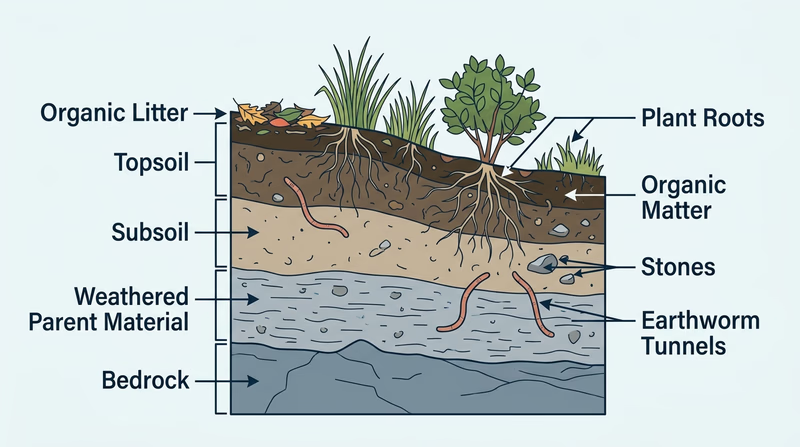
Soil forms slowly. First, parent material such as bedrock or loose sediment breaks down through weathering. Weathering can happen when water freezes and expands in cracks, when wind and flowing water grind rock into smaller pieces, or when roots and chemicals slowly weaken the rock. At the same time, leaves, roots, and other once-living material decay and add organic matter called humus.
Over many years, those materials sort themselves into layers called soil horizons. Near the surface, the soil is usually darker because it contains more organic matter and more living activity. Deeper down, the soil is lighter, denser, and closer to the original material it formed from.
The Dirt on Soil (video) A short introduction to soil as a living system, not just loose dirt. It is a good way to hear the main idea in plain language before you explain it yourself. Link: The Dirt on Soil (video) — https://www.pbs.org/video/soil-video-short-zfxcrn/🎬 Video: Formation of Soil (video) — https://youtu.be/YZ_D1ANF-E0?si=6lNRN2ODpZ7pe872
Requirement 1b
The three basic soil particle types are sand, silt, and clay. They differ mainly by particle size, and that size changes how the soil feels and behaves.
| Soil type | Particle size | Feel | Water behavior | Common strengths | Common problems |
|---|---|---|---|---|---|
| Sand | Largest | Gritty | Drains quickly | Good aeration, easy to work | Dries out fast, nutrients wash out |
| Silt | Medium | Smooth, almost flour-like | Holds more water than sand | Often fertile, holds nutrients well | Can erode easily |
| Clay | Smallest | Sticky when wet, hard when dry | Drains slowly | Holds water and nutrients well | Compacts easily, poor drainage |
Most real soils are mixtures. A soil with a balanced mix of sand, silt, and clay is called loam, and it is often excellent for growing plants because it holds moisture while still letting roots breathe.
A simple way to compare the three is to imagine a rainstorm. Water sinks fast into sand, moves moderately through silt, and may puddle on clay. That is why the same storm can leave one area dusty the next day and another area muddy for a week.
🎬 Video: Types of Soil (video) — https://youtu.be/G0JcVe_-yu0?si=WuJclD25JrEA4AMg
Requirement 1c
The three main plant nutrients are nitrogen (N), phosphorus (P), and potassium (K). You often see them listed on fertilizer labels as the N-P-K numbers.
- Nitrogen helps plants make leafy green growth.
- Phosphorus supports root growth, flowering, and seed production.
- Potassium helps with overall plant health, water balance, and disease resistance.
Plants remove nutrients from the soil as they grow. Harvesting crops removes even more, because the nutrients leave the field with the grain, fruit, hay, or vegetables. Conservation means thinking about how to return those nutrients instead of mining the soil year after year.
Ways to put nutrients back include:
- compost and manure, which add both nutrients and organic matter
- cover crops, especially legumes, which can help add nitrogen
- crop rotation, which keeps one crop from using the same nutrients over and over
- commercial fertilizers, used carefully and in the right amount
- mulching and leaving plant residue, which helps organic matter return to the soil
🎬 Video: The Three Most Important Nutrients for Plant Growth (video) — https://youtu.be/zgppw6fJOlw
In gardening, farming, and habitat work, soil fertility and water quality are tied together. That same connection shows up again in Req 6, where you will look at water pollution.
You know what healthy soil is made of. Next, look at what happens when soil stops staying where it belongs.