Req 2 — Understanding Soil Erosion
Erosion is what happens when soil starts moving instead of staying in place. This requirement covers four parts of that story:
- what erosion is
- why it matters to people as well as land
- the main kinds you are likely to see
- how to document real examples with pictures or drawings
Requirement 2a
Soil erosion is the wearing away and movement of soil by water, wind, ice, or gravity. The key idea is movement. Soil is not just breaking apart — it is being carried from one place to another.
That matters most when the soil being lost is topsoil, the dark upper layer rich in organic matter and nutrients. Topsoil supports plant growth, absorbs water, and helps hold ecosystems together. When it washes or blows away, the land becomes less productive and more vulnerable to more erosion.
🎬 Video: Soil Basics: Erosion (video) — https://youtu.be/DRkw5kOZsc8?si=Gq7gY0l0JDMjxhFD
Requirement 2b
Erosion is important because it damages land twice. First, it removes useful soil from the place where you need it. Second, it drops that soil somewhere else as sediment, which can clog ditches, cover stream bottoms, fill reservoirs, and muddy drinking-water sources.
Even if you do not live on a farm, erosion affects you. It can:
- raise the cost of food by reducing farm productivity
- make trails, roads, and campsites muddy or damaged
- increase flooding by reducing the soil’s ability to absorb rain
- hurt fish and insects when sediment clouds streams
- make communities spend more money on stormwater and water treatment
After a heavy rain, look at the nearest storm drain or roadside ditch. If the runoff is brown, that color is often soil that used to be somewhere uphill.
🎬 Video: Why Soil Conservation is Important to Human Agriculture? (video) — https://youtu.be/BuEdKEh2buI
Requirement 2c
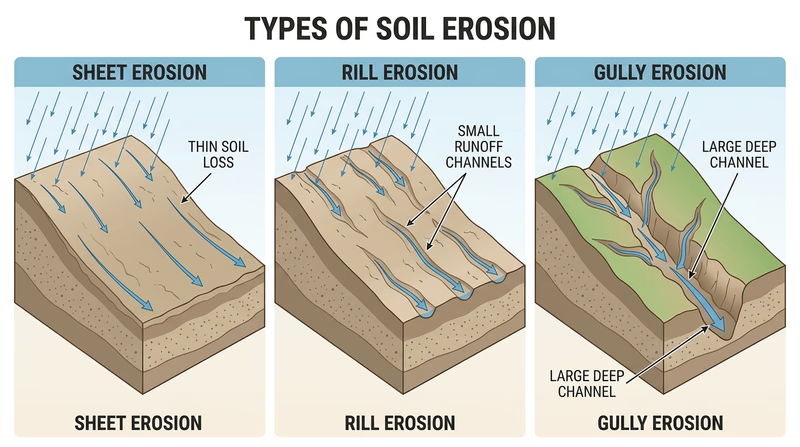
Three common kinds of erosion are sheet erosion, rill erosion, and gully erosion.
Sheet erosion
Sheet erosion is the thin, even removal of soil across a wide area. It can be hard to notice because it does not always leave a dramatic scar. But it steadily removes topsoil from fields, yards, and bare slopes.
Rill erosion
Rill erosion happens when runoff cuts many small channels into the soil. These channels are usually shallow enough to step across or smooth out, but they show that water is starting to concentrate and dig into the ground.
Gully erosion
Gully erosion is the large-scale version. Water cuts deep channels that are too large to ignore and too large to fix by simple smoothing. Gullies can make land unsafe to cross and can keep growing with every storm.
A useful way to remember the pattern is: sheet is spread out, rills are small channels, gullies are big channels.
Requirement 2d
This is a field observation job, not an art contest. Your goal is to show that you can recognize real erosion and label what you are seeing.
Good places to look include:
- the edge of a gravel trail after rain
- a bare slope near a parking lot or school field
- streambanks with exposed roots
- muddy construction entrances
- unmulched flower beds or drainage swales
When you take a picture or make a drawing, include clues that help your counselor read it clearly:
- show the slope or direction water moved
- include something for scale, such as a boot or notebook
- label the erosion type
- note what probably caused it, such as bare soil, steep slope, or concentrated runoff
- write one sentence about how it might be corrected
In Req 3, you will switch from spotting problems to explaining solutions.