Req 5 — The Water Cycle & Runoff
Water is always moving. In this requirement, you will connect the hydrologic cycle to real land-use questions: how water moves through soil, how vegetation changes runoff, and how forests, farms, rangelands, and industry affect usable water supplies.
Requirement 5a
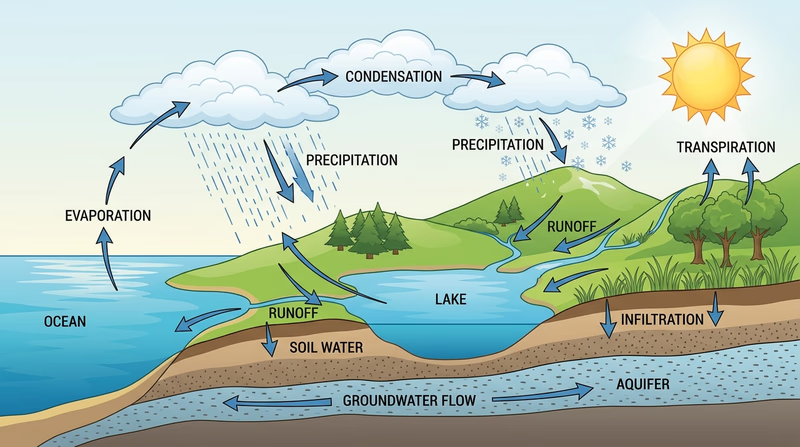
The hydrologic cycle is the continuous movement of water between the land, oceans, atmosphere, plants, and ground. In the pamphlet, it is described as water traveling from the sea through the air by means of clouds, and back to Earth again as precipitation.
A strong drawing should include these labeled parts:
- evaporation from oceans, lakes, rivers, and soil
- condensation forming clouds
- precipitation falling as rain or snow
- runoff moving downhill over land
- infiltration or percolation into soil
- groundwater flow underground
- transpiration from plants back to the air
🎬 Video: The Water (Hydrologic) Cycle (video) — https://youtu.be/FzYjPpxP-Cw
Requirement 5b
Pick two actions you can show clearly and safely. The easiest pair for many Scouts is percolation and capillary action because they are simple to demonstrate with cups, soil, water, and paper materials.
Percolation
Percolation is water moving downward through soil because of gravity. Sandy soil usually percolates faster than clay soil. A basic demonstration is to pour the same amount of water through two containers with different soils and compare how quickly it drains.
Capillary action
Capillary action is water moving upward or sideways through tiny spaces in soil. Plants depend on this movement. You can demonstrate it with a strip of paper towel or with dry soil touching water from below and watching the moisture rise.
Precipitation, evaporation, and transpiration
These are also good choices if you can show them clearly. For example, you might collect rain in a gauge, mark water loss from a shallow pan over time, or place a plastic bag over leaves and watch moisture collect from transpiration.
🎬 Video: Capillary Rise (video) — https://youtu.be/5waNTa2b-yg
🎬 Video: Soil Capillary Action Demonstration (video) — https://youtu.be/0Hcp2UGkbj4?si=7U9FAlP5XbSnUVha
🎬 Video: Soil Percolation Experiment (video) — https://youtu.be/CBmDlbFOZKU
Requirement 5c
Removing vegetation usually makes runoff faster, dirtier, and more damaging. Leaves and stems soften the impact of raindrops. Roots hold soil in place. Plant cover also helps water soak into the ground.
When vegetation is removed:
- less water infiltrates
- more water runs off the surface
- runoff reaches streams faster
- erosion and sediment increase
- flooding risk rises
- stream temperatures can increase if shade is lost
🎬 Video: How Vegetation Protects Soil (video) — https://youtu.be/wa9MTy_lSpY
Requirement 5d
Different land uses affect water in different ways.
Forest
Healthy forests usually improve water quality. Leaf litter and roots increase infiltration, reduce erosion, and help moderate stream flow. But poor logging practices or road building can raise sediment and change runoff.
Range or pasture
Well-managed grazing land can protect soil and water, especially when vegetation cover stays strong. Overgrazing removes cover, compacts soil, and creates bare patches where runoff speeds up.
Farmland
Farmland can either protect or damage usable water supply depending on management. Cover crops, contour farming, buffer strips, and careful fertilizer use help. Bare fields, excessive tillage, and poor drainage management can send sediment and nutrients into waterways.
🎬 Video: Rangeland Management and Water Supply (video) — https://youtu.be/PQf0gdomgGg?si=MNPoiCVV6Cc3QQlQ
Requirement 5e
Industry affects water supply in two main ways: quantity and quality. Some industries use huge amounts of water for cooling, washing, processing, or power generation. That can reduce what is available locally, especially in dry areas. Industry can also affect quality if wastewater, heat, or chemicals are not well controlled.
At the same time, industry can improve its impact through water recycling, efficient equipment, better treatment, and careful monitoring. Many modern facilities work to use less fresh water and discharge cleaner water than in the past.
Reimagining Industrial Water for Sustainable Impact (video) A useful look at how industry can reduce freshwater demand, reuse water, and improve treatment, even though this video must be opened on YouTube instead of embedded here. Link: Reimagining Industrial Water for Sustainable Impact (video) — https://youtu.be/xeTGV3e1QB8?si=rxKeNygqQnzccQd2The next requirement looks at what happens when water quality drops: pollution, wastewater treatment, and the meaning of biochemical oxygen demand.