Space Exploration Merit Badge — Complete Digital Resource Guide
https://merit-badge.university/merit-badges/space-exploration/guide/
Introduction & Overview
Space exploration is the story of people asking huge questions and then building machines brave enough to chase the answers. This badge mixes history, science, engineering, and imagination, so you will not just learn what happened in space — you will practice thinking like the people who plan missions and solve problems there.
From weather satellites above Earth to robotic probes crossing billions of miles, space work changes everyday life in ways you can actually see. It helps us understand our planet, invent better technology, and imagine where humans might go next.
Then and Now
Then — Looking Up and Wondering
Long before rockets existed, people studied the sky to tell time, predict seasons, and navigate across oceans and deserts. Ancient astronomers tracked the motions of the Sun, Moon, and planets because those moving lights mattered to farming, travel, and religion. For most of human history, though, space was something you could only watch.
That changed in the 1900s when scientists and engineers learned how to build rockets powerful enough to leave the atmosphere. Sputnik 1, launched by the Soviet Union in 1957, proved that humans could place an object in orbit. A few years later, astronauts and cosmonauts were circling Earth, and by 1969 humans had walked on the Moon.
- Early goal: Prove that reaching space was possible
- Big drivers: National pride, scientific curiosity, and military competition
- Big result: Humanity moved from observing space to visiting it
Now — Space Is Part of Daily Life
Today, space exploration is no longer only about flags and firsts. Satellites help forecast storms, guide airplanes, power map apps, study climate, monitor crops, and connect people across the world. Robotic probes visit planets, moons, comets, and asteroids that are too distant or dangerous for humans right now.
Modern exploration is also more international and more commercial. NASA works with partners from many nations, and private companies now launch cargo, satellites, and crews. Space is still exciting because of discovery, but it is also practical, cooperative, and increasingly connected to life on Earth.
Get Ready!
This badge asks you to think like a historian, engineer, designer, and explorer. You will compare missions, build or model rockets, and imagine how humans could live far from Earth.
Kinds of Space Exploration
Human Spaceflight
Human spaceflight sends people into space to test spacecraft, run experiments, repair equipment, and learn how the body handles life beyond Earth. Mercury, Gemini, Apollo, the Space Shuttle, Soyuz, Shenzhou, Crew Dragon, and the International Space Station all belong to this part of the story.
Robotic Exploration
Robotic missions go where people cannot easily go yet. Rovers crawl across Mars, probes dive toward the Sun, orbiters map planets from above, and sample-return missions bring pieces of distant worlds back to Earth for study.
Earth Observation
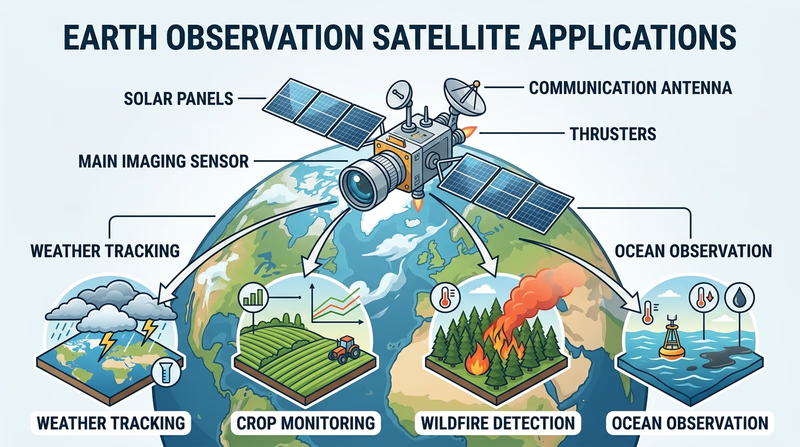
Not every space mission heads deeper into the solar system. Many satellites stay close to Earth and watch weather, wildfires, oceans, forests, glaciers, and cities. These missions help scientists and emergency crews make decisions here at home.
Space Habitats
Some spacecraft are built to travel, while others are built to be places where people live and work. Capsules, stations, lunar bases, and future Mars habitats all answer the same question in different ways: how do you keep humans alive and useful in a place that does not naturally support life?
You are ready to start with the biggest question of all: why people choose to explore space in the first place.
Req 1 — Why We Go
This requirement covers four big ideas: where the drive to explore came from, what scientists want to learn right away, how space work helps people on Earth, and why many missions depend on countries working together. If you can explain all four clearly, you are no longer just naming space facts — you are explaining why space exploration matters.
Requirement 1a
Historical reasons for space exploration
People first wanted to explore space for the same reason they crossed oceans and climbed mountains: they wanted to know what was out there. Curiosity is a real historical force. Humans tracked stars for navigation, calendars, and religion long before rockets existed, so once technology caught up, reaching space became the next great frontier.
Another historical reason was competition. During the Cold War, the Soviet Union and the United States both wanted to prove that their science, industry, and political systems were stronger. That pressure helped drive early launches, the first human spaceflights, and the race to the Moon. This competition was not always peaceful in its motives, but it pushed technology forward very quickly.
A third reason was national pride. Countries saw space success as proof that they could solve enormous technical problems. Being first to orbit Earth, send a human into space, or land on the Moon became symbols of power and prestige.
🎬 Video: The History of Space Exploration (video) — https://youtu.be/TL__l9gC1Ss?si=BXoLcRCoNZXPEALe
🎬 Video: The History of Space Exploration: A Timeline (video) — https://youtu.be/3JuKR7jf46o
Requirement 1b
Immediate goals in terms of specific knowledge
When scientists launch a mission, they usually have very specific questions they want answered. They may want to measure the atmosphere of a planet, map the surface of an asteroid, test how a new engine performs, or learn whether water ice is present in a certain region. Those are immediate goals because they focus on knowledge a mission can gather now, not a vague dream for the future.
A good way to explain this is to start with the question and then match the mission. If a rover goes to Mars, one immediate goal might be learning what rocks are made of or whether the environment once supported microbial life. If a satellite studies Earth, one immediate goal might be measuring storms, fires, ocean temperatures, or changing ice sheets.
How to explain an immediate goal
Use this simple pattern when you talk with your counselor- Question: What does the mission want to find out?
- Tool: What spacecraft, instrument, or experiment is being used?
- Evidence: What data will the mission collect?
- Meaning: How will that data help scientists understand a place or process better?
Requirement 1c
Benefits related to Earth resources, technology, and new products
Space exploration helps Earth in two major ways. First, satellites help us manage real resources here at home. They track forests, crops, water supplies, sea ice, wildfires, storms, and pollution. That makes space work useful to farmers, firefighters, meteorologists, shipping companies, scientists, and emergency planners.
Second, building spacecraft leads to new tools and improved products. Engineers designing for space need equipment that is lighter, tougher, smaller, and more reliable. That work can lead to better sensors, water filters, solar panels, medical tools, insulation, communication systems, and materials used in everyday products.
The key idea is that space exploration is not separate from life on Earth. It often creates practical benefits because hard engineering problems force people to invent better solutions.
🎬 Video: How Space Benefits Earth (video) — https://youtube.com/shorts/i3D4pCq_lyg?si=S_3HJWJ9TrvcHvry
🎬 Video: Space Exploration, Is It Really Worth It? Yes. (video) — https://youtube.com/shorts/jPuqA136SfA?si=EgcAXSXcMBJmVLw4
🎬 Video: 10 Surprising Ways Space Exploration Benefits Life on Earth (video) — https://youtube.com/shorts/_2uSv1C-FDw?si=JCFVs8xAXqeJvozN
Requirement 1d
International relations and cooperation
Space is too expensive, too technical, and too ambitious for most nations to tackle alone all the time. That is why many missions depend on international cooperation. Countries share launch sites, astronauts, instruments, science teams, tracking stations, and funding.
The International Space Station is one of the best examples. It was built and operated by multiple space agencies, including NASA, Roscosmos, ESA, JAXA, and CSA. That kind of partnership helps spread cost and expertise, but it also builds trust. Nations that work together on difficult missions practice solving problems together.
International cooperation also means science becomes stronger. A mission may use a camera from one country, an orbiter from another, and a communications network run by a third partner. When the data returns, scientists around the world can study it.
🎬 Video: What Role Does International Cooperation Play in Space Exploration? (video) — https://youtu.be/TS27Br2-XgY?si=W1CeXgcrzOZ-Trgm
By the time you finish this requirement, you should be able to explain space exploration as a mix of history, science, practical benefits, and teamwork — not just as a list of famous launches.
Req 2 — Collector Card Mission
A good collector card does more than list dates. It helps someone understand why a person mattered. Your job is to choose one pioneer, show who they were on the front, and explain their impact on the back in a way that is fast, clear, and memorable.
The word pioneer does not only mean astronaut. A space pioneer could be a rocket scientist, flight director, computer scientist, engineer, mission designer, test pilot, mathematician, planetary scientist, or entrepreneur who changed what humans can do in space.
What to put on the front
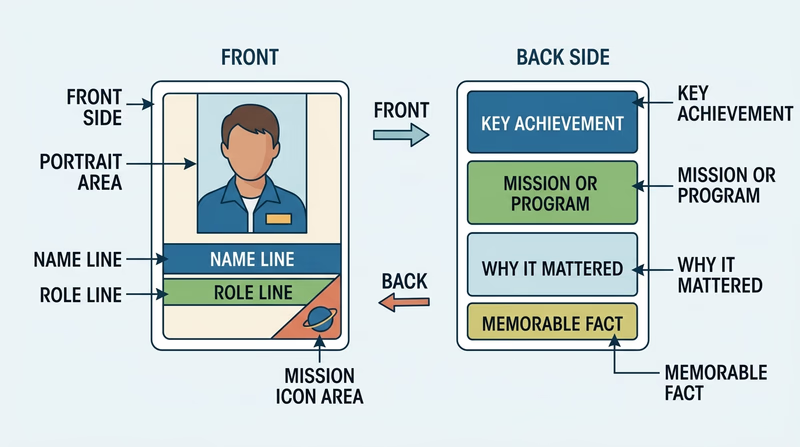
The front should grab attention quickly. Use a photo, drawing, or other image that clearly shows your pioneer. Around that image, include only a few details so the card stays readable.
Front of your card
Keep it clean and easy to scan- Name: Full name of the space pioneer.
- Role: Astronaut, engineer, mathematician, scientist, mission commander, and so on.
- Visual clue: A picture, mission patch, rocket, spacecraft, or planet tied to that person’s work.
- One strong label: A phrase like “First American to orbit Earth” or “Helped save Apollo 13.”
What to put on the back
The back is where you prove why this person belongs in your collection. Do not try to tell their whole life story. Pick the facts that show what problem they helped solve and why their work still matters.
Back of your card
Focus on significance, not trivia- Key achievement: What are they best known for?
- Mission or program: What spacecraft, project, or discovery were they part of?
- Why it mattered: What changed because of their work?
- One memorable fact: Something specific that helps you remember them.
How to discuss four more pioneers
You only make one card, but you must also discuss four additional pioneers. The easiest way is to compare them by role.
For example, you might choose:
- An astronaut who flew the mission
- An engineer who designed the spacecraft
- A scientist who planned the experiments
- A mathematician or computer expert who solved critical problems
- A modern leader in commercial or international spaceflight
That gives you variety and shows your counselor that space exploration is a team effort.
🎬 Video: Here's How I Make Custom Trading Cards (video) — https://youtu.be/PkCCLH_f1us?si=fw5ZdX03GwDyn_eo
🎬 Video: How to Make Trading Cards By Hand (video) — https://youtu.be/vYbeo4iS1Pc
You do not need fancy art supplies or software to do this well. A neat handmade card with strong facts is better than a flashy card that says very little.
Req 3 — Build, Launch, Recover
This is a hybrid requirement. You are not only naming rocket parts — you are building or modeling a rocket, launching and recovering it when allowed, and showing that you understand how every major piece contributes to safe flight. Think of the rocket as a team: each part has a job, and the flight only works when those jobs fit together.
What makes a successful second launch
Pick one clear objective before you fly again- Higher altitude: Try a different approved engine if your kit allows it.
- Straighter flight: Focus on fin alignment and launch rod setup.
- Safer recovery: Adjust packing so the parachute or streamer deploys cleanly.
- Better data: Time the flight, record wind, or compare two launch conditions.
Requirement 3a
Function of the body tube
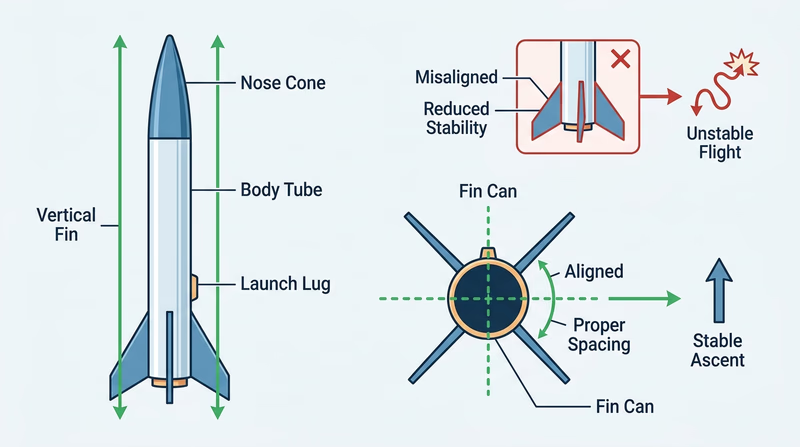
The body tube is the main barrel of the rocket. It holds many other parts in alignment, including the engine mount, recovery system, and often the payload. A strong, straight body tube helps the rocket stay stable in flight.
Why it matters in flight
If the body tube is bent, crushed, or poorly glued, the rocket may wobble or fly off course. It also protects the inside of the rocket from handling damage.
Requirement 3b
Function of the engine mount
The engine mount holds the rocket motor in the correct position inside the body tube. It keeps the engine from sliding forward or backward when thrust begins.
Why it matters in flight
The motor produces strong force in a very short time. If the engine mount is loose, the rocket can fail before it ever leaves the pad properly.
Requirement 3c
Function of the fins
Fins keep the rocket flying straight. They help the rocket point nose-first by adding stability as air moves past the rocket body.
Why it matters in flight
Crooked fins can make a rocket spin, arc, or tumble. Matching fin shape and careful alignment matter more than flashy decoration.
Requirement 3d
Function of the igniter
The igniter starts the rocket engine. Electric current heats the igniter so it lights the propellant inside the motor.
Why it matters in flight
A rocket launch should begin from a safe distance using the electrical system. That lets the launcher count down, clear the pad, and avoid placing a flame directly under the rocket by hand.
Requirement 3e
Function of the launch lug
The launch lug is a small tube attached to the side of the rocket. It slides along the launch rod or rail during liftoff.
Why it matters in flight
For the first moment of flight, the rocket is still moving too slowly for the fins to stabilize it fully. The launch lug keeps the rocket guided straight until it has enough speed for the fins to take over.
Requirement 3f
Function of the nose cone
The nose cone gives the rocket a streamlined front end. It helps reduce drag and often houses or protects the payload area.
Why it matters in flight
A smooth, properly fitted nose cone helps the rocket move through the air cleanly. It also must separate correctly during recovery so the parachute or streamer can deploy.
Requirement 3g
Function of the payload
The payload is whatever the rocket carries besides the equipment needed simply to fly. In a model rocket, that might be a small object, an altimeter, or another demonstration item.
Why it matters in flight
Payload changes the rocket’s mass and balance. Even a small extra load can affect stability, altitude, and recovery, so it has to be planned, not just stuffed in.
Requirement 3h
Function of the recovery system
The recovery system brings the rocket back safely. It may use a parachute, streamer, or other device to slow descent.
Why it matters in flight
Without recovery, a successful launch turns into a broken rocket. Good packing, flame protection, and line attachment all help the recovery system open at the right moment.
Requirement 3i
Function of the rocket engine
The rocket engine provides thrust. In model rocketry, a solid-fuel motor burns rapidly and forces hot gas out the back, pushing the rocket upward.
Why it matters in flight
The engine choice affects altitude, acceleration, and total flight time. Use only the engine sizes recommended for your kit and launch setup.
NASA "Rocket Parts" - Beginner's Guide (website) A labeled guide that explains how the main parts of a rocket fit together and what each one does. Link: NASA "Rocket Parts" - Beginner's Guide (website) — https://www.grc.nasa.gov/www/k-12/VirtualAero/BottleRocket/airplane/bgmr.html National Association of Rocketry Educational Video Series on Model Rocketry (website) Launch safety, building basics, and rocketry lessons from the organization whose safety code this requirement references. Link: National Association of Rocketry Educational Video Series on Model Rocketry (website) — https://www.nar.org/content.aspx?page_id=22&club_id=114127&module_id=669619When you talk with your counselor, do not memorize definitions like a glossary. Instead, explain the flight from start to finish: the igniter starts the engine, the engine pushes the rocket up, the launch lug guides it, the fins stabilize it, the body tube holds everything together, and the recovery system brings it home.
Req 4 — Rockets, Orbits, and Images
This requirement turns model rocketry into real space science. You need to connect a few core ideas: thrust comes from action and reaction, engines create that thrust, satellites stay up because they are falling around Earth instead of straight down, and images from space only become useful when spacecraft can collect and send data back home.
Requirement 4a
Action-reaction is Newton’s third law of motion. If one object pushes on another, the second object pushes back with an equal and opposite force. In rocketry, hot gas shoots out the back of the engine, and the rocket is pushed forward.
A great demonstration is an inflated balloon released without tying it closed. Air rushes out one end, and the balloon shoots the other way. The escaping gas is the action. The balloon moving forward is the reaction.
Newton's Law of Motion (website) NASA's beginner-friendly explanation of the motion laws behind thrust and flight. Link: Newton's Law of Motion (website) — https://www1.grc.nasa.gov/beginners-guide-to-aeronautics/newtons-laws-of-motion/Requirement 4b
Rocket engines carry both fuel and oxidizer, which is one reason rockets can work in space where there is no air to support burning. In a chemical rocket, the propellants react and create very hot gas. That gas expands rapidly and escapes through a nozzle, producing thrust.
Different engines use different fuels and designs, but the basic story stays the same: store energy, control the burn, and direct the exhaust so the spacecraft moves in the opposite direction.
How Rocket Engines Work (website) A step-by-step explanation of fuel, combustion, exhaust, and thrust. Link: How Rocket Engines Work (website) — https://science.howstuffworks.com/rocket.htm🎬 Video: Rocket Engines Explained (website) — https://youtu.be/gz8L1i0ODeA
Requirement 4c
Satellites do not stay up because there is no gravity. They stay in orbit because gravity is constantly pulling them downward while they are moving sideways fast enough to keep missing Earth.
Imagine throwing a ball. If you throw it softly, it lands nearby. Throw it harder, and it goes farther before hitting the ground. A satellite moves so fast sideways that as it falls, Earth’s curved surface drops away beneath it. That is orbit.
🎬 Video: How Do Satellites Get & Stay in Orbit? (video) — https://youtu.be/IC1JQu9xGHQ?si=qcvDJm44-la-3nsI
🎬 Video: How Satellites Orbit (video) — https://youtu.be/5PCY0rTllPg?si=gNhEm9nAfygodC3Q
Requirement 4d
Space images begin with sensors. Some cameras collect visible light like your eyes do. Others detect infrared heat, ultraviolet light, radar reflections, or other wavelengths humans cannot see directly. The spacecraft stores those measurements as digital data.
Next, the data must be sent to Earth. The spacecraft uses antennas and radio signals to transmit the information to ground stations. Computers on Earth turn those numbers into pictures scientists and the public can use.
Not every space image is a simple snapshot. Some are built from many narrow strips scanned over time. Others use colors added later to highlight materials, temperature, or cloud patterns. That means a space picture is both a measurement and a visual tool.
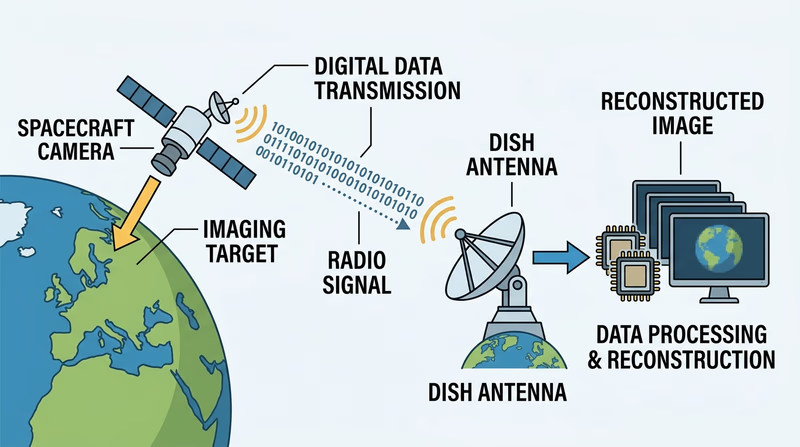
If you can explain this page clearly, you can connect the three biggest parts of spaceflight: force gets a spacecraft moving, orbit keeps it where it needs to be, and communications bring the science back.
Req 5 — Choose Two Missions
You must choose exactly two options from this requirement. One good strategy is to pick one option that asks you to study real missions closely and one option that lets you create something of your own.
Your Options
- Req 5a — Compare Great Missions: Compare one robotic mission and one historic crewed mission. This option builds your ability to explain discoveries, mission goals, and why certain flights changed history.
- Req 5b — Build a Mission Story: Create a blog, website, slideshow, or scrapbook about a current planetary mission. This option helps you organize information for an audience.
- Req 5c — Design a Sample Return: Invent a robotic sample-return mission to another world. This option strengthens mission-planning and engineering thinking.
How to Choose
Choosing your two options
Think about time, materials, and what kind of work you enjoy most- If you like comparing real events: Start with 5a. You will talk about actual missions and what they discovered.
- If you enjoy presenting information: Add 5b. It works well if you like slides, websites, or visual storytelling.
- If you like designing systems: Add 5c. It is the most creative and engineering-heavy choice.
- If you want balance: Pair 5a with 5c or 5b with 5c so you practice both research and design.
Req 5a — Compare Great Missions
This option works best when you compare missions that reveal different strengths. Robotic missions can go farther, stay longer, and survive harsher places. Crewed missions can adapt quickly, make decisions on the spot, and do complex work with human hands and eyes.
What to include for each mission
Do not just retell the launch and landing. Your counselor wants to hear three things clearly:
- Major discoveries — what new information came back?
- Importance — why did that mission matter at the time?
- What was learned — how did it change what people understood about a place in space?
A strong mission comparison
Use the same categories for both missions- Mission goal: What was it trying to do?
- Destination: Moon, Mars, outer planets, or another region of space.
- Discoveries: What did it find or prove?
- Importance: Why do people still remember it?
- Legacy: What later missions built on it?
Good pairings to consider
A classic pairing is Voyager and Apollo 11. Voyager shows the power of long-range robotic exploration, while Apollo 11 shows what a crewed mission can accomplish under intense time pressure and risk.
Another strong pairing is Perseverance and Apollo 17. Both missions gathered surface information in detail, but one did it with a rover and onboard instruments while the other relied on astronauts working directly in the field.
🎬 Video: Voyager (video) — https://youtu.be/uJpJ79AxrzI?list=PLTiv_XWHnOZq5bv1w9Db2uNJVFiVCkWW5
🎬 Video: Putting Man on The Moon in 11 Years | The Apollo Program (video) — https://youtu.be/jUW_1XlrWmg
🎬 Video: NASA SpaceX Crew Dragon Launch (video) — https://youtu.be/1gmvUPTdoP4
🎬 Video: Mars Perseverance Rover (video) — https://www.youtube.com/watch?v=0-oQRSViZQE&pp=ygUUcGVyc2VydmVyYW5jZSByb3ZlciA%3D
A simple discussion structure
Start with your robotic mission first. Explain where it went, what tools it carried, and what it discovered. Then shift to the crewed mission and show what human presence added. End by comparing the two directly.
Req 5b — Build a Mission Story
This option is about storytelling with evidence. Your final product should help someone else understand a mission that is happening now or very recently, not just dump facts onto a page. Good mission storytelling answers three questions: what is the mission trying to do, how is it doing it, and why should anyone care?
Pick a current planetary mission
A planetary mission studies another world, such as Mars, Jupiter, Europa, an asteroid, or a comet. Choose something current enough that you can find recent updates, images, or progress reports.
Possible examples include missions studying Mars, Jupiter’s moons, asteroids, or the outer planets. Once you choose, stick with one mission so your project stays focused.
Choose the format that fits you
A slideshow works well if you like presenting aloud. A website or blog works well if you want sections with images and links. A scrapbook works well if you enjoy arranging visuals and captions by hand.
What your project should include
No matter which format you choose- Mission name and destination: What is going where?
- Mission goal: What question is it trying to answer?
- Spacecraft or instruments: What tools does it use?
- Current status: What has happened so far?
- Why it matters: What could scientists learn from it?
Make the audience care
Do not lead with the launch date unless it is the most exciting part. Lead with the mystery. Maybe the mission is hunting for signs of past habitability, sampling a primitive asteroid, or looking beneath icy crust for evidence of an ocean. Start with the question that makes the mission interesting.
Use pictures like evidence
Photographs are not decorations here. Use them to support a point. A launch image can show scale. A map can show destination. A spacecraft diagram can explain instruments. A planetary image can show what scientists are studying.
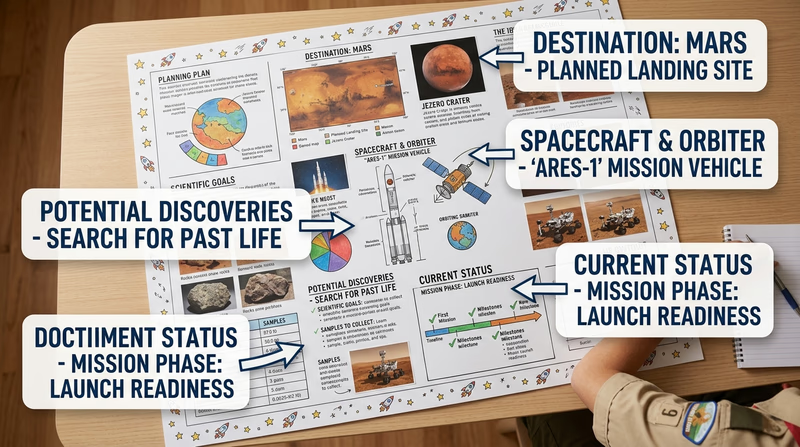
Since this option has no official requirement-level resource links, focus on building a clean, accurate project you can walk your counselor through with confidence.
Req 5c — Design a Sample Return
Sample-return missions are some of the hardest robotic missions ever attempted. A spacecraft has to travel to another world, arrive safely, collect material without contaminating it, launch or depart again, and then get the sample home in one piece. That means your design should solve a chain of problems, not just draw a cool spacecraft.
Start with the destination
Your first choice controls almost everything else. A mission to an asteroid deals with tiny gravity and loose rubble. A mission to Mars deals with dust, cold temperatures, and the challenge of launching back off another planet. A mission to a comet may face fast motion, weak gravity, and fragile icy material.
Build around the environment
Questions your design must answer
Use the environment to drive the spacecraft design- How will it land or make contact? Gravity, terrain, and atmosphere all matter.
- How will it collect the sample? Scoop, drill, core tube, sticky pad, or another method?
- How will it protect the sample? Keep it sealed, labeled, and uncontaminated.
- How will it get home? Return capsule, ascent stage, or rendezvous plan?
- How will it survive local conditions? Temperature, dust, radiation, weak sunlight, or rough terrain?
Think like a systems engineer
A strong answer explains why the mission choices fit the destination. If you choose Europa, you need to explain radiation and extreme cold. If you choose an asteroid, you need to explain how the spacecraft will anchor or hover without bouncing away. If you choose Titan, you need to consider thick atmosphere, cold temperatures, and long travel time.
A simple mission structure
One useful pattern is:
- Launch from Earth
- Cruise through space
- Arrive and survey the target
- Collect the sample
- Store and seal it
- Return it to Earth
- Recover the capsule safely
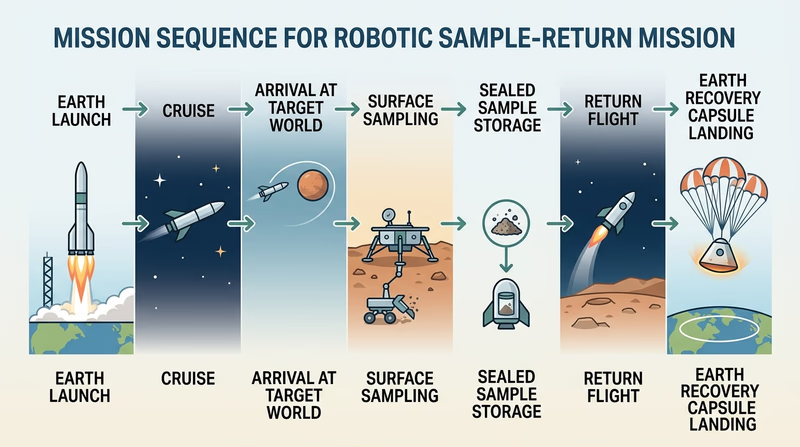
This option has no official requirement-level links, so your best evidence is a clear diagram or model plus a strong explanation of how the environment shaped your design.
Req 6 — Choose a Space Home
You must choose exactly one option from this requirement. Both choices focus on how humans live and work in orbit, but they do it at different scales.
Your Options
- Req 6a — Crewed Orbital Vehicles: Study a shuttle, capsule, or other crewed orbital vehicle. This option helps you explain how a spacecraft carries people to orbit, supports them briefly, and returns them safely.
- Req 6b — International Space Station: Focus on the ISS as a long-term orbital home and laboratory. This option is great if you want to explain how people live, work, and cooperate in space over time.
How to Choose
Choosing your option
Pick the one that fits what you want to describe- Choose 6a if you are most interested in launches, reentry, crews, and spacecraft systems packed into one vehicle.
- Choose 6b if you are most interested in long-duration living, science experiments, and international teamwork.
- What you gain from 6a: Better understanding of how spacecraft transport humans.
- What you gain from 6b: Better understanding of how humans stay alive and productive in orbit.
Req 6a — Crewed Orbital Vehicles
This page asks you to describe three things about a crewed orbital vehicle: its purpose, how it operates, and its major components. A strong answer should show how all three connect. The vehicle exists to carry people and cargo safely, it operates through launch-orbit-reentry stages, and each major component supports one of those stages.
Purpose
A crewed orbital vehicle is built to transport humans to orbit, keep them alive there for a period of time, and return them safely to Earth. Some vehicles are reusable spaceplanes, like the Space Shuttle orbiter. Others are capsules, like Soyuz or Crew Dragon.
Operation
Most crewed orbital vehicles work in stages:
- Launch — Rockets lift the vehicle through the atmosphere.
- Orbit — The spacecraft separates, uses onboard systems, and supports the crew.
- Return — The vehicle reenters the atmosphere and lands or splashes down.
A shuttle-style vehicle and a capsule do this differently, but both must manage power, air, navigation, communications, heat protection, and safe recovery.
Components to explain
Key components to notice
Choose examples from the vehicle you study- Crew cabin: Where astronauts live and work.
- Life-support systems: Air, temperature control, water, and waste handling.
- Guidance and navigation: Computers, sensors, and control systems.
- Power source: Batteries, solar panels, or fuel cells.
- Thermal protection: Heat shield tiles, ablative shield, or other systems for reentry.
- Docking or cargo systems: Hardware for meeting stations or carrying equipment.
🎬 Video: First Space Shuttle (video) — https://youtu.be/9zu6gReRV98
🎬 Video: How the Space Shuttle Worked (video) — https://www.youtube.com/watch?v=w4FCkbPykdQ
🎬 Video: NASA SpaceX Crew Dragon Launch (video) — https://youtu.be/1gmvUPTdoP4
🎬 Video: Soyuz (video) — https://youtu.be/_v7YgDum2Sg
Good examples to compare
- Space Shuttle: Reusable orbiter that launched like a rocket and landed like a glider.
- Soyuz: Tough capsule system with long service history.
- Crew Dragon: Modern commercial capsule with digital systems and autonomous docking.
- Orion on Artemis II: NASA’s first crewed Artemis mission, a four-astronaut lunar flyby using the Orion spacecraft to test deep-space life support, navigation, communications, and reentry before later lunar landing missions.
Artemis II is especially useful for this requirement because it is a current example of a crewed vehicle built for missions beyond low Earth orbit. Unlike the Shuttle, Soyuz, or Crew Dragon, Orion is designed for deep-space travel around the Moon rather than short trips to and from Earth orbit.
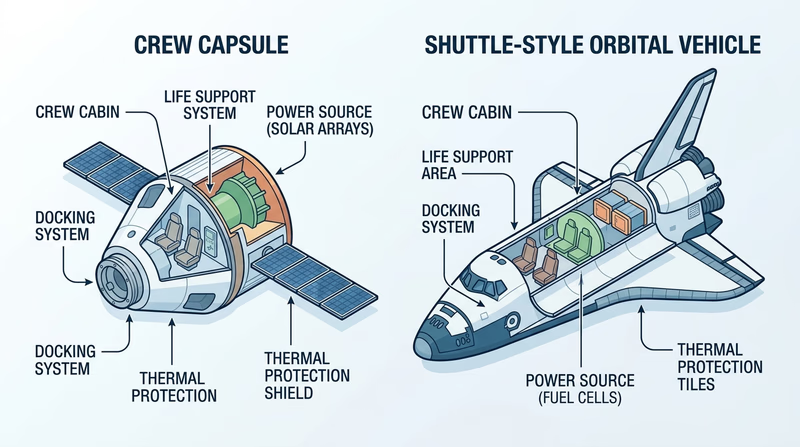
Req 6b — International Space Station
The International Space Station is both a spacecraft and a place to live. Its purpose is to support long-term human life in orbit while giving scientists a laboratory where they can study microgravity, Earth, technology, and the human body.
Purpose
The ISS helps crews perform research that is hard or impossible to do on Earth. It also teaches engineers how to support people in space for months at a time, which matters for future missions to the Moon and Mars.
Operation
The ISS circles Earth about once every 90 minutes. Crews arrive on spacecraft, dock, live aboard, perform experiments, exercise to stay healthy, maintain equipment, and eventually rotate home while a new crew takes over.
Because it is a station instead of a short-mission vehicle, its operation depends on constant teamwork: ground controllers, cargo deliveries, visiting spacecraft, maintenance schedules, and international coordination.
Components to describe
Major ISS systems
These components help it work as a long-term orbiting outpost- Modules: Pressurized rooms where crews live, work, and do science.
- Solar arrays: Large panels that collect sunlight for power.
- Trusses and radiators: Structures that support equipment and release extra heat.
- Docking ports: Places where visiting spacecraft connect.
- Life-support systems: Air, water recycling, and temperature control.
- Robotic systems: Arms and tools used for moving equipment and helping with station work.
Req 7 — Design a Space Base
This is a hybrid requirement because the main task is already substantial before you ever reach the lettered parts. You are designing a real habitat concept, and the four subrequirements are the four systems every successful base needs: energy, construction, life support, and a clear purpose.
Choose your location first. A base on the Moon, Mars, Titan, or an asteroid should not all look the same, because those environments are wildly different.
🎬 Video: How NASA Will Build a City on the Moon (video) — https://youtu.be/ATgwz_hS3Qg
Requirement 7a
Source of energy
Every base needs dependable power for lights, computers, heating, cooling, communications, science equipment, and life support. Your energy choice should match the location. Solar power may work well on the Moon in some places, but it becomes harder far from the Sun or during long periods of darkness. A base might need batteries, fuel cells, nuclear systems, or a combination.
You Can't Take It All With You (PDF) A NASA activity that helps you think through limited cargo space, power, and tradeoffs when planning what a mission must bring. Link: You Can't Take It All With You (PDF) — https://www.nasa.gov/wp-content/uploads/2023/05/you-cant-take-it-all-with-you-grades-6-12-students-tagged.pdfRequirement 7b
How it will be constructed
Construction in space rarely begins with humans carrying boards and tools out of a truck. Your plan might use robots first, inflatable modules, 3-D printing with local soil or rock, or prefabricated sections launched from Earth. The harder the environment, the more useful remote construction becomes before a crew arrives.
🎬 Video: How NASA Plans to Build the First Moon Base (video) — https://youtu.be/ajP0AlYxhug?si=lKaqYRoM8V4LiXSg
Requirement 7c
Life-support system
Life support keeps people alive by managing air, water, temperature, food systems, waste, and pressure. A good design should recycle as much as possible because resupply missions are expensive and slow. That means your base may reuse water, scrub carbon dioxide from the air, and protect people from radiation and extreme temperatures.
🎬 Video: Robots Building a Mars Base (video) — https://youtu.be/2tr6rJrv8hs?si=dm1LYgNqLCH7smpr
Requirement 7d
Purpose and function
A base should exist for a reason bigger than “because it is cool.” Maybe it studies geology, searches for signs of past life, mines water ice, serves as a refueling stop, tests long-term habitation, or supports exploration farther into space. Its purpose should shape every design choice.
If the base is mainly for science, you may need labs and sample storage. If it is a staging site, you may need fuel systems, cargo space, and vehicle maintenance areas. If it is a long-term habitat, you need exercise space, medical support, and room for crews to live well, not just survive.
🎬 Video: How Robots Will Build on Mars (video) — https://youtu.be/ZbOg_cC1_Eo
Pulling the whole design together
Before you present your base
Make sure the four parts support each other- Location: Why did you choose that world?
- Energy: How does the base stay powered day after day?
- Construction: How does it get built without wasting mass and time?
- Life support: How are people kept alive and healthy?
- Purpose: What work makes the base worth building?
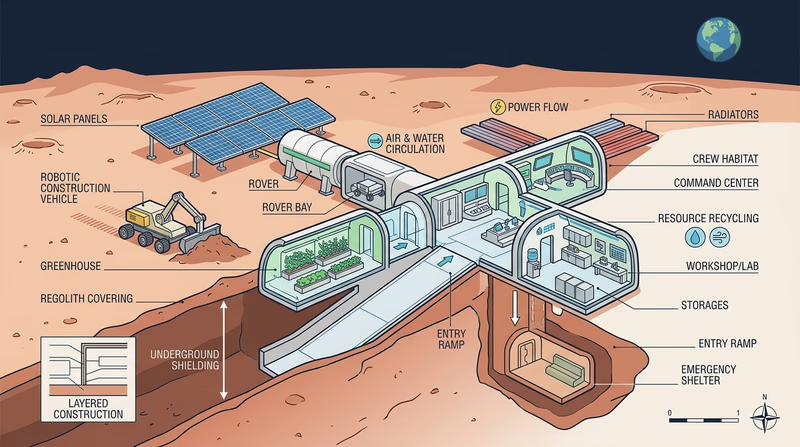
A good drawing or model should make your choices visible. Label major systems so your counselor can see how the base solves the problems of that location.
Req 8 — Your Future in Space
The space field is much bigger than astronauts. Most people who make missions possible never leave Earth. Your goal here is to choose one career, research it carefully, and then explain both the practical facts and your personal reaction to it.
Good careers to explore
You could look at jobs such as aerospace engineer, astrophysicist, roboticist, planetary geologist, satellite systems technician, flight controller, software engineer, mission planner, machinist, spacesuit designer, or science communicator.
What to research
Career research checklist
Bring this information to your counselor discussion- Training and education: What courses, degrees, certificates, or military pathways are common?
- Costs: What might school, training, or certifications cost?
- Job prospects: Is the field growing, stable, or highly competitive?
- Salary: What does entry-level pay look like, and how can it change with experience?
- Job duties: What does the person actually do day to day?
- Career advancement: What higher roles or specializations can come later?
Best ways to gather information
An interview can be especially strong because it gives you real details that websites sometimes skip. If you know someone who works in engineering, aviation, science, software, manufacturing, education, or communications, ask whether their work overlaps with space systems. Space careers often connect to other industries too.
A library or internet search is also useful, especially if you compare several sources instead of trusting just one. Look for job descriptions, professional organizations, university programs, and government labor data.
Questions worth asking yourself
- Do I want hands-on work, research, coding, fieldwork, design, or public communication?
- Do I like long projects that may take years before launch?
- Would I rather build hardware, analyze data, or explain discoveries to others?
- Am I excited by teamwork under pressure?
This requirement has no official resource links, so the quality of your research notes and your discussion will matter most.
Extended Learning
Congratulations!
You have completed a badge built on some of the biggest questions humans can ask. If this subject grabbed your attention, that is a good sign — space exploration rewards people who stay curious, keep learning, and are willing to connect science with imagination.
Living in Microgravity
Space missions are not only about machines. They are also about what happens to people when gravity changes. In microgravity, muscles weaken faster, bones lose density, fluids shift upward, and even simple tasks like sleeping or eating have to be rethought.
That is one reason astronauts exercise so much on the ISS. Future Moon and Mars missions will depend on understanding how to keep crews healthy during long trips.
Space Weather and Radiation
A thunderstorm on Earth can ruin a campout. In space, radiation and solar storms can threaten electronics, communications, and human health. Beyond Earth’s magnetic field, crews have less natural protection, so spacecraft and habitats need shielding and careful planning.
This is one of the biggest reasons deep-space travel is hard. The challenge is not only distance. It is staying healthy while exposed to a harsher environment for a long time.
Mining, Fuel, and Space Resources
Some future missions may depend on using local resources instead of carrying everything from Earth. Ice on the Moon or Mars could become water, oxygen, or rocket fuel. Local rock and dust might become building material.
This idea is called in-situ resource utilization, often shortened to ISRU. If explorers can make supplies where they land, missions can last longer and cost less to support.
Telescopes as Time Machines
When telescopes look deep into space, they also look back in time because light takes time to travel. That means observatories such as Hubble and the James Webb Space Telescope are not just taking pretty pictures. They are helping scientists study galaxies, stars, and planets as they were long ago.
Real-World Experiences
Visit a planetarium or science museum
Watch a real launch stream
Join a model rocketry launch day
Attend a public star party
Organizations
The main U.S. civil space agency, with mission updates, educational resources, images, videos, and career paths across science and engineering.
Organization: NASA — https://www.nasa.gov/
Leads many robotic planetary missions and shares excellent mission explainers, engineering stories, and image galleries.
Organization: Jet Propulsion Laboratory (JPL) — https://www.jpl.nasa.gov/
A major international partner in space science, astronomy, Earth observation, and planetary exploration.
Organization: European Space Agency (ESA) — https://www.esa.int/
Offers model rocketry safety guidance, clubs, launches, contests, and resources for people who want to keep flying rockets.
Organization: National Association of Rocketry (NAR) — https://www.nar.org/
Supports public engagement in space science and shares articles, advocacy, and mission explainers for curious learners.
Organization: The Planetary Society — https://www.planetary.org/