Req 1 — Why We Go
This requirement covers four big ideas: where the drive to explore came from, what scientists want to learn right away, how space work helps people on Earth, and why many missions depend on countries working together. If you can explain all four clearly, you are no longer just naming space facts — you are explaining why space exploration matters.
Requirement 1a
Historical reasons for space exploration
People first wanted to explore space for the same reason they crossed oceans and climbed mountains: they wanted to know what was out there. Curiosity is a real historical force. Humans tracked stars for navigation, calendars, and religion long before rockets existed, so once technology caught up, reaching space became the next great frontier.
Another historical reason was competition. During the Cold War, the Soviet Union and the United States both wanted to prove that their science, industry, and political systems were stronger. That pressure helped drive early launches, the first human spaceflights, and the race to the Moon. This competition was not always peaceful in its motives, but it pushed technology forward very quickly.
A third reason was national pride. Countries saw space success as proof that they could solve enormous technical problems. Being first to orbit Earth, send a human into space, or land on the Moon became symbols of power and prestige.
🎬 Video: The History of Space Exploration (video) — https://youtu.be/TL__l9gC1Ss?si=BXoLcRCoNZXPEALe
🎬 Video: The History of Space Exploration: A Timeline (video) — https://youtu.be/3JuKR7jf46o
Requirement 1b
Immediate goals in terms of specific knowledge
When scientists launch a mission, they usually have very specific questions they want answered. They may want to measure the atmosphere of a planet, map the surface of an asteroid, test how a new engine performs, or learn whether water ice is present in a certain region. Those are immediate goals because they focus on knowledge a mission can gather now, not a vague dream for the future.
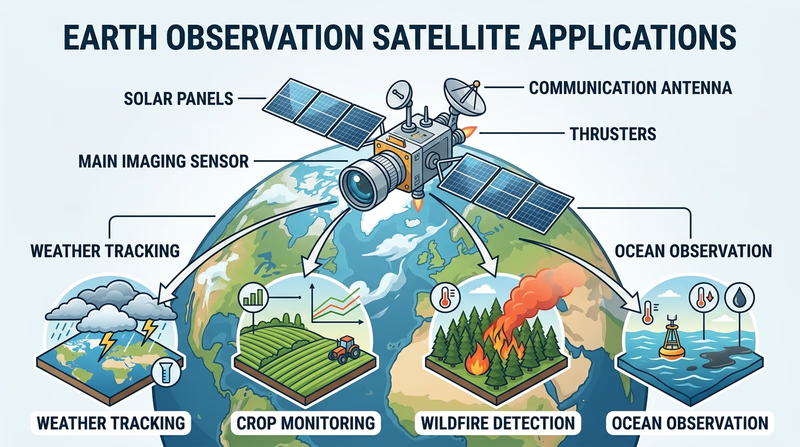
A good way to explain this is to start with the question and then match the mission. If a rover goes to Mars, one immediate goal might be learning what rocks are made of or whether the environment once supported microbial life. If a satellite studies Earth, one immediate goal might be measuring storms, fires, ocean temperatures, or changing ice sheets.
How to explain an immediate goal
Use this simple pattern when you talk with your counselor
- Question: What does the mission want to find out?
- Tool: What spacecraft, instrument, or experiment is being used?
- Evidence: What data will the mission collect?
- Meaning: How will that data help scientists understand a place or process better?
Requirement 1c
Benefits related to Earth resources, technology, and new products
Space exploration helps Earth in two major ways. First, satellites help us manage real resources here at home. They track forests, crops, water supplies, sea ice, wildfires, storms, and pollution. That makes space work useful to farmers, firefighters, meteorologists, shipping companies, scientists, and emergency planners.
Second, building spacecraft leads to new tools and improved products. Engineers designing for space need equipment that is lighter, tougher, smaller, and more reliable. That work can lead to better sensors, water filters, solar panels, medical tools, insulation, communication systems, and materials used in everyday products.
The key idea is that space exploration is not separate from life on Earth. It often creates practical benefits because hard engineering problems force people to invent better solutions.
🎬 Video: How Space Benefits Earth (video) — https://youtube.com/shorts/i3D4pCq_lyg?si=S_3HJWJ9TrvcHvry
🎬 Video: Space Exploration, Is It Really Worth It? Yes. (video) — https://youtube.com/shorts/jPuqA136SfA?si=EgcAXSXcMBJmVLw4
🎬 Video: 10 Surprising Ways Space Exploration Benefits Life on Earth (video) — https://youtube.com/shorts/_2uSv1C-FDw?si=JCFVs8xAXqeJvozN
Requirement 1d
International relations and cooperation
Space is too expensive, too technical, and too ambitious for most nations to tackle alone all the time. That is why many missions depend on international cooperation. Countries share launch sites, astronauts, instruments, science teams, tracking stations, and funding.
The International Space Station is one of the best examples. It was built and operated by multiple space agencies, including NASA, Roscosmos, ESA, JAXA, and CSA. That kind of partnership helps spread cost and expertise, but it also builds trust. Nations that work together on difficult missions practice solving problems together.
International cooperation also means science becomes stronger. A mission may use a camera from one country, an orbiter from another, and a communications network run by a third partner. When the data returns, scientists around the world can study it.
🎬 Video: What Role Does International Cooperation Play in Space Exploration? (video) — https://youtu.be/TS27Br2-XgY?si=W1CeXgcrzOZ-Trgm
By the time you finish this requirement, you should be able to explain space exploration as a mix of history, science, practical benefits, and teamwork — not just as a list of famous launches.