Req 4 — Rockets, Orbits, and Images
This requirement turns model rocketry into real space science. You need to connect a few core ideas: thrust comes from action and reaction, engines create that thrust, satellites stay up because they are falling around Earth instead of straight down, and images from space only become useful when spacecraft can collect and send data back home.
Requirement 4a
Action-reaction is Newton’s third law of motion. If one object pushes on another, the second object pushes back with an equal and opposite force. In rocketry, hot gas shoots out the back of the engine, and the rocket is pushed forward.
A great demonstration is an inflated balloon released without tying it closed. Air rushes out one end, and the balloon shoots the other way. The escaping gas is the action. The balloon moving forward is the reaction.
Newton's Law of Motion (website) NASA's beginner-friendly explanation of the motion laws behind thrust and flight. Link: Newton's Law of Motion (website) — https://www1.grc.nasa.gov/beginners-guide-to-aeronautics/newtons-laws-of-motion/Requirement 4b
Rocket engines carry both fuel and oxidizer, which is one reason rockets can work in space where there is no air to support burning. In a chemical rocket, the propellants react and create very hot gas. That gas expands rapidly and escapes through a nozzle, producing thrust.
Different engines use different fuels and designs, but the basic story stays the same: store energy, control the burn, and direct the exhaust so the spacecraft moves in the opposite direction.
How Rocket Engines Work (website) A step-by-step explanation of fuel, combustion, exhaust, and thrust. Link: How Rocket Engines Work (website) — https://science.howstuffworks.com/rocket.htm🎬 Video: Rocket Engines Explained (website) — https://youtu.be/gz8L1i0ODeA
Requirement 4c
Satellites do not stay up because there is no gravity. They stay in orbit because gravity is constantly pulling them downward while they are moving sideways fast enough to keep missing Earth.
Imagine throwing a ball. If you throw it softly, it lands nearby. Throw it harder, and it goes farther before hitting the ground. A satellite moves so fast sideways that as it falls, Earth’s curved surface drops away beneath it. That is orbit.
🎬 Video: How Do Satellites Get & Stay in Orbit? (video) — https://youtu.be/IC1JQu9xGHQ?si=qcvDJm44-la-3nsI
🎬 Video: How Satellites Orbit (video) — https://youtu.be/5PCY0rTllPg?si=gNhEm9nAfygodC3Q
Requirement 4d
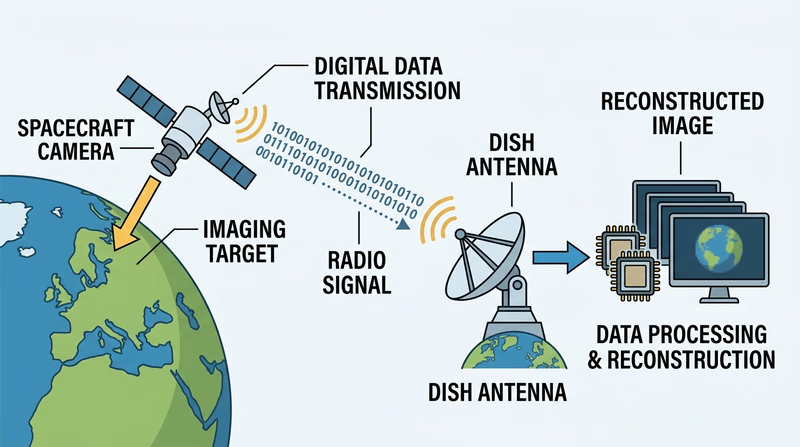
Space images begin with sensors. Some cameras collect visible light like your eyes do. Others detect infrared heat, ultraviolet light, radar reflections, or other wavelengths humans cannot see directly. The spacecraft stores those measurements as digital data.
Next, the data must be sent to Earth. The spacecraft uses antennas and radio signals to transmit the information to ground stations. Computers on Earth turn those numbers into pictures scientists and the public can use.
Not every space image is a simple snapshot. Some are built from many narrow strips scanned over time. Others use colors added later to highlight materials, temperature, or cloud patterns. That means a space picture is both a measurement and a visual tool.
If you can explain this page clearly, you can connect the three biggest parts of spaceflight: force gets a spacecraft moving, orbit keeps it where it needs to be, and communications bring the science back.