Req 5c — Design a Sample Return
Sample-return missions are some of the hardest robotic missions ever attempted. A spacecraft has to travel to another world, arrive safely, collect material without contaminating it, launch or depart again, and then get the sample home in one piece. That means your design should solve a chain of problems, not just draw a cool spacecraft.
Start with the destination
Your first choice controls almost everything else. A mission to an asteroid deals with tiny gravity and loose rubble. A mission to Mars deals with dust, cold temperatures, and the challenge of launching back off another planet. A mission to a comet may face fast motion, weak gravity, and fragile icy material.
Build around the environment
Questions your design must answer
Use the environment to drive the spacecraft design
- How will it land or make contact? Gravity, terrain, and atmosphere all matter.
- How will it collect the sample? Scoop, drill, core tube, sticky pad, or another method?
- How will it protect the sample? Keep it sealed, labeled, and uncontaminated.
- How will it get home? Return capsule, ascent stage, or rendezvous plan?
- How will it survive local conditions? Temperature, dust, radiation, weak sunlight, or rough terrain?
Think like a systems engineer
A strong answer explains why the mission choices fit the destination. If you choose Europa, you need to explain radiation and extreme cold. If you choose an asteroid, you need to explain how the spacecraft will anchor or hover without bouncing away. If you choose Titan, you need to consider thick atmosphere, cold temperatures, and long travel time.
A simple mission structure
One useful pattern is:
- Launch from Earth
- Cruise through space
- Arrive and survey the target
- Collect the sample
- Store and seal it
- Return it to Earth
- Recover the capsule safely
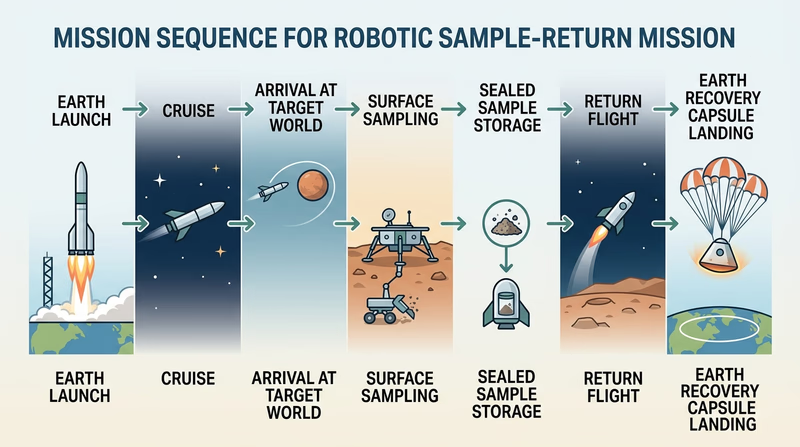
This option has no official requirement-level links, so your best evidence is a clear diagram or model plus a strong explanation of how the environment shaped your design.