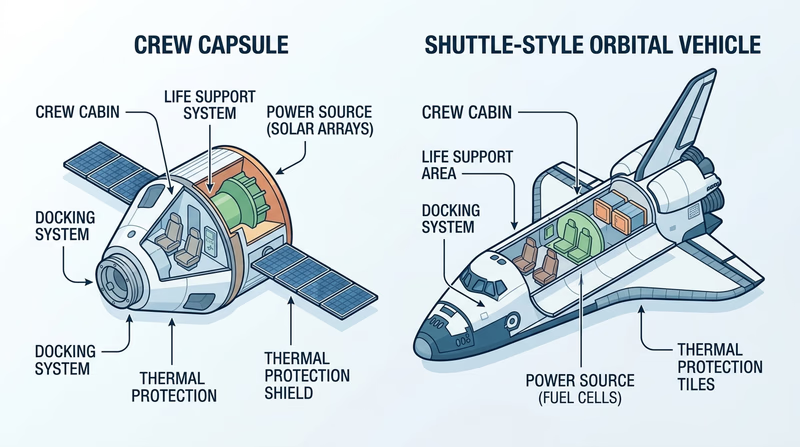
Req 6a — Crewed Orbital Vehicles
This page asks you to describe three things about a crewed orbital vehicle: its purpose, how it operates, and its major components. A strong answer should show how all three connect. The vehicle exists to carry people and cargo safely, it operates through launch-orbit-reentry stages, and each major component supports one of those stages.
Purpose
A crewed orbital vehicle is built to transport humans to orbit, keep them alive there for a period of time, and return them safely to Earth. Some vehicles are reusable spaceplanes, like the Space Shuttle orbiter. Others are capsules, like Soyuz or Crew Dragon.
Operation
Most crewed orbital vehicles work in stages:
- Launch — Rockets lift the vehicle through the atmosphere.
- Orbit — The spacecraft separates, uses onboard systems, and supports the crew.
- Return — The vehicle reenters the atmosphere and lands or splashes down.
A shuttle-style vehicle and a capsule do this differently, but both must manage power, air, navigation, communications, heat protection, and safe recovery.
Components to explain
Key components to notice
Choose examples from the vehicle you study
- Crew cabin: Where astronauts live and work.
- Life-support systems: Air, temperature control, water, and waste handling.
- Guidance and navigation: Computers, sensors, and control systems.
- Power source: Batteries, solar panels, or fuel cells.
- Thermal protection: Heat shield tiles, ablative shield, or other systems for reentry.
- Docking or cargo systems: Hardware for meeting stations or carrying equipment.
🎬 Video: First Space Shuttle (video) — https://youtu.be/9zu6gReRV98
🎬 Video: How the Space Shuttle Worked (video) — https://www.youtube.com/watch?v=w4FCkbPykdQ
🎬 Video: NASA SpaceX Crew Dragon Launch (video) — https://youtu.be/1gmvUPTdoP4
🎬 Video: Soyuz (video) — https://youtu.be/_v7YgDum2Sg
Good examples to compare
- Space Shuttle: Reusable orbiter that launched like a rocket and landed like a glider.
- Soyuz: Tough capsule system with long service history.
- Crew Dragon: Modern commercial capsule with digital systems and autonomous docking.
- Orion on Artemis II: NASA’s first crewed Artemis mission, a four-astronaut lunar flyby using the Orion spacecraft to test deep-space life support, navigation, communications, and reentry before later lunar landing missions.
Artemis II is especially useful for this requirement because it is a current example of a crewed vehicle built for missions beyond low Earth orbit. Unlike the Shuttle, Soyuz, or Crew Dragon, Orion is designed for deep-space travel around the Moon rather than short trips to and from Earth orbit.