Req 7 — Design a Space Base
This is a hybrid requirement because the main task is already substantial before you ever reach the lettered parts. You are designing a real habitat concept, and the four subrequirements are the four systems every successful base needs: energy, construction, life support, and a clear purpose.
Choose your location first. A base on the Moon, Mars, Titan, or an asteroid should not all look the same, because those environments are wildly different.
🎬 Video: How NASA Will Build a City on the Moon (video) — https://youtu.be/ATgwz_hS3Qg
Requirement 7a
Source of energy
Every base needs dependable power for lights, computers, heating, cooling, communications, science equipment, and life support. Your energy choice should match the location. Solar power may work well on the Moon in some places, but it becomes harder far from the Sun or during long periods of darkness. A base might need batteries, fuel cells, nuclear systems, or a combination.
You Can't Take It All With You (PDF) A NASA activity that helps you think through limited cargo space, power, and tradeoffs when planning what a mission must bring. Link: You Can't Take It All With You (PDF) — https://www.nasa.gov/wp-content/uploads/2023/05/you-cant-take-it-all-with-you-grades-6-12-students-tagged.pdfRequirement 7b
How it will be constructed
Construction in space rarely begins with humans carrying boards and tools out of a truck. Your plan might use robots first, inflatable modules, 3-D printing with local soil or rock, or prefabricated sections launched from Earth. The harder the environment, the more useful remote construction becomes before a crew arrives.
🎬 Video: How NASA Plans to Build the First Moon Base (video) — https://youtu.be/ajP0AlYxhug?si=lKaqYRoM8V4LiXSg
Requirement 7c
Life-support system
Life support keeps people alive by managing air, water, temperature, food systems, waste, and pressure. A good design should recycle as much as possible because resupply missions are expensive and slow. That means your base may reuse water, scrub carbon dioxide from the air, and protect people from radiation and extreme temperatures.
🎬 Video: Robots Building a Mars Base (video) — https://youtu.be/2tr6rJrv8hs?si=dm1LYgNqLCH7smpr
Requirement 7d
Purpose and function
A base should exist for a reason bigger than “because it is cool.” Maybe it studies geology, searches for signs of past life, mines water ice, serves as a refueling stop, tests long-term habitation, or supports exploration farther into space. Its purpose should shape every design choice.
If the base is mainly for science, you may need labs and sample storage. If it is a staging site, you may need fuel systems, cargo space, and vehicle maintenance areas. If it is a long-term habitat, you need exercise space, medical support, and room for crews to live well, not just survive.
🎬 Video: How Robots Will Build on Mars (video) — https://youtu.be/ZbOg_cC1_Eo
Pulling the whole design together
Before you present your base
Make sure the four parts support each other
- Location: Why did you choose that world?
- Energy: How does the base stay powered day after day?
- Construction: How does it get built without wasting mass and time?
- Life support: How are people kept alive and healthy?
- Purpose: What work makes the base worth building?
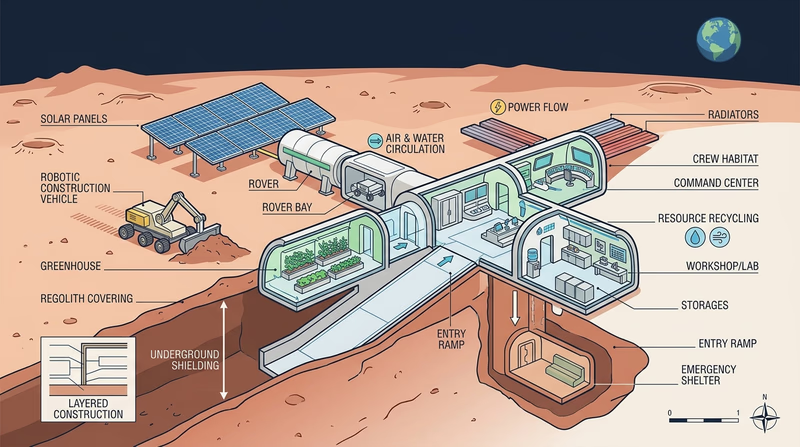
A good drawing or model should make your choices visible. Label major systems so your counselor can see how the base solves the problems of that location.