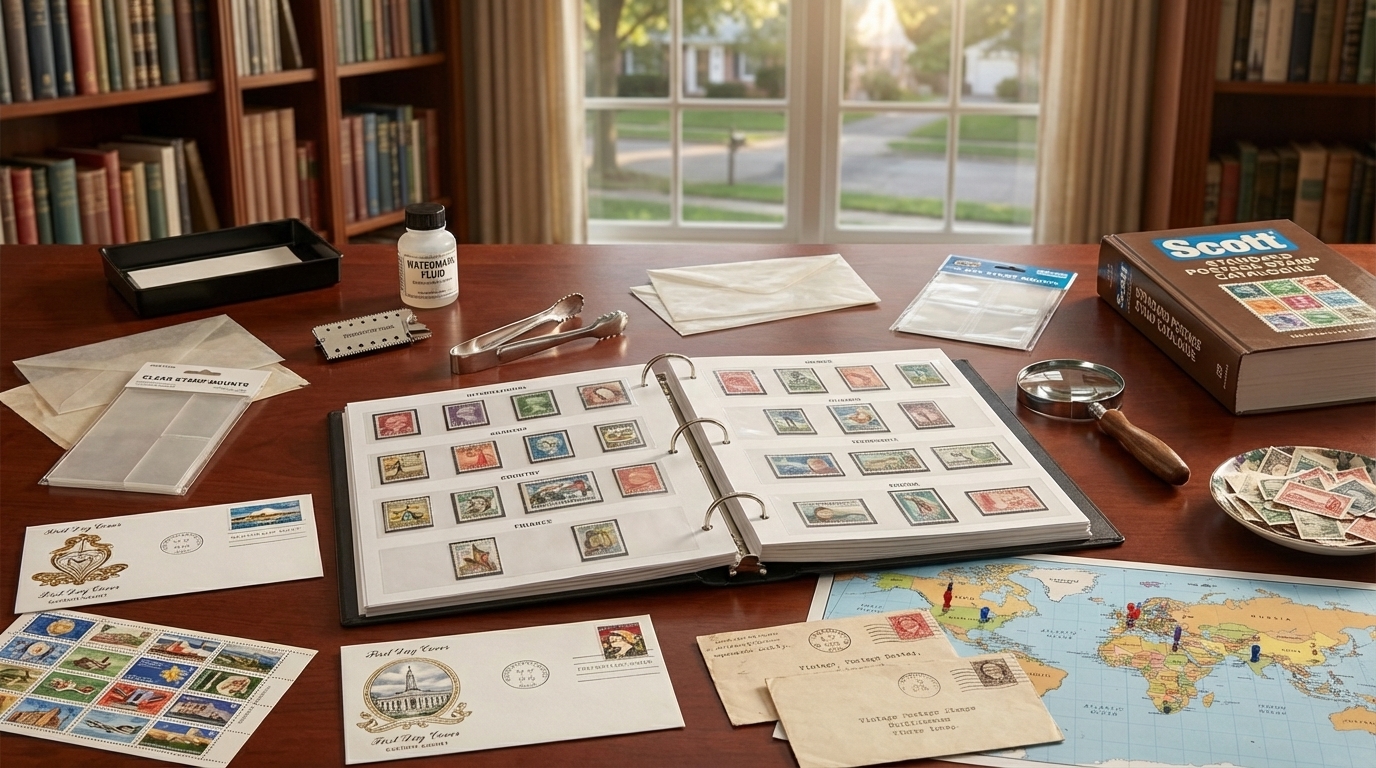
Stamp Collecting Merit Badge — Complete Digital Resource Guide
https://merit-badge.university/merit-badges/stamp-collecting/guide/
Introduction & Overview
A postage stamp is a tiny piece of paper, but it can open a giant window into the world. One stamp might show a famous explorer, a national bird, a scientific discovery, or a country’s biggest celebration. When you collect stamps, you are not just gathering paper — you are learning how people tell their stories.
Stamp collecting, also called philately, rewards careful eyes and curious minds. It mixes history, art, geography, design, research, and detective work. This badge helps you see why stamps matter, how collections are built, and how to turn everyday mail into a collection with meaning.
Then and Now
Then
Modern postage stamps began in 1840 with Great Britain’s Penny Black, the first adhesive postage stamp used nationwide. Before that, mailing letters could be confusing and expensive. Prepaid stamps made the system simpler, and countries around the world quickly adopted the idea.
As postal systems expanded, stamps became more than proof of payment. Governments used them to honor leaders, celebrate inventions, mark wars and victories, and show national symbols. Collectors soon realized that stamps could preserve history in miniature. Albums from the late 1800s and early 1900s became scrapbooks of world events.
Now
Today, many people send fewer letters than past generations, but stamps still matter. Postal services issue stamps for holidays, science, sports, wildlife, art, and major anniversaries. Collectors can also study postmarks, first day covers, printing methods, watermarks, and postal routes.
Modern collectors use both old and new tools. You might soak stamps from envelopes, compare them with a catalog, design your own album pages on a computer, or visit online communities to learn what to look for next. The hobby still teaches patience and observation, but it also connects you with a worldwide network of people who love history and design.
Get Ready!
If you like spotting details that other people miss, this badge will feel like a treasure hunt. You will compare tiny printing differences, notice clues in cancellations, and build a collection that says something about what interests you. Start with curiosity, take your time, and let each stamp lead you to another question.
Kinds of Stamp Collecting
Country Collections
Some collectors focus on one country or a closely related group of countries. This approach helps you see how a nation’s art, leaders, and postal system changed over time. It is a good fit if you like orderly albums and want to go deep instead of wide.
Topical Collections
A topical collection is built around a subject shown on the stamp rather than the country that issued it. That subject might be Scouting, birds, space, ships, sports, trains, insects, or famous people. Topical collecting is flexible because you can combine stamps from many places into one story.
Postal History Collections
Postal history collectors care about how the mail moved. They study envelopes, cancellations, rates, routes, wartime mail, and special markings. This style feels a little like being a detective because the envelope itself holds clues.
First Day Covers and Cachets
Some collectors save envelopes canceled on the first official day a new stamp goes on sale. These first day covers often include a cachet, which is artwork or text printed on the envelope to match the event or theme. This style blends stamp collecting with design and storytelling.
Specialized Collecting
Specialists zoom in on details such as perforations, paper types, gum, watermarks, printing methods, or plate blocks. Two stamps that look almost the same at first glance can turn out to be different issues with different values. Specialized collecting is where magnifiers, gauges, and careful note-taking really matter.
Now that you know why the hobby lasts a lifetime, it is time to see how stamps can teach you about the world around you.
Req 1 — Why Stamps Matter
This requirement answers the question every new collector eventually asks: why save stamps at all? These two parts show how stamps can teach you about the world and how the postal system grew into a huge public service.
- Req 1a helps you explain what stamps reveal about people, places, institutions, history, and geography.
- Req 1b helps you connect collecting to the real-world history of the United States mail and compare it with other countries.
🎬 Video: Stamp Collecting (video) — https://youtu.be/Bu6vw5qlO3M?si=2ly00w2ou8AHx4LO
Requirement 1a
A good stamp collection is like a shelf of tiny history books. One stamp might honor a scientist, another might show a mountain range, and another might celebrate a national holiday. When you study why a country chose those images, you learn what matters to the people who live there.
People
Stamps often feature inventors, athletes, artists, explorers, political leaders, and humanitarians. If you collect stamps showing famous people, you naturally start asking questions: Who was this person? Why were they important? What did they change? That turns stamp collecting into biography study.
Places
Many stamps highlight cities, rivers, monuments, wildlife refuges, or famous landscapes. A stamp from Peru might show Machu Picchu. One from Kenya might show elephants on the savanna. A stamp from the United States might feature a national park. Each one gives you a reason to look at maps and learn where those places are.
Institutions
Postal services, space agencies, courts, museums, Olympic committees, and charities all appear on stamps. These images help you understand how institutions work and what jobs they do. A stamp celebrating the Red Cross or the United Nations can lead to a discussion about international aid and cooperation.
History
Stamps often mark wars, independence days, scientific breakthroughs, major anniversaries, and famous speeches. They show what events a country wants remembered. If you compare older and newer stamps, you can even see how a country’s priorities and identity changed over time.
Geography
Because stamps come from many countries, they invite you to notice continents, borders, climates, and natural resources. A tropical country may issue stamps showing coral reefs or rainforest birds. A northern country may highlight polar research or winter sports. Geography stops being just lines on a map and starts becoming connected to real life.
How a Stamp Teaches You Something
Use these prompts when you study any stamp- Who is shown? Identify the person, group, or symbol and ask why they were chosen.
- Where is it from? Find the issuing country on a map.
- What is happening? Look for clues about an event, tradition, invention, or place.
- Why now? Ask whether the stamp was issued for an anniversary, a current event, or a long-term national symbol.
🎬 Video: Stamp Collecting Is for Old People (Just Kidding) (video) — https://youtu.be/mp07V-_-lc0?si=qw61WgakvzvCy7sz
🎬 Video: Stamps: A World of Fun (video) — https://youtu.be/FRMsUTbLK4U?si=vFyVadEM1Zd9Ww75
Requirement 1b
The United States postal system grew along with the country itself. In the early years, mail moved slowly by horse, ship, and stagecoach. As roads improved and railroads expanded, the mail moved faster. Later came airmail, ZIP Codes, automated sorting, and the huge national network run today by the U.S. Postal Service.
A few milestones worth knowing
- Colonial and early national mail: Post riders connected scattered towns long before modern highways.
- 1847 U.S. postage stamps: The United States began issuing national adhesive postage stamps a few years after Britain’s Penny Black.
- Railway mail service: Sorting mail on trains helped speed delivery across long distances.
- Rural Free Delivery: Mail began reaching farms and small communities more reliably, not just city post offices.
- Airmail: Airplanes cut delivery times and opened new design themes for collectors.
- ZIP Codes and automation: Modern sorting systems made it possible to process huge amounts of mail quickly.
The U.S. system is unusual because it serves a very large country with a legal obligation to deliver to almost every address, including remote places. Some other countries are smaller, rely more heavily on private carriers for certain services, or use different pricing structures and delivery schedules. Postal systems also differ in language, stamp design styles, how often they issue commemoratives, and what kinds of special services they offer.
For example, one country may issue many stamps focused on royal events, while another may highlight wildlife or revolution anniversaries. Some countries use very frequent special cancellations or issue many souvenir sheets. Others issue fewer stamps each year.
🎬 Video: A Chaotic History of the US Postal Service | Illustrated U.S. History (video) — https://youtu.be/aZ9j5t25CaU?si=b2xn0FgNumDoiiNU
🎬 Video: History of US Mail - From the Beginning (video) — https://youtu.be/U8ioOqupzmo?si=UlX_1ztm7NDn3yyL
By now you can explain both why stamps matter and how the mail system behind them grew. Next, you will sort out the main ways collectors organize their albums.
Req 2 — Types of Collections
One of the first big choices in this hobby is deciding what kind of collection you want to build. Without a focus, a pile of stamps can feel random. With a focus, even a small group of stamps starts to tell a story.
A topical collection is built around a subject shown on the stamp rather than the country that issued it. The topic could be Scouting, space, birds, maps, sports, trains, holidays, medicine, or almost anything else. The fun of topical collecting is that you can pull stamps from many countries into one theme, which makes the collection feel creative and personal.
The merit badge also asks you to name and describe three other kinds of collections. Here are four strong examples, so you can choose the three you understand best when you talk with your counselor.
Four common collection styles
Country collection
This kind of collection focuses on one country, such as the United States, Canada, Japan, or Brazil. Some collectors narrow it even further to one time period or one set. Country collections are great for noticing changes in national history, design style, and postal policy over time.
Regional or related-country collection
Instead of just one country, some collectors group nearby or historically connected countries together. You might collect Nordic countries, Caribbean nations, or former British colonies. This approach helps you compare culture, language, and design across a region.
Postal history collection
Postal history collectors care about envelopes, routes, cancellations, rates, military mail, and how letters actually moved. The stamp matters, but so do the markings and the journey. This style feels like combining history class with detective work.
First day cover collection
A first day cover is an envelope with a stamp canceled on the stamp’s first official day of issue. Many first day covers also include a cachet, which is artwork or text printed on the envelope to match the stamp or event. This kind of collection works well if you enjoy commemorations and presentation.
Choosing a collecting style
Think through these questions before you start filling an album- What already interests you? Choose a topic or place you genuinely care about.
- How easy will it be to find material? Some topics are common and inexpensive. Others are harder to build.
- Do you want variety or depth? Topical collections often give variety. Country collections can go deeper.
- Do you like research or display? Postal history leans toward research. First day covers and topical pages often lean toward display.
If you can explain topical collecting clearly and describe three other styles, you are ready for the next step: learning the vocabulary collectors use to tell stamps apart.
Req 3 — Stamp Terms in Action
This page is your stamp collector’s vocabulary lab. You are not just memorizing words — you are learning to look at a stamp or envelope and notice the clues that collectors use to describe it correctly.
Bring real examples whenever you can. A real stamp, envelope, booklet pane, or piece of metered mail is much stronger than a definition spoken from memory.
🎬 Video: Beginner's Guide to Stamp Collecting - Key Terms (video) — https://youtu.be/Z4iqhT2yfN8?si=FuJGCx8crtaeEDeW
Requirement 3a
A perforated stamp has small holes punched between stamps so they can be separated neatly. An imperforate stamp was issued without those holes. Early stamps were often cut apart with scissors, so seeing whether a stamp has perforations is one of the fastest ways to classify it.
Look at the stamp’s edges. Tiny even holes usually mean perforated. Smooth cut edges all the way around usually mean imperforate.
🎬 Video: American Perforate and Imperforate Stamps (video) — https://youtu.be/H1xxRY_ysR8?si=sLQR28tpc50LtyTS
🎬 Video: A Quick History of US Imperforate Stamps (video) — https://youtu.be/FFr1VyNHG6g?si=X1ERB1Hg0TjshndA
Requirement 3b
A mint stamp has never been postally used. If it still has original gum on the back with no hinge disturbance, collectors may call it mint never hinged (MNH). A used stamp has been canceled or otherwise shows postal use.
This difference matters because mint and used examples often have different values and appeal to different collectors. Some collectors prefer the fresh look of mint stamps. Others like used stamps because the cancellation proves real postal service.
The Characteristics of Used Stamps Can Affect How You Collect (website) Linn's explains why used stamps vary so much in appearance and why those differences matter to collectors. Link: The Characteristics of Used Stamps Can Affect How You Collect (website) — https://www.linns.com/news/postal-updates-page/stamp-collecting-basics/2014/july/the-characteristics-of-used-stamps-can-affect-how-you-collect.htmlRequirement 3c
A sheet stamp comes from a large flat sheet sold in panes. A booklet stamp is cut and packaged in a booklet or folded pane for convenience. A coil stamp comes in a long roll, often used in vending machines or by businesses that mail a lot.
You can often tell them apart by the way the edges are perforated, by spacing, or by attached margin paper. Coil stamps especially may have straight edges on opposite sides because of how they were trimmed from the roll.
🎬 Video: America's First Airmail Coil Stamp (video) — https://youtu.be/W-ZrlWDJM_s?si=BL_EPOHtnbxHbzEl
Requirement 3d
Collectors pay attention to numbers and markings printed in the margin around stamps. A plate block includes part of the sheet margin with the plate number that identifies the printing plate. Booklets, coils, and other formats may have counting numbers, position numbers, or markings that help identify how the stamp was produced.
These details are useful because they prove where on the sheet the stamp came from and sometimes separate a common example from a more interesting one.
🎬 Video: First US Commemorative Stamp Booklet (video) — https://youtu.be/q16VF0GoEeM?si=Aqq-jz_Mw_EqLBt2
Requirement 3e
An overprint is extra text or a symbol printed on a stamp after the original design was made. A surcharge is an overprint that changes the stamp’s value. Postal services use overprints for new governments, special purposes, emergencies, or rate changes.
If you show an example, point out what was added later. The added printing is the clue, not the original stamp design underneath.
🎬 Video: Precancels, Overprints, and Occupations (video) — https://youtube.com/shorts/_aGpp0N9XaM?si=AQmz7Hwg5H9wwxka
🎬 Video: Overprints on Stamps (video) — https://youtube.com/shorts/nKd9o-eGp20?si=h_FRvsJTYIFug4RO
Requirement 3f
Metered mail uses a postage meter imprint instead of an adhesive stamp. Businesses, schools, and offices often use it for large amounts of outgoing mail. The printed mark shows postage paid, and it may include a town, date, slogan, or permit information.
This is a good example to collect from everyday envelopes at home because metered mail still appears regularly in business correspondence.
🎬 Video: What is Metered Mail? (video) — https://youtu.be/epE2ugDNbGE
Requirement 3g
These four categories tell you what job a stamp was made to do.
- Definitive stamps are everyday workhorse stamps, usually printed in large numbers and used for common postal rates over long periods.
- Commemorative stamps honor a person, event, place, or anniversary and are usually issued for a shorter time.
- Semipostal stamps include extra value beyond postage to support a cause.
- Airmail stamps were issued specifically for mail carried by air.
If you show examples, explain what features helped you sort them into these categories. The picture, printed value, wording, and issue purpose all give hints.
🎬 Video: A Crash Course on U.S. Stamp Categories (video) — https://youtu.be/qVZm1aZlcHI?si=dPrhFCKwEd8dRCrl
🎬 Video: A Quick History of US Definitive Stamps (video) — https://youtu.be/_4Gu-yHkFuw?si=B-7AJXgbNPMkuSYr
🎬 Video: A Quick History of US Commemorative Stamp (video) — https://youtu.be/Djn6erAUtfM?si=wyNHfk67Z09ktc8Z
🎬 Video: A Quick History of US Airmail Stamps (video) — https://youtu.be/yrc5yk1sbOU?si=2wKly428qLgu8WK7
Requirement 3h
A cancellation is the mark that prevents a stamp from being reused. A postmark usually includes the place and date where the item entered the mail. Sometimes the two are part of the same marking, but collectors still talk about their different purposes.
If you have a used stamp on cover, point out where the date and location appear and where the stamp was canceled.
🎬 Video: Postmarks and Cancels (video) — https://youtu.be/9i06SxrZ0tQ?si=l8SujsCw07O-5ymi
Requirement 3i
A first day cover is an envelope bearing a stamp canceled on the stamp’s first official day of sale. Many first day covers also include a cachet related to the stamp’s theme. Collectors like them because they tie together the stamp, the envelope, the cancellation, and the event.
The envelope itself is part of the collectible, so keep it flat and protected.
🎬 Video: Collecting Stamps On Cover (video) — https://youtu.be/7IHlZxJouGc?si=aC__tsUPMMKT9OOP
Requirement 3j
Postal stationery is mail material with postage already printed or embossed into it. An aerogramme is a lightweight folded letter sheet for airmail. A stamped envelope is an envelope with a stamp design already on it. A postal card is like a postcard with postage already included.
These items remind you that collectors do not study only loose stamps. They also study the many forms mail can take.
🎬 Video: 4 Helpful Stamp Collecting Tips for Beginners (video) — https://youtube.com/shorts/vdXeCjAFtng?si=4lDNQZtcCqOoyfgr
Best ways to prepare for your counselor
Make your examples easy to explain- Label each example with the term it matches.
- Bring at least one real item whenever possible instead of only describing it.
- Point to the evidence such as perforations, gum, cancellation marks, or printed indicia.
- Use sleeves or stock pages so you can show items without damaging them.
You can now speak the language of stamp collecting. Next, you will learn how collectors judge value and condition instead of guessing.
Req 4 — Catalogs and Condition
These two parts teach a lesson that every collector learns sooner or later: a stamp’s value is never just one number. You need a catalog to identify what you have, and you need careful observation to judge its condition.
Requirement 4a
A standard catalog helps you identify a stamp and gives a reference value. The Scott catalog is one common example in the United States. A listing can tell you the country, issue date, denomination, color, printing method, catalog number, and separate values for mint and used examples.
How to use a catalog
Start with the country that issued the stamp. Then compare your stamp’s design to the illustrations or descriptions in the catalog. If more than one listing seems possible, look for the clues the pamphlet points out: perforations, color, paper, or watermark.
On many catalog pages, you will also see information about printing method and listing style. That matters because two stamps that look almost alike may still be different issues.
Catalog demonstration steps
Use this order when you show your counselor how a catalog works- Identify the country that issued the stamp.
- Match the design to the correct listing or illustration.
- Check details such as denomination, perforations, watermark, or color.
- Read the listing for catalog number, printing method, and value information.
- Compare mint and used values if both are given.
The catalog value is a useful guide, but it is not the same as the price you will always pay. The pamphlet explains that catalog value is a retail figure reflecting recent selling prices, supply and demand, and market conditions. Common stamps often sell for less than catalog value.
Here are a few reasons catalog value and purchase price can differ:
- The stamp may have faults such as thin spots, tears, missing perforations, or hinge damage.
- The market may be full of common copies, which pushes prices down.
- A dealer may price material differently based on demand, location, or how quickly they want to sell it.
- The exact stamp may not match the higher-value listing if the perforations, paper, or watermark are different.
🎬 Video: What is Grading In Stamp Collecting? (video) — https://youtu.be/xlmqU1LOoAw?si=1uEac-awB-qJ8JjJ
🎬 Video: Stamp Collecting Basics - The Scott Catalogue: More Than Just Stamp Values (Pt 1) (video) — https://youtu.be/fjnm2Val5UQ?si=C_AUKlkD-vV9Nir3
🎬 Video: Stamp Collecting Basics - The Scott Catalogue: Reading Stamp Listings (Pt 2) (video) — https://youtu.be/_-m6ctmETJ8?si=6DamNPvgEw7dmThC
Requirement 4b
In stamp collecting, condition means the physical quality of the stamp. Condition is one of the biggest factors in value. Two copies of the same stamp can be worth very different amounts if one is clean and well centered and the other is damaged.
The pamphlet separates grade from condition. Grade is about centering: how evenly the design sits inside the margins. Condition includes other physical traits such as gum, tears, creases, pinholes, color quality, and missing perforations.
Things to inspect
- Centering: Is the design evenly placed, or does it crowd one side?
- Perforations: Are they complete, or are some missing or cut into the design?
- Gum: On a mint stamp, is the original gum intact, regummed, lightly hinged, or heavily hinged?
- Surface and paper: Look for tears, thin spots, creases, stains, or pinholes.
- Color and freshness: A faded or toned stamp usually has less appeal than a bright, clean one.
The pamphlet lists terms like original gum, regummed, no gum, never hinged, lightly hinged, and heavily hinged. Those details matter because collectors often pay more for cleaner, less disturbed examples.
🎬 Video: Stamp Collecting Basics - The Scott Catalogue (video) — https://youtu.be/fjnm2Val5UQ?si=C_AUKlkD-vV9Nir3
Once you can use a catalog and judge condition, you are ready for the tools that help collectors handle stamps safely and identify fine details.
Req 5 — Choosing Your Tools
You must choose exactly 3 options from this requirement. This overview page helps you pick tools that match the kinds of stamps and projects you expect to handle most often.
Your Options
- Req 5a — Using Stamp Tongs: Learn the safest everyday way to pick up stamps without bending corners or leaving skin oils on them.
- Req 5b — Soaking With Water and a Tray: Remove paper from used stamps and prepare them for drying and storage.
- Req 5c — Inspecting With Magnifiers: Spot fine details, flaws, and printing clues that your eyes may miss.
- Req 5d — Hinges and Mounts: Compare two common methods for attaching stamps to album pages.
- Req 5e — Measuring With a Perforation Gauge: Measure perforations so you can tell similar-looking issues apart.
- Req 5f — Safe Storage Sleeves: Use glassines and sleeves to store loose stamps and covers without damage.
- Req 5g — Finding Watermarks: Reveal hidden paper marks that can identify the exact stamp issue.
How to Choose
Choosing your three tools
Think about what kind of collecting you plan to do most- Best beginner foundation: Tongs, magnifiers, and storage sleeves are useful almost every day.
- Best for used stamps from mail: Water and tray, tongs, and storage sleeves help with safe removal and sorting.
- Best for identifying tricky stamps: Magnifiers, perforation gauge, and watermark fluid help you separate similar issues.
- Best for building albums: Hinges and mounts, tongs, and magnifiers help you present stamps neatly and safely.
- What you’ll gain: Some tools help with handling, some with identification, and some with presentation. Pick a mix that shows more than one skill.
Once you pick your three tools, start with stamp tongs. They are one of the most basic habits of careful collecting.
Req 5a — Using Stamp Tongs
Stamp tongs are tweezers made for collectors. They let you pick up a stamp without touching it with your fingers, which helps prevent bent corners, skin oil stains, and accidental tears.
Why tongs matter
Even clean hands leave natural oils behind. On mint stamps, that can damage gum. On fragile used stamps, squeezing too hard with fingers can crease the paper. Tongs give you control without direct contact.
How to demonstrate them
- Place a stamp on a flat clean surface.
- Hold the tongs lightly, not like pliers.
- Grip the stamp gently near the edge, not across the whole design.
- Lift and move it to a stock page, album page, or sorting tray.
- Set it down without scraping or pressing hard.
🎬 Video: Stamp Collecting Tools Ep3 - Top 3 Everyday Use Tools for the Philatelist (video) — https://www.youtube.com/watch?v=d-Id1hb4F3I
🎬 Video: Stamp Collecting Tools - Talking Tongs - Best Practices & Features of Tongs for Philatelic Use (video) — https://youtu.be/NWD7JyRKXj0?si=mACiqtjaYKMdNC5C
By mastering tongs, you show one of the most important collector habits: handling stamps with care from the very start.
Req 5b — Soaking With Water and a Tray
Collectors use water and a tray to remove many used stamps from envelope paper. This is a practical skill because stamps are often easiest to save straight from everyday mail.
What the tool does
The tray holds clean water while the paper softens. After a short soak, the stamp may slide free from the envelope paper. Then it can be dried flat for storage.
How to demonstrate it
- Cut the envelope paper around the used stamp, leaving space around it.
- Put the piece face up in a tray of clean lukewarm water.
- Wait until the stamp loosens from the backing paper.
- Lift the stamp out gently with tongs.
- Place it face down on a clean drying surface, then press it flat between blotting paper or clean absorbent sheets.
Not every stamp should be soaked. Some self-adhesive stamps, colored envelopes, or fragile covers need different treatment. That is why careful collectors test before they rush.
🎬 Video: How to Soak Postage Stamps off Paper (video) — https://youtu.be/xbdFwdo7gW8?si=GiMrdGKX3twCE_rl
This tool shows that collectors do more than buy stamps. They rescue usable material from the mail stream and prepare it carefully for an album.
Req 5c — Inspecting With Magnifiers
A magnifier helps you see the tiny details that often decide what a stamp is worth and how it should be identified. Without magnification, you can miss damaged perforations, small tears, color differences, printing dots, or faint overprints.
What to look for
Use a magnifier to inspect:
- centering and margins
- missing or clipped perforations
- gum disturbances on the back
- small creases or thin spots
- fine lines in engraved printing
- faint postmarks or overprints
A hand lens with moderate magnification is often enough for everyday use. The goal is not to make the stamp look gigantic. The goal is to make the important details clear.
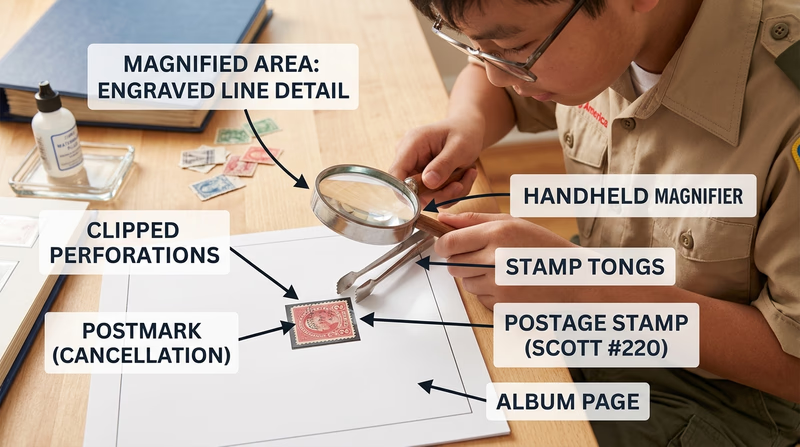
Magnifiers are especially helpful when you pair them with what you learned in Req 4. Catalog work and condition checks become much more reliable when you can actually see the clues.
This tool proves that good collecting depends on observation, not guessing.
🎬 Video: Stamp Collecting Tools Ep3 - Top 3 Everyday Use Tools for the Philatelist (video) — https://www.youtube.com/watch?v=d-Id1hb4F3I
Req 5d — Hinges and Mounts
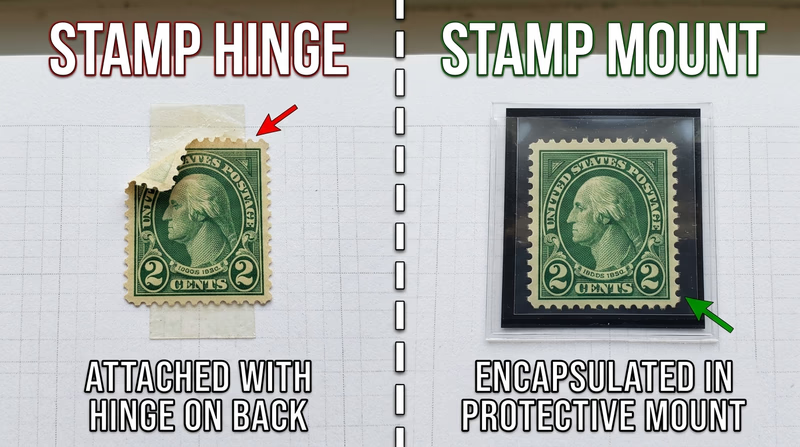
Hinges and mounts both attach stamps to album pages, but they do it in different ways. Knowing when to use each one shows that you understand both presentation and preservation.
Hinges
A hinge is a small folded strip of gummed paper. One part sticks lightly to the back of the stamp, and the other part sticks to the album page. Hinges are inexpensive and work well for many used stamps.
Mounts
A mount is a clear protective sleeve that holds the stamp without sticking directly to the front or back. Many collectors prefer mounts for mint stamps, valuable stamps, or stamps with delicate gum because mounts offer better protection.
How to compare them
- Cost: Hinges are cheaper.
- Protection: Mounts protect better.
- Best use: Hinges often suit ordinary used stamps. Mounts often suit mint or higher-value material.
- Appearance: Mounts give a clean, framed display on album pages.
🎬 Video: How to Trim Self-Adhesive Stamps for Mounts (video) — https://youtu.be/_HT-sU7NHdI?si=X14V2fIh0yn2ndZd
After this tool, you will move from handling and storage to measurement.
Req 5e — Measuring With a Perforation Gauge
A perforation gauge measures the number of perforation holes within a set distance. The merit badge pamphlet explains that collectors use it to tell apart stamps that may look alike but were issued with different perforation styles.
Why this tool matters
A stamp’s design alone is not always enough to identify it. Two issues might have the same picture and denomination, but one has a different perforation measurement. That difference can change the catalog listing and the value.
How to demonstrate it
- Place the stamp along the printed measurement lines on the gauge.
- Slide it until the perforation holes line up with one set exactly.
- Read the matching measurement.
- Compare that number with the catalog listing.
The key is patience. If the holes do not line up cleanly, keep checking. Close is not good enough for identification.
🎬 Video: How to Use a Perforation Gauge (video) — https://youtu.be/4hsQRQnEKqw?si=KuygYUWGMtP_szqj
This tool connects directly to Req 4, where catalog listings depend on details like perforations, paper, and watermark.
Req 5f — Safe Storage Sleeves
Collectors need safe temporary storage, not just display pages. Glassine envelopes and cover sleeves help protect stamps and covers while you sort, transport, or organize them.
Glassine envelopes
A glassine envelope is a smooth translucent paper envelope used to hold loose stamps. It is useful for sorting duplicates, keeping packets separated by country or topic, and moving stamps without direct handling.
Cover sleeves
A cover sleeve is a clear protective holder for envelopes, first day covers, and other full postal items. It keeps edges from bending and protects markings, cachets, and stamps from wear.
When to use them
- after sorting mail for later study
- while carrying material to a meeting or merit badge session
- when storing first day covers flat and clean
- when separating stamps by country, topic, or catalog work in progress
Storage tools may not seem dramatic, but they help keep the rest of your work neat, safe, and organized.
Req 5g — Finding Watermarks
A watermark is a design pressed into stamp paper during manufacturing. Sometimes it is invisible until you use a watermark detector dish and watermark fluid. The merit badge pamphlet explains that this hidden mark can help identify the exact stamp issue.
What the tool does
The stamp is placed in a dark tray or dish, and a small amount of watermark fluid is used to make the paper’s hidden design easier to see. The watermark may appear as lighter or darker shapes for a moment.
Why collectors use it
Some stamps look identical on the front but have different watermarks. If the catalog lists more than one possibility, the watermark can help you choose the correct entry.
🎬 Video: How to Find Watermarks on Stamps (video) — https://youtu.be/Ury0mawE7m4?si=ctCOkAPh6V_GB22X
You have finished the tools section. Next, you will use those skills to mount stamps in an album and protect a collection for the long term.
Req 6 — Mounting and Protecting a Collection
This requirement moves from collecting individual items to building a collection that looks organized and stays safe over time. One part is about how you mount and present material. The other is about how you protect it from the enemies every collector worries about: moisture, sunlight, rough handling, and poor storage.
🎬 Video: How Do You Mount Your Stamps in an Album (video) — https://www.youtube.com/watch?v=WvQGoi62i9U
Requirement 6a
An album does two jobs at once: it organizes your collection and protects it. A good album page lets your counselor see that the stamps belong together and that you know how to handle them properly.
If you use hinges, show how a stamp is lightly attached to the page. If you use mounts, show how the stamp slides into the protective strip. Either way, the goal is a neat page with stamps aligned, labels readable, and no crowding.
What makes a strong album page
- the stamps fit a clear topic, country, or time period
- the page is uncluttered and easy to read
- the stamps are mounted straight and safely
- labels or notes help explain what the viewer is seeing
🎬 Video: How to Trim Self-Adhesive Stamps for Mounts (video) — https://youtu.be/_HT-sU7NHdI?si=X14V2fIh0yn2ndZd
Requirement 6b
Collectors preserve stamps by controlling the environment and reducing handling damage. Here are more than three good methods to explain to your counselor.
1. Keep them dry and clean
Moisture can wrinkle paper, encourage mold, and damage gum. Keep albums and covers in a dry place away from spills, damp basements, and bathrooms.
2. Protect them from sunlight
Direct sunlight can fade colors over time. Display pages where they will not sit in bright sun for long periods.
3. Handle them with tools, not fingers
Use tongs instead of bare fingers whenever possible. Skin oils and pressure can damage stamps, especially mint examples.
4. Use safe storage materials
Glassines, stock pages, cover sleeves, and quality album pages help protect stamps from bending and rubbing. Cheap or acidic materials can damage paper over time.
5. Avoid overcrowding
When stamps are packed too tightly, they are harder to remove and easier to crease. Give each item enough room.
6. Leave full covers intact when needed
If the postal markings, cachet, or route information matter, do not cut the stamp off the envelope. The full item may be the real collectible.
🎬 Video: 3 Attractive Ways to Store and Display Your Stamp Collection (video) — https://youtu.be/i6sIwSc3jYs?si=UdDB47GrWSNvSdqa
Three preservation points to mention
Choose any three, but explain why they matter- Dry storage prevents mold, stuck pages, and gum damage.
- Low-light storage prevents fading and discoloration.
- Careful handling prevents tears, bends, and oil stains.
- Protective sleeves and pages reduce wear from friction and movement.
At this point, you know how to handle, mount, and preserve a collection. Next, you get to choose two creative stamp projects that show what kind of collector you want to become.
Req 7 — Pick Two Stamp Projects
You must choose exactly 2 options from this requirement. These choices let you shape the badge around your interests: art, research, visiting real stamp spaces, writing, or building a display.
Your Options
- Req 7a — Design Work: Create your own stamp, cancellation, or cachet and think like a designer.
- Req 7b — Visit the Stamp World: Visit a post office, stamp club, or stamp show and learn by observing real collectors and postal professionals.
- Req 7c — Review a Stamp Article: Read something interesting about philately and explain what was worth learning.
- Req 7d — Research Stamp History: Investigate a person or a famous stamp story and report what makes it important.
- Req 7e — How Stamps Are Made: Study the production process from design through paper, printing, perforation, and gum.
- Req 7f — Build a Stamp Display: Turn stamps and supporting material into a two- to three-page story exhibit.
How to Choose
Choosing your two projects
Match the options to the kind of work you enjoy most- If you like art and design: Req 7a gives you the most room for creativity.
- If you like field trips and live events: Req 7b puts you in real stamp-collecting spaces.
- If you like reading and writing: Req 7c turns research into a written review.
- If you like history: Req 7d helps you chase a story behind a person or a famous issue.
- If you like process and how-things-work topics: Req 7e is the best technical option.
- If you like presentation and storytelling: Req 7f lets you build something visual from your collection.
After you choose, start with the design option. Even if you do not select it, it is a good example of how collectors turn ideas into something memorable.
Req 7a — Design Work
This option lets you step into the role of designer. Instead of only studying what other people created, you decide what message your image should send and how it should fit the purpose of a stamp, cancellation, or cachet.
Three good directions
- Design a stamp if you want to create the main picture and message.
- Design a cancellation if you want to focus on a special event mark or pictorial postmark.
- Design a cachet if you want to decorate an envelope to match a stamp or theme.
The pamphlet explains that a cachet is usually hand-drawn, rubber-stamped, or printed on the left side of an envelope to draw attention to the stamp or to an event being promoted.
What makes a strong design
- a clear main subject
- lettering that is readable
- a layout that is not overcrowded
- a reason for every symbol, color, or image you include
- a connection to history, geography, culture, or an event
🎬 Video: Creativity in Cachets (video) — https://youtu.be/sz84x5n22wY?si=GpQuXf6hM3BWDrC8
🎬 Video: Pictorial Postmarks (video) — https://youtu.be/GW5b6RJpLCg?si=QmKSTvjWRPRmJncK
This option shows that stamp collecting is not only about saving the past. It can also inspire new art and new ideas.
Req 7b — Visit the Stamp World
This option is about learning from real people in real places. A visit helps you see how stamp collecting works outside your own album — how material is bought, sold, displayed, discussed, and cared for.
What to notice during your visit
At a post office, pay attention to current stamp issues, postal products, and how mailing services work. At a stamp club, notice how collectors organize discussions and share knowledge. At a stamp show, look at dealer tables, exhibit pages, judging standards, and the wide variety of specialties.
Questions to bring on your visit
These will help you explain what you learned later- What kinds of collections are people building?
- How are stamps stored and displayed?
- What tools do experienced collectors use most often?
- What surprised you about the hobby in person?
🎬 Video: Visiting a Stamp Show (video) — https://youtu.be/5bImEro1G30?si=nz4q-uxDtxbHqgXZ
🎬 Video: The Great American Stamp Show 2024 Wrap Up! (video) — https://youtu.be/Gtpcz8eCdSU?si=qkd88rX16c3iYwPv
🎬 Video: The Great American Stamp Show 2025 (video) — https://youtu.be/867c5dwUzp0?si=F9Lz9rgw2RRY3Zv1
A visit reminds you that stamp collecting is not a lonely hobby. It is a community built around shared curiosity.
Req 7c — Review a Stamp Article
A review is more than a summary. It tells what the article covered, what made it interesting, and whether it helped you understand stamp collecting better.
A simple review structure
- Identify the source: Give the article title, author, and where you found it.
- Summarize the topic: Explain what the article was about in a few sentences.
- Share what you learned: Point out the most useful or surprising idea.
- Give your opinion: Was it clear, helpful, and interesting?
- Connect it to the badge: Explain how it helped your collecting skills or knowledge.
This option builds a skill every collector needs: reading carefully and deciding whether a source really helped.
Req 7d — Research Stamp History
This option is where stamp collecting becomes history research. You can follow the life of an important collector, printer, postal reformer, or designer, or you can trace the story of one famous stamp issue.
Strong topics include the Penny Black, the Inverted Jenny, Rowland Hill, a major U.S. commemorative issue, or a stamp connected to Scouting, aviation, or world events.
What to include in your report
- who or what you researched
- why that person or stamp matters
- what problem, innovation, or event made it important
- what collectors still care about today
🎬 Video: History through Cachets (video) — https://youtu.be/v-9uGTbE49w?si=lfIIkUTytsVgA5DT
A good report does not just repeat facts. It explains why those facts matter to collectors.
Req 7e — How Stamps Are Made
This option is a production story. It asks you to explain how a stamp goes from idea to finished postal product.
A simple production sequence
- Planning and design: The subject, artwork, denomination, and text are chosen.
- Paper selection: The paper may include features such as watermarking or coatings.
- Printing: The design is printed using a method such as engraving, lithography, or other modern printing techniques.
- Perforating or die-cutting: Separation patterns are added so the stamps can be detached.
- Gumming or adhesive backing: Traditional stamps receive gum on the back, while some modern stamps are self-adhesive.
- Cutting and packaging: The finished stamps are prepared as sheets, booklets, or coils.
Why collectors care
Each production step leaves clues. Printing method affects the look and feel of the design. Paper type can affect watermark and texture. Perforations help identify issues. Gum and adhesive style matter for condition and storage.
🎬 Video: Stamp Production (video) — https://youtu.be/G7iAscgzEp4?si=98JeDgk8avgA00Ih
Points to cover in your explanation
Make sure you mention all the pieces the requirement asks for- Printing methods such as engraving or lithography
- Paper types and any identifying features
- Perforation styles and why they matter
- Gumming or self-adhesive backing
This option helps you see that every finished stamp is really a manufactured object with many decisions hidden inside it.
Req 7f — Build a Stamp Display
This option is about storytelling. Instead of mounting stamps in a simple list, you organize them so a viewer can follow an idea from beginning to end.
Start with a clear theme
Choose a topic narrow enough to guide your page order. Good examples include one historical event, one branch of Scouting, a group of related animals, space exploration, railroads, or a single country across time.
Build the display like a short exhibit
- Page 1 introduces the theme.
- Page 2 develops the story with more stamps, notes, and supporting material.
- Page 3, if used, adds depth or closes with a strong final section.
Clippings, maps, drawings, captions, and short notes should support the stamps, not overwhelm them. The stamps are still the stars.
Have Lasting Fun: How to Create an Exhibit and Enter It Into a Show (website) A helpful introduction to organizing a stamp exhibit so the viewer can follow a clear theme and story from page to page. Link: Have Lasting Fun: How to Create an Exhibit and Enter It Into a Show (website) — https://www.linns.com/insights/have-lasting-fun--how-to-create-an-exhibit-and-enter-it-into-a-s.htmlThis project is a bridge to the final collection requirement. It teaches you how to make a collection readable, not just complete.
Req 8 — Choose Your Album Project
You must choose exactly one option from this requirement. This is your final big collection project, so choose the one that best matches the stamps you can realistically gather and the story you want your album to tell.
Your Options
- Req 8a — 250 Stamps From 15 Countries: Build a broad international collection that proves you can sort and organize many different stamps.
- Req 8b — 50 Countries on Maps: Combine stamps with geography by mounting one stamp from each of 50 countries in map-based pages.
- Req 8c — One Country or Region: Go deeper into one nation or a connected group of countries.
- Req 8d — A Thematic Collection: Build a topic-driven album such as Scouting, birds, sports, or space.
- Req 8e — A 30-Day Mail Study: Observe your household mail for a month and build a collection from real postal items you discover.
How to Choose
Choosing the right final project
Pick the option that fits your time, supply, and interests- Best for lots of variety: Req 8a gives you the widest mix of countries and designs.
- Best for geography lovers: Req 8b turns collecting into a map project.
- Best for focused study: Req 8c works well if you already like one country or region.
- Best for personal interests: Req 8d lets you connect stamps to a favorite topic.
- Best for everyday discovery: Req 8e uses the mail that actually reaches your house over time.
🎬 Video: How to Make Your Own Stamp Album Pages! (video) — https://youtu.be/5N18BN6HZ4I?si=9QwToD12oZ0KVS5S
Once you choose, start with the broad international collection option to see how the final pages are supposed to come together.
Req 8a — 250 Stamps From 15 Countries
This option is about range. You are building a collection wide enough to show that you can sort, organize, and mount many different stamps from many different postal systems.
How to make this manageable
Break the project into smaller goals. Fifteen countries means you only need an average of about 17 different stamps per country. Some countries will be easy to gather in large numbers, which gives you flexibility with harder ones.
Smart ways to organize the album
- by continent, then country
- by country in alphabetical order
- by country with a short note about language, symbols, or themes
Progress plan for option 8a
A simple way to build toward 250 stamps- First 50: Sort by country and remove duplicates.
- Next 100: Build pages for the countries where you already have the most material.
- Final 100: Fill gaps so you reach at least 15 countries and 250 different stamps total.
A strong album for this option shows more than quantity. It shows order, legible labels, and care in mounting.
Req 8b — 50 Countries on Maps
This option mixes collecting with geography. The stamps are important, but so is showing where each country belongs in the world.
What makes this option special
Unlike a standard album sorted in rows, this one asks you to connect each stamp directly to place. That means your maps should be readable and your mounting should not cover the important geographic information.
Ways to organize it
- one world map with numbered references
- separate continental maps
- regional pages such as Africa, Europe, Asia, and the Americas
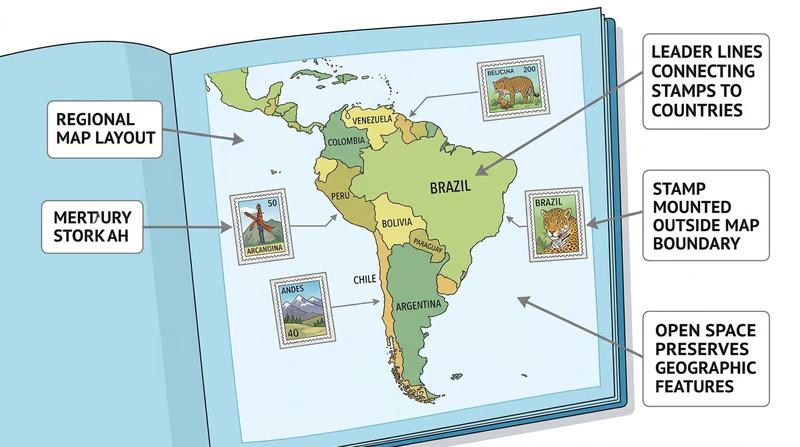
This option is especially strong if you want to show that stamps can teach geography in a very visual way.
Req 8c — One Country or Region
This option trades breadth for depth. Instead of sampling many places, you focus on one country or a connected region and learn to notice changes across time, design, and postal history.
A good project country is one where stamps are reasonably available and the designs keep changing enough to make the pages interesting. Closely related countries can also work well if they share language, geography, or political history.
Good organizing patterns
- by year or decade
- by ruler, government, or historical era
- by major themes such as wildlife, transportation, or national symbols
This option is ideal if you like spotting patterns. The more closely related your material is, the easier it becomes to compare paper, design style, rates, and commemorative choices.
Req 8d — A Thematic Collection
This option is the clearest example of topical collecting in action. You choose one topic and then build a collection that explores it across many countries.
What makes a strong topic
A strong topic is specific enough to organize but broad enough to find 75 different stamps. “Transportation” might be too broad. “Trains” or “space exploration” is easier to shape.
Ways to keep the album interesting
- split the topic into smaller categories
- add short captions that explain why each stamp fits
- show how different countries portray the same idea differently
For example, a bird collection could be organized by habitat, continent, or type of bird. A Scouting collection could be organized by jamborees, uniforms, camping, service, or world Scouting events.
A strong thematic album feels like a mini exhibit: one big idea shown through many small pieces.
Req 8e — A 30-Day Mail Study
This option turns your mailbox into a research site. Instead of building from bought packets or old album pages, you watch real incoming mail for a month and collect the postal clues it carries.
What to save
Look for envelopes and cards that show different types from Req 3, such as metered mail, commemoratives, definitives, cancellations, postmarks, booklet or coil stamps, or postal stationery.
How to track the month
Keep a simple log with:
- date received
- sender type, such as business, friend, club, or charity
- country of origin if not domestic
- what type of postal item it includes
- whether you kept the whole cover or just the stamp
A good 30-day routine
Small habits make this option much easier- Check the mail carefully every day before anything gets thrown away.
- Set aside promising items immediately in a sleeve or folder.
- Label items while they are fresh so you remember what made each one interesting.
- Sort by type each week so you can see whether you already have five different kinds.
This is one of the most realistic postal-history style options because it comes from actual mail use, not just loose stamps.
Extended Learning
Congratulations
You have finished a badge that trains your eyes, your patience, and your curiosity all at once. Stamp collecting can stay with you for years because there is always another story to follow — another country to compare, another printing clue to notice, or another album page to improve.
Building a Better Exhibit
A collection becomes more powerful when it explains itself well. Advanced collectors learn how to title pages clearly, write short captions, and arrange stamps so the viewer can follow a theme without guessing. If you enjoyed Req 7f, try turning one album section into a true exhibit page with a title, a short introduction, and labels that connect each stamp to the next.
Postal History as Detective Work
Loose stamps are only one part of the hobby. Covers, postmarks, auxiliary markings, rates, and routes can reveal how mail moved and what conditions people faced when they sent it. A wartime cover, a first day cover, or an airmail envelope can hold a whole story in one object.
If this interests you, start saving full envelopes instead of trimming off every stamp. You may find that the cancellation, cachet, or return address is the most interesting part.
Learning the Printing Side
Many collectors become fascinated by how stamps are made. Printing methods, perforation changes, watermark differences, paper choices, and gum styles can turn a simple stamp into a much deeper study. If you liked Req 4 and Req 7e, try comparing several stamps with similar designs and asking how the production details differ.
Real-World Experiences
Visit a Stamp Show
Join a Local Club Meeting
Build a Mini Exhibit
Track a Month of Mail Again
Organizations
The largest nonprofit organization for stamp collectors in the United States, with education, clubs, shows, and beginner resources.
Organization: American Philatelic Society — https://stamps.org/
A longtime stamp-collecting news and learning source with articles on collecting basics, history, and market trends.
Organization: Linn's Stamp News — https://www.linns.com/
A major museum resource for postal history, stamps, mail routes, and the broader story of communication.
Organization: Smithsonian National Postal Museum — https://postalmuseum.si.edu/
Useful for learning about current stamp issues, postal products, and official U.S. postal history.
Organization: United States Postal Service — https://about.usps.com/