Extended Learning
A. Congratulations!
You have earned one of the most important merit badges in Scouting. The Sustainability merit badge covers more ground than almost any other — from the water in your pipes to the food on your plate, from the energy powering your home to the global systems that keep our planet alive. The knowledge you have built does not expire when you finish the last requirement. It is a lens for seeing the world differently and making better decisions every day.
The sections below go deeper into practical sustainability skills you can use right now and throughout your life.
B. The Circular Economy: Rethinking “Throw Away”
Most of our economy operates on a linear model: take raw materials, make products, use them, throw them away. This “take-make-dispose” approach assumes unlimited resources and unlimited space for waste. It has neither.
The circular economy is a fundamentally different approach. Instead of designing products to be thrown away, a circular economy designs them to be:
- Reused — Products are built to last and to be used by multiple owners
- Repaired — When something breaks, you fix it instead of replacing it
- Remanufactured — Old products are disassembled and their components are used to build new ones
- Recycled — At the very end of life, materials are recovered and fed back into production
Companies like Patagonia (which repairs and resells used clothing), Apple (which recovers rare earth metals from old devices), and IKEA (which has started buying back used furniture) are pioneering circular business models.
You can practice circular economy thinking in your own life. Before throwing something away, ask: Can it be repaired? Can someone else use it? Can its materials be recovered? The most sustainable product is the one that never becomes waste.
Right to Repair
A growing movement called Right to Repair advocates for laws that require manufacturers to make repair parts, tools, and manuals available to consumers. Several states have passed Right to Repair laws, and the Federal Trade Commission has expressed support for the concept. When you can fix your phone screen instead of buying a new phone, that is a win for sustainability.
Biomimicry
Biomimicry is a design approach that looks to nature for solutions to human problems. Nature has been “designing” solutions for 3.8 billion years — and it produces zero waste. Examples include:
- Velcro — inspired by the way burdock burrs stick to animal fur
- Bullet train nose cones — shaped like a kingfisher’s beak to reduce noise and energy use
- Self-cleaning surfaces — modeled after lotus leaves that repel water and dirt
- Building ventilation systems — designed after termite mound airflow patterns
When engineers and designers study how nature solves problems, they often find solutions that are more efficient, more durable, and more sustainable than conventional approaches.
C. Food Forests and Regenerative Agriculture
Traditional farming often works against nature — clearing land, planting a single crop, and using chemicals to keep everything else away. Regenerative agriculture takes the opposite approach, working with natural systems to build soil health, increase biodiversity, and capture carbon.
Key regenerative practices include:
- Cover cropping — Planting crops specifically to protect and nourish the soil between growing seasons, rather than leaving fields bare
- No-till farming — Avoiding plowing, which disrupts soil structure, kills beneficial organisms, and releases stored carbon
- Crop rotation — Growing different crops in sequence to naturally replenish soil nutrients and break pest cycles
- Integrated pest management — Using beneficial insects, companion planting, and targeted interventions instead of blanket pesticide application
- Agroforestry — Integrating trees with crops and livestock to create more productive, resilient, and diverse farming systems
A food forest takes this even further. It is a garden designed to mimic a natural forest ecosystem, with layers of fruit and nut trees, berry bushes, ground cover plants, root vegetables, and climbing vines all working together. Once established, a food forest requires minimal maintenance and produces food year after year with almost no external inputs.
Starting a small food forest or regenerative garden at your school, Scout camp, or community center is an ambitious service project that combines sustainability with hands-on learning. You would learn about soil biology, plant ecology, and food production while creating something that benefits your community for decades.
D. Citizen Science: Collecting Data That Matters
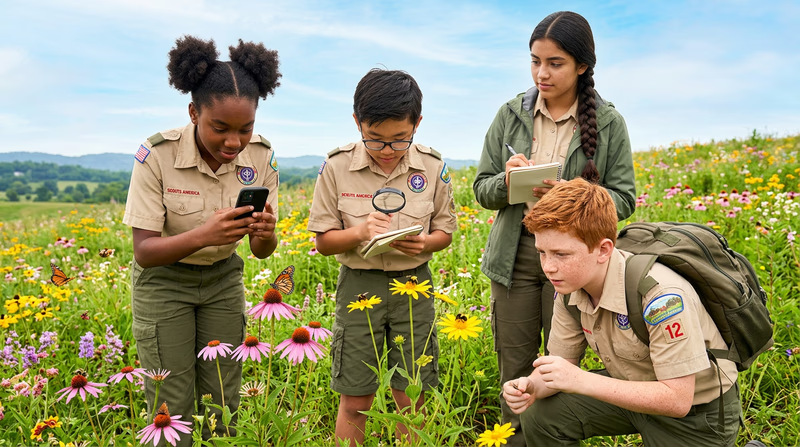
You do not need a lab or a degree to contribute to real scientific research. Citizen science projects allow ordinary people — including Scouts — to collect data that scientists use to study environmental change. Participating in citizen science is one of the most impactful things you can do beyond the badge.
Notable citizen science programs include:
- iNaturalist — Photograph plants and animals to help scientists track biodiversity worldwide. AI helps identify species from your photos.
- Globe Observer (NASA) — Measure cloud cover, tree height, land cover, and mosquito habitats. Your observations help validate satellite data.
- Christmas Bird Count (Audubon Society) — The longest-running citizen science project in the world (since 1900). Volunteers count birds during a specific period each winter.
- CoCoRaHS — Measure daily precipitation with a simple rain gauge. Your data helps meteorologists improve weather forecasts and track drought.
- Water quality monitoring — Many local organizations train volunteers to test streams and rivers for pH, dissolved oxygen, temperature, and pollutants.
Most citizen science projects require no special equipment beyond a smartphone and some patience. They are perfect for Scouts who want to combine outdoor time with meaningful contributions to science.
E. Real-World Experiences
These activities can deepen your understanding of sustainability beyond the badge requirements:
Local Recycling Center or Materials Recovery Facility (MRF) Tour a recycling facility to see how materials are sorted, processed, and prepared for reuse. Many MRFs offer free group tours. Use Earth911 to find facilities near you. Community Solar or Wind Farm Visit Visit a renewable energy installation to see how clean energy is generated at scale. Many solar and wind farms welcome educational group visits. Water Treatment Plant Tour See firsthand how your community's water is treated before and after household use. Contact your local water utility to arrange a group tour. Sustainable Farm or Community Garden Visit a farm practicing regenerative agriculture or volunteer at a community garden. LocalHarvest helps you find farms, CSAs, and farmers markets near you. Sustainability-Themed Service Project Organize a trail cleanup, community recycling drive, tree planting event, or energy audit workshop with your troop. Leave No Trace offers resources for planning outdoor service projects.F. Organizations
These organizations offer resources, volunteer opportunities, and educational materials to help you continue your sustainability journey:
Leave No Trace Center for Outdoor Ethics The leading nonprofit dedicated to responsible outdoor recreation. Offers training courses, educational materials, and volunteer programs for youth groups. U.S. Environmental Protection Agency (EPA) The federal agency responsible for protecting human health and the environment. Extensive educational resources, data tools, and program information. National Wildlife Federation America's largest conservation organization, with programs for youth, educators, and families focused on wildlife conservation and environmental education. The Nature Conservancy A global environmental organization working on conservation, climate change, and sustainable development. Offers volunteer opportunities and youth programs. United Nations Sustainable Development Goals The official home of the 17 SDGs, with progress data, educational resources, and ways to take action at every level — from individual to global. Project Drawdown A research organization that identifies and analyzes the most impactful solutions to climate change, ranked by potential to reduce greenhouse gas emissions.