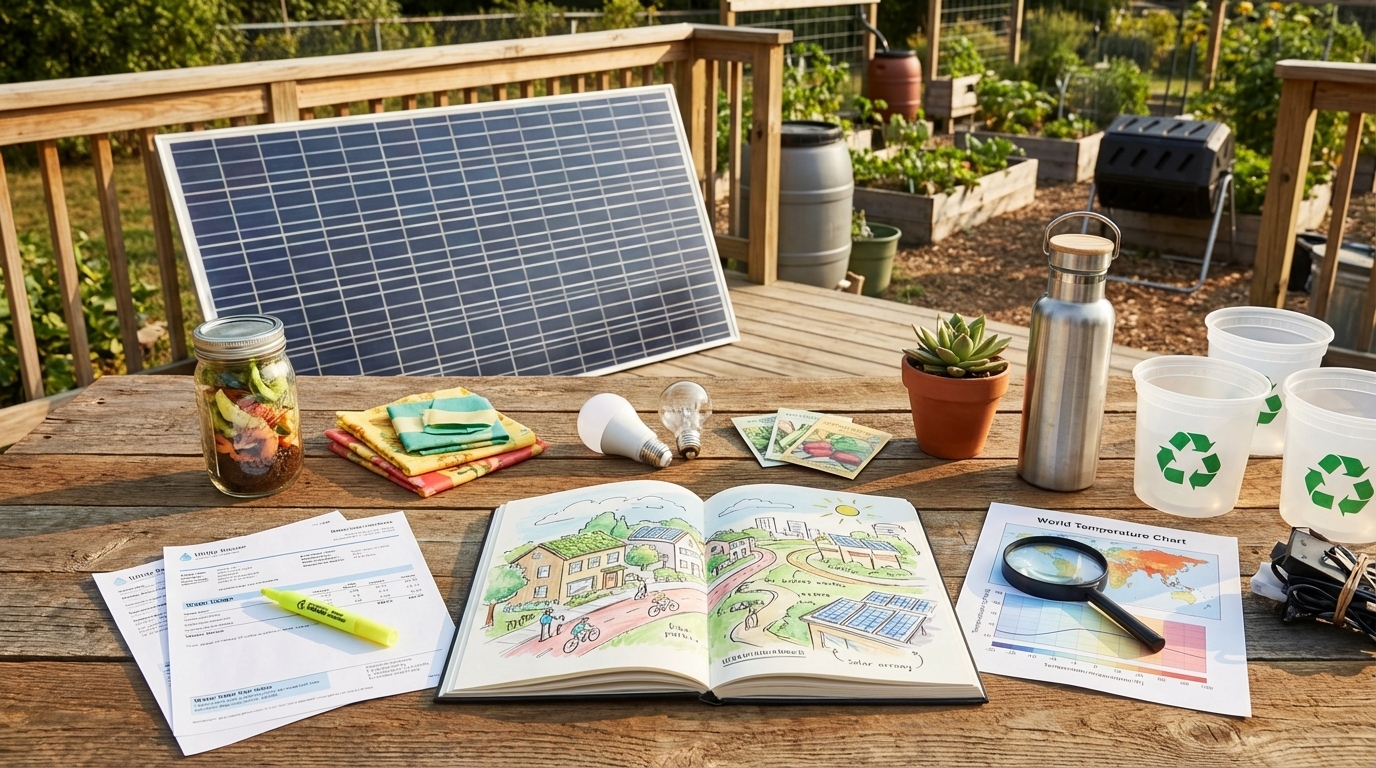
Sustainability Merit Badge — Complete Digital Resource Guide
https://merit-badge.university/merit-badges/sustainability/guide/
Introduction & Overview
Every choice you make — what you eat, how you get to school, what you do with old clothes — shapes the world around you. The Sustainability merit badge helps you see those connections and gives you the tools to make choices that protect the planet for generations to come.
Sustainability is one of the most important ideas of our time. It touches everything: water, food, energy, communities, and the stuff you own. This Eagle-required badge will challenge you to look at everyday life through a new lens and take real action in your home, your community, and beyond.
Then and Now
Then — Ancient Wisdom
Long before anyone used the word “sustainability,” people lived by its principles. Indigenous communities around the world practiced land stewardship for thousands of years — rotating crops, managing forests with controlled burns, and harvesting only what they needed. The Haudenosaunee (Iroquois) made decisions based on how they would affect the next seven generations. Ancient civilizations in Mesopotamia built irrigation systems to share water fairly, and terraced farming in the Andes kept soil from washing away for centuries.
- Key idea: Take only what you need, give back what you can
- Mindset: Survival depended on keeping the land, water, and wildlife healthy
Now — A Global Movement
The modern sustainability movement took shape in 1987 when a United Nations report called “Our Common Future” (also known as the Brundtland Report) defined sustainable development as “meeting the needs of the present without compromising the ability of future generations to meet their own needs.” That idea changed everything. Today, 193 countries have agreed on 17 Sustainable Development Goals, businesses measure their carbon footprints, and young people are leading the charge for climate action.
- Key idea: Balance what we use today with what future generations will need
- Mindset: Every person, business, and community plays a role
Get Ready! You are about to explore one of the biggest challenges — and greatest opportunities — of your lifetime. The skills you build in this merit badge will serve you long after you earn it. Let’s dig in!
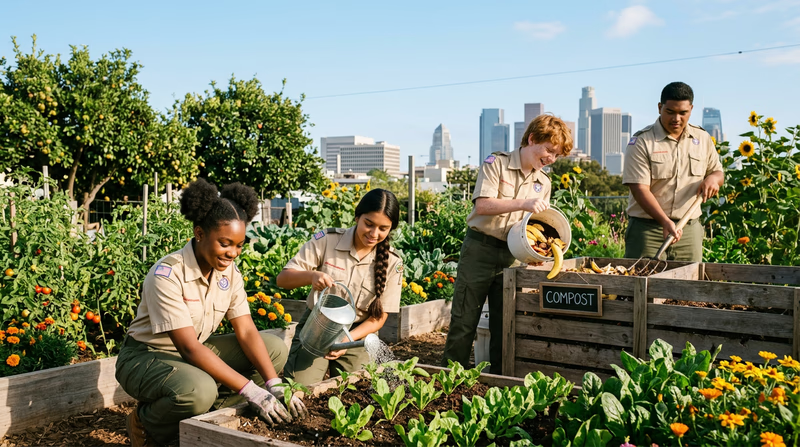
Kinds of Sustainability
Sustainability is not just about “going green.” It is a way of thinking that applies to many parts of life. Here are the main areas you will explore in this badge.
Environmental Sustainability
This is what most people think of first — protecting the natural world. Clean air, clean water, healthy forests, thriving wildlife, and a stable climate all depend on how we treat the environment. Environmental sustainability means using natural resources at a rate that allows them to replenish themselves.
Economic Sustainability
A sustainable economy does not just grow — it grows in ways that do not destroy the resources it depends on. This means creating jobs and businesses that use materials responsibly, minimize waste, and invest in renewable solutions. When a company designs products that can be repaired instead of thrown away, that is economic sustainability in action.
Social Sustainability
People matter too. Social sustainability means making sure that communities have access to clean water, nutritious food, education, healthcare, and safe places to live — not just today, but for generations to come. It means treating people fairly and making sure that the benefits of progress are shared.
Personal Sustainability
This one is all about you. Personal sustainability is the set of daily choices you make — turning off lights, reducing food waste, choosing to walk instead of drive, and thinking twice before buying something you do not need. Small actions, repeated by millions of people, add up to massive change.
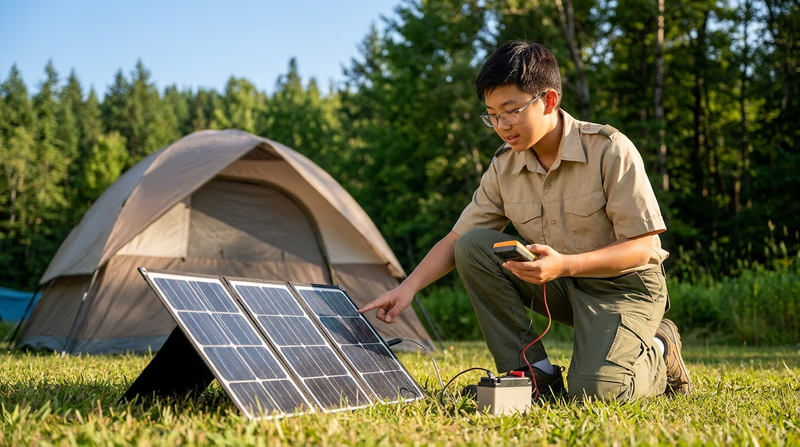
Sustainability connects to almost every other merit badge you can earn — from Camping and Environmental Science to Cooking and Citizenship in the World. As you work through these requirements, you will see how the skills you build here make you stronger in every part of Scouting.
Now let’s start with the big question: what does sustainability actually mean?
Req 1 — Defining Sustainability
What Does Sustainability Mean?
At its core, sustainability is about balance. Imagine a bank account. If you keep withdrawing money without ever making deposits, eventually you run out. Earth’s resources work the same way. Sustainability means using resources — water, soil, energy, forests, minerals — at a pace that lets them replenish, so future generations have what they need too.
The most widely used definition comes from the United Nations’ 1987 Brundtland Report: “Meeting the needs of the present without compromising the ability of future generations to meet their own needs.” That single sentence shaped how governments, businesses, and communities think about the future.
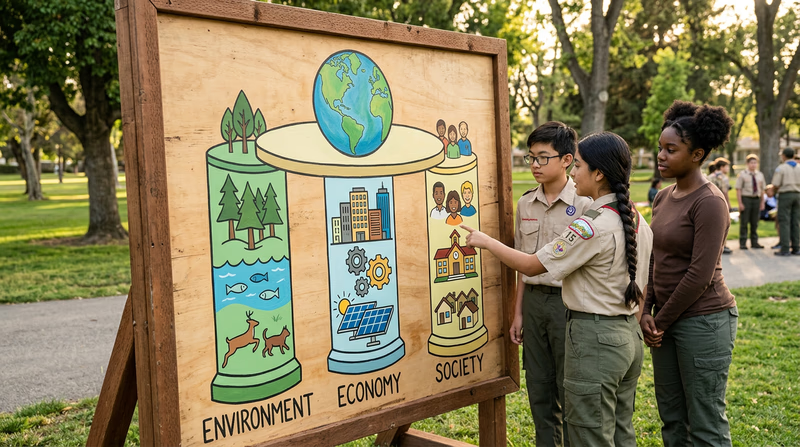
But sustainability is not just about the environment. It rests on three connected pillars:
- Environmental — Protecting ecosystems, clean air, clean water, and biodiversity
- Economic — Creating jobs and wealth without destroying the resources we depend on
- Social — Making sure all people have access to food, education, healthcare, and safe communities
When all three pillars are strong, a society is sustainable. When one is weak, the others eventually suffer too.
Why Sustainability Matters to Society
Think about the resources you used just today. The water in your shower came from a river, lake, or underground aquifer. The electricity powering your phone was generated by burning fuel, splitting atoms, or capturing sunlight. The food on your plate traveled an average of 1,500 miles to reach you.
Now multiply that by 8 billion people. Every day, humanity uses enormous quantities of water, energy, and materials. Some of those resources — like solar energy and wind — are renewable. Others — like fossil fuels and certain minerals — are not.
Sustainability matters because:
- Resources are finite. We cannot keep using non-renewable resources as if they will last forever.
- Ecosystems are connected. Cutting down a forest does not just remove trees — it changes rainfall patterns, drives away wildlife, and increases flooding downstream.
- People depend on each other. A drought in one country can raise food prices worldwide. Pollution from one factory can affect communities hundreds of miles away.
- Future generations deserve a fair chance. The choices we make now determine what kind of world our children and grandchildren will inherit.
How You Can Contribute
You do not need to be a world leader or a scientist to make a difference. Sustainability starts with everyday choices:
- Reduce waste by using reusable water bottles, lunch containers, and shopping bags
- Conserve energy by turning off lights, unplugging chargers, and choosing energy-efficient appliances
- Save water by taking shorter showers and fixing leaky faucets
- Choose wisely by buying durable products instead of disposable ones
- Spread awareness by sharing what you learn with family, friends, and your Scout troop
🎬 Video: What is Sustainability — https://www.youtube.com/watch?v=zx04Kl8y4dE
As you work through the rest of this badge, you will dive deep into each pillar of sustainability — water, food, community, energy, and more. Each requirement builds on this foundation.
Req 2a — Household Water Usage
Choose ONE of requirements 2a, 2b, or 2c. This page covers option 2a. Read all three options before deciding which one interests you most.
Understanding Your Water Footprint
Every household uses water differently, but the average American family uses about 300 gallons of water per day. That is enough to fill six bathtubs. Some of that water is obvious — showers, flushing toilets, running the dishwasher. But a lot of it is hidden, like the water used to grow your food or manufacture your clothes.
To complete this requirement, you need to become a water detective in your own home.
How to Evaluate Your Water Usage
Step 1: Find your water bills. Ask a parent or guardian for water bills from the past 12 months. Most water utilities measure usage in gallons or CCF (centum cubic feet — one CCF equals 748 gallons). If paper bills are not available, many water utilities offer online accounts where you can view usage history.
Step 2: Track seasonal patterns. Create a simple chart or table showing your monthly water usage over the year. Look for patterns:
- Does usage spike in summer? (Lawn watering, pools, garden hoses)
- Does it drop in winter? (Less outdoor watering)
- Are there any unexplained spikes? (Could indicate a leak)
Step 3: Compare to benchmarks. The EPA estimates that the average American uses about 82 gallons of water per day at home. How does your household compare?
Where Does Household Water Go?
Average indoor water use breakdown- Toilets: About 24% of indoor water use
- Showers: About 20% of indoor water use
- Faucets: About 19% of indoor water use
- Clothes washers: About 17% of indoor water use
- Leaks: About 12% of indoor water use (often unnoticed)
- Other (dishwashers, baths): About 8% of indoor water use
Three Ways to Reduce Water Consumption
The requirement asks you to identify three ways — but here are several ideas to choose from. Pick the ones that would make the biggest difference in your home.
Fix Leaks
Check every faucet, toilet, and hose connection in your home. To test a toilet for leaks, put a few drops of food coloring in the tank. If color appears in the bowl within 15 minutes (without flushing), you have a leak.
Shorten Showers
Cutting your shower by just two minutes can save up to 5 gallons of water per shower. Set a timer on your phone to keep yourself honest.
Upgrade Fixtures
Low-flow showerheads and faucet aerators can cut water use by 30–50% without a noticeable difference in water pressure. They are inexpensive and easy to install.
Water the Lawn Wisely
If your family waters the lawn, do it early in the morning when evaporation is lowest. Better yet, consider drought-resistant landscaping that needs little or no watering.
Run Full Loads
Only run the dishwasher and washing machine when they are full. A half-empty dishwasher uses the same amount of water as a full one.
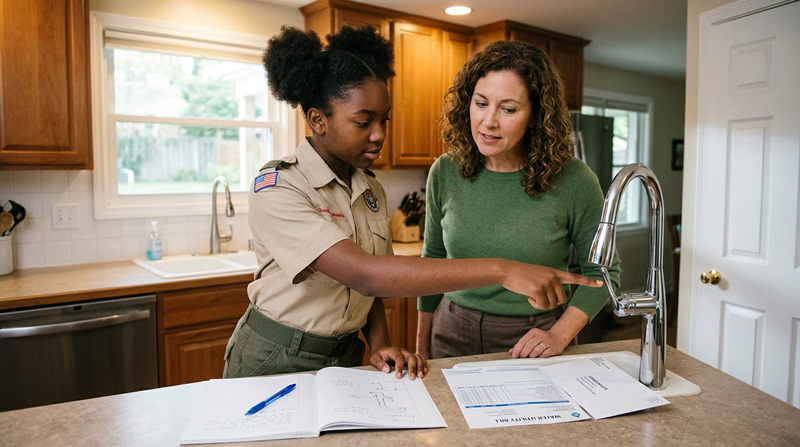
🎬 Video: How We Use Water — https://www.youtube.com/watch?v=dEmYud2wGlc
Req 2b — Water Systems
Why Water Is Essential
Water is the most important substance on Earth for living things. Your body is about 60% water, and every cell depends on it to function. Here is why water is so critical:
- Drinking and hydration — Your body needs about 8 cups of water a day to stay healthy. Without water, a person can survive only about three days.
- Food production — It takes about 1,800 gallons of water to produce one pound of beef and 100 gallons for one pound of wheat. Every meal you eat depends on water.
- Sanitation and hygiene — Clean water prevents the spread of diseases like cholera, typhoid, and dysentery. Handwashing alone saves thousands of lives every year.
- Ecosystems — Rivers, lakes, and wetlands support fish, birds, plants, and countless other species. These ecosystems also filter pollution and control flooding naturally.
- Industry and energy — Factories use water for cooling, cleaning, and manufacturing. Power plants use water to generate steam and electricity.
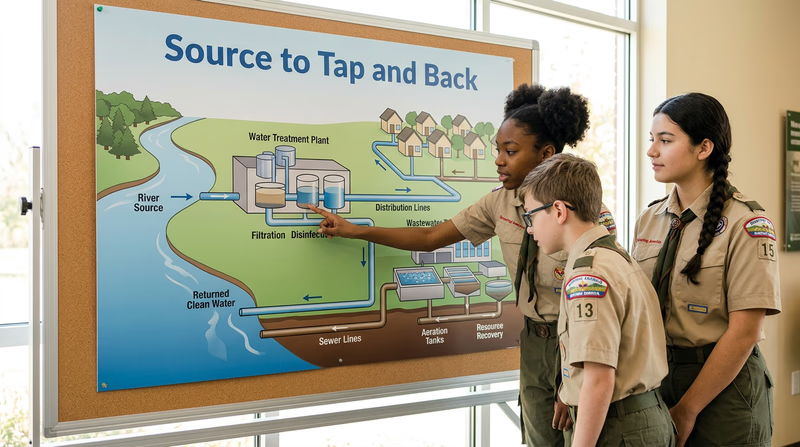
Your Water’s Journey: Source to Drain
To create your diagram, you need to understand two systems: how water gets to your home and where it goes after you use it.
From Nature to Your Faucet
Most communities get their water from one of two sources:
Surface water — Rivers, lakes, and reservoirs. A dam or intake structure captures the water and sends it to a treatment plant.
Groundwater — Underground aquifers accessed through wells. A pump brings the water to the surface.
At the water treatment plant, the water goes through several steps:
- Coagulation and flocculation — Chemicals cause dirt and particles to clump together
- Sedimentation — Heavy clumps settle to the bottom
- Filtration — Water passes through sand, gravel, and charcoal filters
- Disinfection — Chlorine or UV light kills bacteria and viruses
The treated water then flows through underground pipes (water mains) to your home.
From Your Drain to Nature
After you flush, shower, or wash dishes, the used water (called wastewater) flows through sewer pipes to a wastewater treatment plant. There, it goes through a similar process:
- Screening — Large debris is removed
- Primary treatment — Solids settle out in large tanks
- Secondary treatment — Bacteria break down organic matter
- Disinfection — Remaining pathogens are killed
- Discharge — The cleaned water is released back into a river, lake, or ocean
Some homes use septic systems instead of connecting to a public sewer. A septic tank breaks down waste on-site, and the treated water soaks into a drain field in the yard.
Preserving Clean Water Access
Here are ways communities can protect their water supply for the future. Choose two that are relevant to your area:
Protect Watersheds
A watershed is the land area that drains into a particular body of water. Keeping watersheds healthy — by preventing pollution, limiting development near waterways, and planting trees along stream banks — protects the water supply at its source.
Prevent Pollution
Storm drains carry rainwater directly to rivers and lakes without treatment. Oil, fertilizers, pesticides, and trash that wash into storm drains contaminate drinking water sources. Proper disposal of chemicals and reducing fertilizer use keeps water cleaner.
Invest in Infrastructure
Many American cities have water pipes that are 50–100 years old. Aging infrastructure leads to leaks, breaks, and contamination. Investing in pipe replacement and treatment plant upgrades protects water quality and reduces waste.
Conserve Aquifers
In areas that rely on groundwater, pumping water faster than rain can replenish it causes the water table to drop. Conservation measures and managed recharge (intentionally directing rainwater underground) help keep aquifers healthy.
🎬 Video: Why Do We Drink Water? - Facts About Water for Kids — https://www.youtube.com/watch?v=paUYby1kbMs
Req 2c — Floods & Droughts
Too Much or Too Little
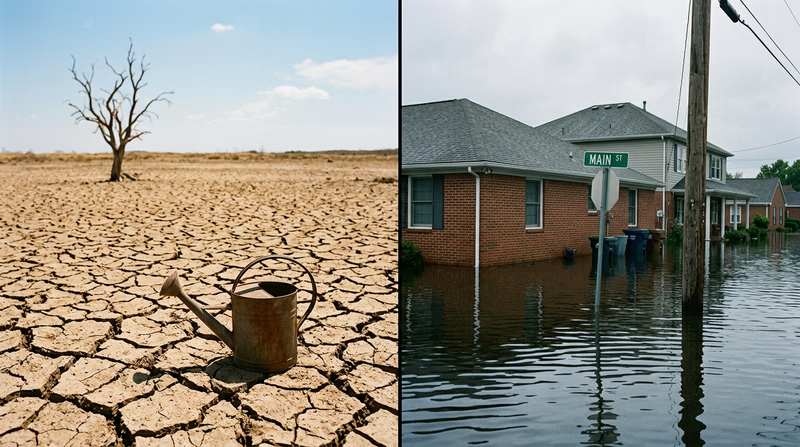
Water is one of nature’s most powerful forces. When there is too much, it floods homes, washes away roads, and contaminates drinking water. When there is too little, crops fail, wells run dry, and wildfires become more likely. Most places in the world deal with one or both of these challenges.
Understanding Drought
A drought happens when an area receives significantly less rainfall than normal for an extended period. Droughts can last weeks, months, or even years. They affect:
- Agriculture — Crops wither and livestock need more water than is available
- Water supplies — Reservoirs and wells drop to dangerously low levels
- Ecosystems — Fish, wildlife, and plant life struggle to survive
- Fire risk — Dry vegetation becomes fuel for wildfires
The western United States has experienced severe drought conditions in recent decades. The Colorado River, which supplies water to 40 million people, has seen its reservoirs drop to historically low levels.
Understanding Flooding
A flood occurs when water overflows onto normally dry land. Floods can be caused by:
- Heavy rainfall — Too much rain in a short time overwhelms rivers and drainage systems
- Snowmelt — Rapid spring warming can melt snow faster than the ground can absorb it
- Storm surge — Hurricanes and coastal storms push ocean water inland
- Dam failure — When a dam breaks, the released water can devastate communities downstream
Flooding is the most common natural disaster in the United States. It can happen in every state and in any season.
Does This Affect Where You Live?
To explore whether drought or flooding affects your area, try these steps:
- Check your state’s drought monitor at the U.S. Drought Monitor website. It shows current drought conditions across the country, updated weekly.
- Look up flood zone maps from FEMA. Enter your address to see if your home or community is in a flood-prone area.
- Ask local officials or librarians about historical floods or droughts in your area. Many communities have records of past events.
- Talk to older family members or neighbors. They may remember droughts, water restrictions, or flooding that affected your community.
Water Conservation and Flood Mitigation Practices
Here are examples of practices that communities have tried. Research which ones apply to your area — and whether they worked.
Conservation Practices (For Drought)
Water rationing and restrictions — During droughts, many communities limit lawn watering, car washing, and other non-essential uses. Some assign watering days based on your address. These have been effective in reducing usage by 20–30% during drought emergencies.
Desalination — Removing salt from ocean water to make it drinkable. San Diego, California opened one of the largest desalination plants in the Western Hemisphere. It is expensive but provides a drought-proof water source.
Water recycling — Treating wastewater to a high standard and reusing it for irrigation, industrial processes, or even drinking water. Orange County, California has been recycling wastewater into drinking water since 2008.
Rainwater harvesting — Capturing rain from rooftops and storing it in tanks for later use. Some communities encourage this with rebates for rain barrel purchases.
Flood Mitigation Practices
Levees and floodwalls — Barriers built along rivers to hold back floodwater. New Orleans relies heavily on levees, though Hurricane Katrina in 2005 showed what happens when they fail.
Green infrastructure — Using natural features like wetlands, rain gardens, and permeable pavement to absorb rainwater and reduce runoff. These approaches work with nature instead of against it.
Detention basins — Large areas designed to temporarily hold floodwater and release it slowly. Many communities build these near rivers or in parks that serve double duty as recreational spaces.
Buyout programs — Some communities purchase homes in repeatedly flooded areas and return the land to its natural state, giving the river more room to flood safely.
🎬 Video: Science Behind Drought — https://www.youtube.com/watch?v=Do6cC05LuDs
Req 3a — Food Sources
Choose ONE of requirements 3a, 3b, or 3c. This page covers option 3a. Read all three options before deciding which one interests you most.
From Farm to Fork
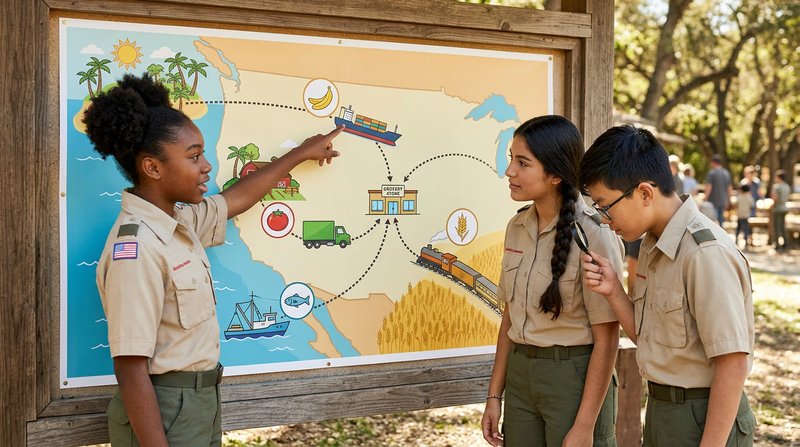
Every food you eat has a story. That story includes where the food was grown or raised, how it was harvested, how it was processed and packaged, and how it traveled — sometimes thousands of miles — to reach your plate. Understanding that journey is key to understanding food sustainability.
Three Types of Food Production
Plant-based foods include fruits, vegetables, grains, nuts, and legumes. These are grown on farms and require soil, water, sunlight, and often fertilizers and pesticides. Some plant-based foods, like lettuce, are eaten fresh. Others, like wheat, go through extensive processing to become bread, pasta, or cereal.
Animal-based foods include meat, dairy, eggs, and poultry. These come from livestock raised on farms and ranches. Animal agriculture generally requires more water, land, and energy than plant-based food production because animals need to eat plants (or other feed) throughout their lives before becoming food themselves.
Aquaculture foods come from fish and shellfish farming. Instead of catching wild fish from the ocean, aquaculture raises fish in controlled environments — ponds, tanks, or ocean pens. It is the fastest-growing form of food production in the world, now providing about half of all fish consumed globally.
Tracing Four Foods
The requirement asks you to pick four foods and trace their journey. Here is what to look for with each one:
Food Journey Checklist
Questions to answer for each food- Where is this food originally grown, raised, or caught?
- What climate and resources does it need (water, land, temperature)?
- How is it harvested or collected?
- What processing steps does it go through before reaching a store?
- How is it packaged?
- How far does it travel to reach your community?
- What transportation methods are used (truck, ship, plane, train)?
Example: A Banana
- Source: Grown on tropical plantations in countries like Ecuador, Costa Rica, and the Philippines
- Harvest: Picked green by hand, washed, and sorted at a packing facility
- Processing: Minimal — bananas are sold fresh with no cooking or canning
- Transport: Shipped by refrigerated cargo ship (about 2 weeks at sea), then by truck to distribution centers and stores
- Sustainability factors: Banana farming uses significant pesticides, and long-distance shipping burns fossil fuels. Some farms use monoculture (growing only one crop), which can deplete soil
Example: Canned Tuna
- Source: Caught in the Pacific, Atlantic, or Indian oceans by commercial fishing boats
- Harvest: Caught using purse seine nets, longlines, or pole-and-line methods
- Processing: Cleaned, cooked, canned, and sealed at a processing plant — often in Thailand, Vietnam, or Ecuador
- Transport: Shipped by cargo container to warehouses, then trucked to stores
- Sustainability factors: Overfishing threatens some tuna species. Certain fishing methods also catch dolphins, sea turtles, and other marine life (called bycatch)
🎬 Video: Exploring Food Sustainability — https://www.youtube.com/watch?v=PyiVf26C5pc
Req 3b — Global Food Supply
What Limits Food Availability?
The world produces enough food to feed everyone on the planet — yet nearly 800 million people go hungry. The problem is not just about growing enough food. It is about getting food to where it is needed, keeping it affordable, and making the systems that produce it sustainable.
Here are key factors that limit food availability around the world:
Climate and Weather
Farming depends on predictable weather patterns. When droughts, floods, heat waves, or unexpected frosts hit, crops fail and livestock suffer. Climate change is making weather less predictable, which makes farming riskier in many regions. Areas near the equator — where many developing nations are located — face some of the most severe impacts.
Soil Degradation
Healthy soil is the foundation of food production. When soil is overfarmed, overgrazed, or exposed to erosion, it loses the nutrients plants need to grow. The United Nations estimates that about one-third of the world’s soil is moderately to highly degraded. Without healthy soil, food production drops — and recovering damaged soil can take decades.
Water Scarcity
Agriculture uses about 70% of the world’s freshwater supply. In regions where water is scarce — parts of Africa, the Middle East, and western United States — there is often not enough water to grow food and supply communities at the same time. As populations grow and water sources shrink, this competition gets more intense.
Political Instability and Conflict
War and political instability destroy farming infrastructure, displace farmers, and block food supply routes. In conflict zones, food is sometimes used as a weapon — shipments are blocked, farms are burned, and humanitarian aid is prevented from reaching people who need it.
Poverty and Economic Inequality
Even when food is available, many people cannot afford it. Poverty limits access to nutritious food in both developing nations and wealthy countries. In some communities, there are “food deserts” — areas where grocery stores with fresh produce are miles away, and the only nearby options are fast food or convenience stores.
Transportation and Infrastructure
In remote or rural areas, poor roads, lack of refrigeration, and limited access to markets mean that food often spoils before it can be sold or eaten. Post-harvest losses — food that is grown but never eaten — can reach 40% in some developing countries.
Growing Your Own Food
You do not need a farm to produce food. Here are ways individuals, families, and communities can create their own food sources:
Backyard and Container Gardens
Even a small space — a patio, a balcony, or a sunny windowsill — can produce herbs, tomatoes, peppers, lettuce, and more. Container gardening works for people without a yard. Start with easy-to-grow crops and expand as you learn.
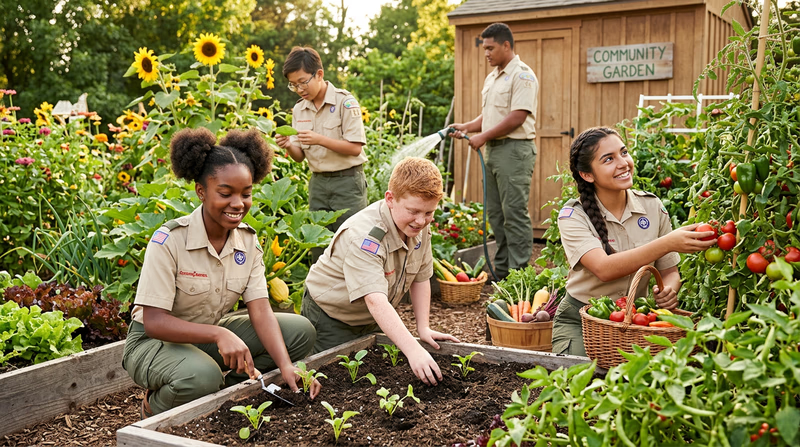
Community Gardens
A community garden is a shared space where neighbors grow food together. They build community connections, provide fresh produce in areas that might lack it, and teach gardening skills to the next generation. Many cities offer plots for free or a small fee.
School and Troop Gardens
Starting a garden at your school or Scout meeting place is a great service project. It teaches sustainability, provides fresh food, and connects people to where their food comes from.
Raising Small Livestock
Depending on local regulations, families can raise chickens for eggs, keep bees for honey, or raise rabbits for meat. These small-scale operations can supplement a family’s food supply and reduce dependence on grocery stores.
Farmers Markets and CSAs
While not growing your own food, buying from local farmers through farmers markets or Community Supported Agriculture (CSA) programs reduces the distance food travels, supports local economies, and often provides fresher, more sustainably grown food.
🎬 Video: Food Security — https://www.youtube.com/watch?v=YF18lUXUIk4
Req 3c — Reducing Food Waste
The Food Waste Problem
In the United States, about 30–40% of the food supply is wasted. That is roughly 133 billion pounds of food — enough to fill a football stadium to the brim every single day. Wasted food also wastes the water, energy, and labor that went into producing it, and it generates methane (a powerful greenhouse gas) when it rots in landfills.
The good news? Your household can make a real difference. This requirement asks you to measure your food waste, make a plan, and track your progress over two weeks.
Step 1: Establish a Baseline
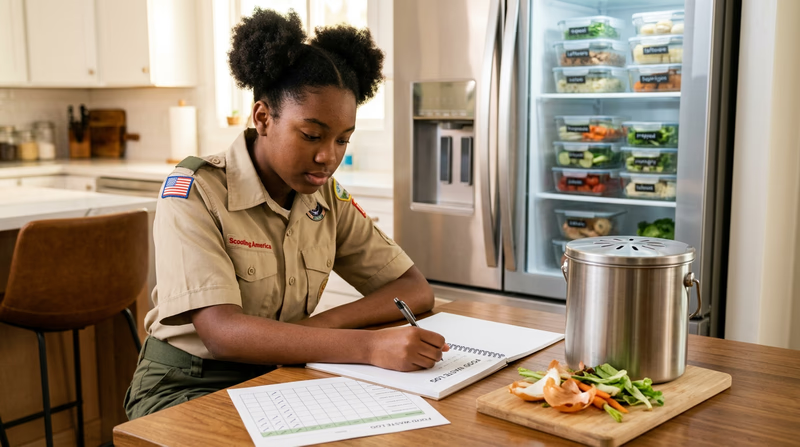
Before you can reduce food waste, you need to know how much your household currently wastes. For three to five days before starting your plan:
- Place a separate container near your kitchen trash for food waste only (a bowl, a small bin, or a bag)
- Track what gets thrown away — write down each item, the approximate amount, and why it was wasted
- Note the reason for each wasted item: expired, spoiled, leftover not eaten, overcooked, or simply not wanted
Common categories of household food waste include:
Common Food Waste Categories
What to track during your baseline- Produce that spoiled before it was eaten (fruits, vegetables, herbs)
- Leftovers from meals that were never finished
- Expired items cleaned out of the fridge or pantry
- Plate waste — food served but not eaten
- Food prepared but not to anyone’s liking
- Bread, baked goods, or snacks that went stale
Step 2: Make Your Plan
Based on your baseline data, identify the biggest sources of waste and create specific strategies to address them. Here are proven approaches:
Meal Planning
Plan your meals for the week before you shop. Make a list of exactly what you need and stick to it. This reduces impulse purchases that often end up wasted.
First In, First Out (FIFO)
When you put away groceries, move older items to the front of the fridge and pantry and newer items to the back. This way, you use older food before it spoils.
Proper Storage
Many foods last longer when stored correctly. Berries stay fresh longer when washed just before eating (not when you buy them). Herbs keep well in a glass of water in the fridge. Bread lasts longer in the freezer than on the counter.
Creative Leftover Use
Designate one dinner each week as “leftover night.” Transform yesterday’s roasted chicken into today’s chicken soup. Turn wilting vegetables into a stir-fry or smoothie. Get creative instead of throwing food away.
Composting
Food scraps that cannot be eaten — like banana peels, coffee grounds, and eggshells — can be composted instead of sent to a landfill. Composting turns waste into nutrient-rich soil for gardens. Even apartment dwellers can use small countertop composters or worm bins.
Understanding Date Labels
“Sell by,” “best by,” and “use by” dates are confusing — and they cause a lot of unnecessary waste. In most cases, these dates indicate peak quality, not safety. Milk that is one day past its “sell by” date is usually still fine. Use your senses — smell it, look at it, taste a small amount — before throwing food away just because of a date.
Step 3: Track for Two Weeks
Continue tracking your food waste daily during the two-week period. Use a simple log:
| Date | Item Wasted | Amount | Reason | Could It Have Been Prevented? |
|---|---|---|---|---|
| Day 1 | Lettuce | Half a head | Wilted | Yes — eat sooner or store properly |
At the end of two weeks, compare your results to your baseline. Calculate the change in total food waste. Most families who actively try to reduce waste can cut it by 25–50% in just two weeks.
🎬 Video: 5 Food Waste Reduction Tips for Your Home — https://www.youtube.com/watch?v=waMsKjl8HkM
Req 4a — Design a Community
Choose ONE of requirements 4a, 4b, or 4c. This page covers option 4a. Read all three options before deciding which one interests you most.
What Makes a Community Sustainable?
A sustainable community is designed so that the way people live, work, shop, and travel reduces waste, conserves resources, and supports a healthy environment and economy. It is not about fancy technology — it is about smart design.
Think about your own community. How far do you travel to get to school? Do most people drive or walk? Are there parks and green spaces? Where does your trash go? The answers to these questions reveal how sustainable — or unsustainable — a community’s design really is.
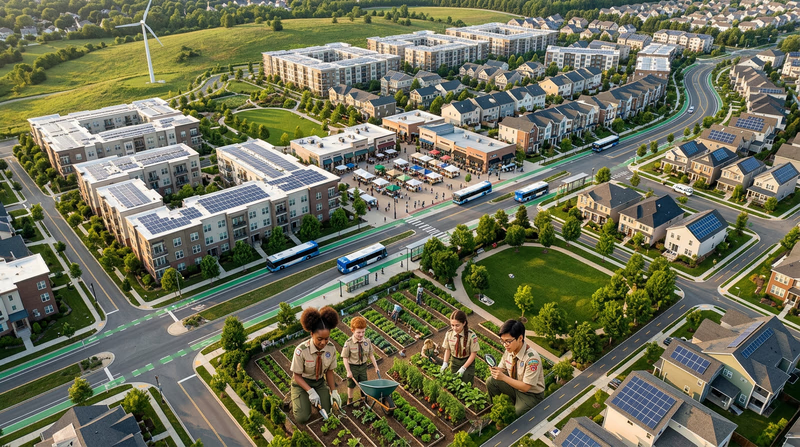
Key Elements of Sustainable Community Design
Housing
Sustainable housing uses less energy, less water, and fewer materials than conventional homes:
- Energy-efficient design — Good insulation, double-pane windows, and efficient heating/cooling systems reduce energy use by 30–50%
- Solar panels — Rooftop solar can generate much of a home’s electricity
- Mixed housing types — Apartments, townhomes, and single-family homes in the same area give people affordable options and reduce sprawl
- Green building materials — Recycled, locally sourced, and sustainably harvested materials reduce the environmental footprint of construction
Work Locations
Where people work relative to where they live has a huge impact on sustainability:
- Mixed-use zoning — Putting homes, offices, and shops in the same area reduces the need to drive long distances
- Remote work — When people work from home, they eliminate commute-related emissions entirely
- Local businesses — Money spent at local businesses circulates in the community, strengthening the local economy
Shops and Services
- Walkable shopping — When stores, restaurants, and services are within walking distance of homes, people drive less
- Farmers markets — Local food requires less transportation and packaging
- Repair shops — Access to repair services means fewer items get thrown away
Schools
- Neighborhood schools — Schools within walking or biking distance reduce bus and car trips
- Green school buildings — Energy-efficient schools save money and teach students about sustainability by example
- School gardens — Growing food on campus connects students to sustainable food practices
Transportation
Transportation is often the biggest source of pollution and energy use in a community:
- Public transit — Buses, trains, and light rail move more people with less energy than individual cars
- Bike lanes and sidewalks — Safe infrastructure for walking and cycling reduces car dependence
- Electric vehicle charging — Supporting the transition from gas-powered to electric vehicles
- Compact design — When everything is closer together, people travel shorter distances
Creating Your Sketch
Your sketch does not need to be artistic — it needs to be clear. Here is how to approach it:
Sketch Planning Guide
Elements to include in your community design- Housing areas with different types of homes (apartments, townhomes, houses)
- A town center with shops, services, and public spaces
- Schools positioned within walking distance of neighborhoods
- Work areas (offices, workshops) integrated with or near residential areas
- Parks, green spaces, and community gardens
- Transportation routes: roads, bike lanes, bus/transit lines, sidewalks
- Natural features: streams, forests, wetlands preserved as green buffers
- Renewable energy sources: solar panels, wind turbines
- Water management: rain gardens, retention ponds
How Design Affects Sustainability
When you discuss your sketch with your counselor, be ready to explain these connections:
| Design Element | Energy Impact | Pollution Impact | Natural Resources | Economic Impact |
|---|---|---|---|---|
| Compact layout | Less driving = less fuel | Lower emissions | Less land consumed | Lower infrastructure costs |
| Solar panels | Renewable energy | Zero emissions | Reduces fossil fuel use | Long-term energy savings |
| Public transit | Shared energy use | Fewer cars = cleaner air | Less road building | Accessible to all income levels |
| Green spaces | Natural cooling | Air filtration | Habitat preservation | Higher property values |
| Local shops | Less transportation energy | Less delivery pollution | Less packaging waste | Money stays local |
🎬 Video: How to Plan and Design a Sustainable Community — https://www.youtube.com/watch?v=RBQiRx6VP7o
Req 4b — Fix an Unsustainable Practice
Finding Unsustainable Practices
Every community has practices that waste resources, create pollution, or harm the environment. The first step is to look around with a critical eye. Here are places to look:
Transportation
- No bike lanes or sidewalks, forcing everyone to drive even short distances
- School bus routes that are inefficient, with buses running half-empty
- Lack of public transit options
Waste Management
- No curbside recycling program, or a program with very low participation
- No composting options for yard waste or food scraps
- Excessive use of single-use plastics at community events
Water
- Overwatering of public parks, sports fields, or golf courses
- Storm drains that carry polluted runoff directly into waterways
- Aging water infrastructure with frequent leaks and breaks
Energy
- Public buildings (schools, libraries, offices) with poor insulation or old HVAC systems
- Streetlights left on during daylight hours or using inefficient bulbs
- No electric vehicle charging stations
Land Use
- Paving over green spaces for parking lots
- New development in flood-prone or ecologically sensitive areas
- Lack of urban tree canopy, creating heat islands
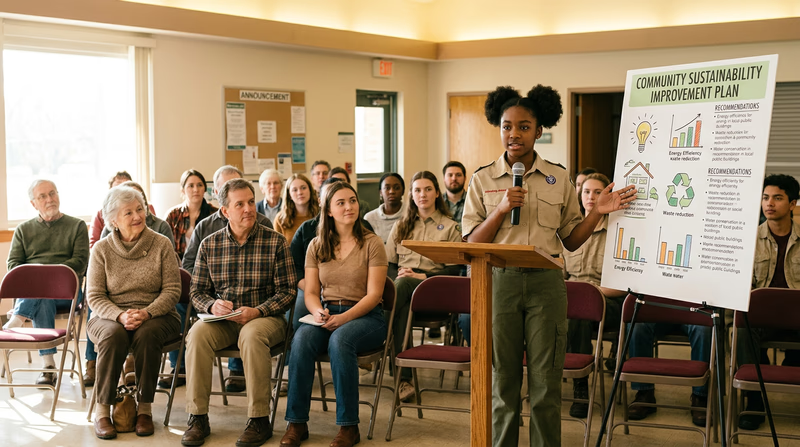
Writing Your Plan
Once you have identified an unsustainable practice, develop a written plan to fix it. A strong plan includes these elements:
1. Define the Problem
State clearly what the unsustainable practice is, where it occurs, and why it is a problem. Use specific details and data when possible.
Example: “Our community park’s sprinkler system runs for 45 minutes every morning, even when it has rained. This wastes an estimated 2,000 gallons of water per week during wet months.”
2. Research Solutions
Look at what other communities have done to solve similar problems. Identify multiple possible solutions and evaluate each one.
3. Propose a Solution
Choose the best solution and explain:
- What specifically would change
- Who would need to be involved (city council, school board, local businesses, volunteers)
- How it would be implemented step by step
- When each step would happen (create a timeline)
- How much it would cost (estimate if exact figures are not available)
- What benefits it would provide (environmental, economic, social)
4. Address Challenges
Every plan faces obstacles. Identify potential challenges and how you would address them:
- Cost concerns → Show long-term savings or find grant funding
- Resistance to change → Educate and demonstrate benefits
- Technical complexity → Identify experts or partners who can help
5. Measure Success
How would you know if your plan worked? Define specific, measurable outcomes.
Example: “Water usage at the park would decrease by 40% during wet months, saving approximately 8,000 gallons per month.”
🎬 Video: Sustainable Communities — https://www.youtube.com/watch?v=VrBrpSTwPK8
Req 4c — Sustainable Housing
Sustainability Starts at Home
Your home is probably the single biggest consumer of energy and water in your daily life. How it was built, what materials were used, how it is heated and cooled, and how efficiently it uses water all affect its sustainability. This requirement asks you to identify key sustainability factors and honestly evaluate how your home measures up.
Key Sustainability Factors in Housing
Here are important factors to consider. Choose at least five to evaluate your home:
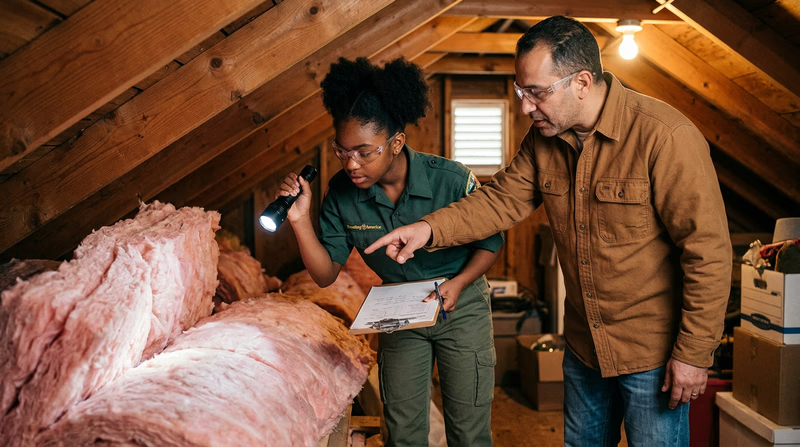
1. Energy Efficiency
How well does your home hold in heat during winter and keep cool during summer? Key elements include:
- Insulation — Walls, attic, and floors should be well-insulated to reduce heating and cooling energy
- Windows — Double-pane or triple-pane windows prevent heat loss far better than single-pane
- Sealing — Gaps around doors, windows, and pipes let conditioned air escape
- HVAC system age — Newer systems are significantly more efficient than systems installed 15–20 years ago
2. Water Conservation
How efficiently does your home use water?
- Low-flow fixtures — Showerheads, faucets, and toilets that use less water per use
- Leak-free plumbing — No dripping faucets or running toilets
- Efficient landscaping — Drought-tolerant plants or efficient irrigation systems
- Rainwater collection — Barrels or cisterns that capture rain for garden use
3. Renewable Energy
Does your home use any renewable energy sources?
- Solar panels — Rooftop solar can offset or eliminate electricity from fossil fuels
- Green energy plans — Some utilities offer plans where your electricity comes from wind or solar farms
- Solar water heating — Using the sun to heat water instead of gas or electricity
4. Building Materials
What is your home made of, and how sustainable are those materials?
- Locally sourced materials — Materials from nearby reduce transportation emissions
- Recycled content — Some building materials use recycled steel, glass, or plastic
- Sustainable wood — FSC-certified lumber comes from responsibly managed forests
- Durability — Materials that last longer mean fewer replacements and less waste
5. Waste Management
How does your home handle waste?
- Recycling — Does your household actively recycle paper, plastic, glass, and metal?
- Composting — Do you compost food scraps and yard waste?
- Reduction — Does your household try to reduce waste in the first place (buying in bulk, avoiding single-use items)?
6. Indoor Air Quality
How healthy is the air inside your home?
- Ventilation — Proper airflow prevents buildup of indoor pollutants
- Low-VOC products — Paints, cleaners, and building materials that do not off-gas harmful chemicals
- Natural light — Good natural lighting reduces the need for artificial lighting and improves well-being
7. Location and Transportation
Where your home is located affects its sustainability footprint:
- Proximity to work, school, and shopping — Shorter commutes mean less fuel burned
- Walkability — Can you walk or bike to daily destinations?
- Public transit access — Nearby bus or train stops reduce car dependence
Rating Your Home
Create a simple scorecard to rate your home. For each factor, assign a rating:
- Strong — Your home performs well in this area
- Average — Some sustainable features, but room for improvement
- Needs Work — Significant opportunities for improvement
Be honest in your assessment — the goal is not a perfect score but an understanding of where your home stands and what could be improved.
Home Sustainability Scorecard
Rate each factor and note why- Factor 1: Name — Rating — Notes on why you gave this rating
- Factor 2: Name — Rating — Evidence or observations
- Factor 3: Name — Rating — What you noticed
- Factor 4: Name — Rating — Specific examples from your home
- Factor 5: Name — Rating — Ideas for improvement
🎬 Video: Environmental Footprint Calculator — https://www.youtube.com/watch?v=2C7F_2OpRT8
Req 5a — Energy Sources
Choose ONE of requirements 5a, 5b, or 5c. This page covers option 5a. Read all three options before deciding which one interests you most.
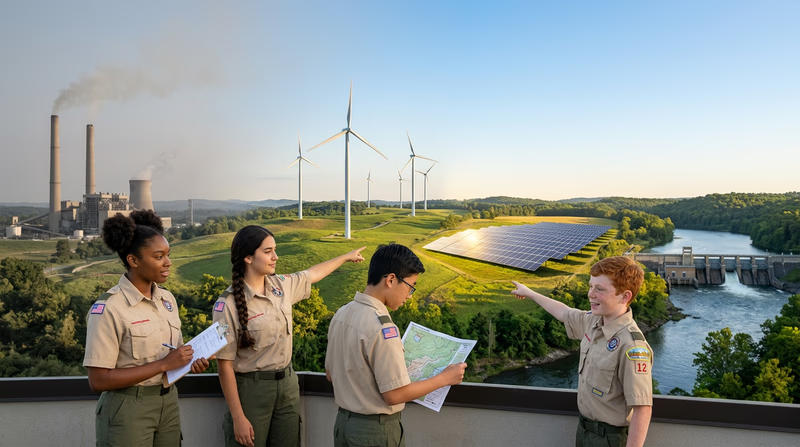
Understanding Energy Sources
Energy powers everything — your lights, your phone, your car, your school’s heating system, and the factories that make everything you buy. But not all energy sources are created equal when it comes to sustainability. Some will run out. Some pollute. Some are clean and renewable. Understanding the differences is essential.
Energy sources fall into two main categories:
Non-renewable — These exist in limited quantities and take millions of years to form. Once used, they are gone.
Renewable — These are naturally replenished and will not run out in any human timescale.
The Energy Sources
Coal (Non-Renewable)
Coal is a fossil fuel formed from ancient plant material over millions of years. It is burned in power plants to generate electricity. Coal was once the backbone of American energy, but its use has declined sharply.
- Sustainability concerns: Highest carbon emissions of any energy source. Mining damages landscapes, pollutes water, and endangers workers. Burning coal releases sulfur dioxide, mercury, and particulate matter.
- Current status: Coal’s share of U.S. electricity has dropped from about 50% in 2005 to under 20% today.
Natural Gas (Non-Renewable)
Natural gas is a fossil fuel found deep underground, often alongside oil. It is used for electricity generation, home heating, and cooking.
- Sustainability concerns: Burns cleaner than coal (about half the CO2) but still produces greenhouse gases. Extraction through fracking can contaminate groundwater and cause small earthquakes. Methane leaks during production are a potent greenhouse gas.
- Current status: Natural gas is currently the largest source of U.S. electricity, generating about 40%.
Petroleum / Oil (Non-Renewable)
Petroleum is refined into gasoline, diesel, jet fuel, and heating oil. It is also the raw material for plastics, chemicals, and many products.
- Sustainability concerns: Burning petroleum is a major source of greenhouse gases and air pollution. Oil spills devastate marine ecosystems. Extraction and refining are energy-intensive.
- Current status: Petroleum provides about 36% of total U.S. energy, mostly for transportation.
Nuclear (Non-Renewable, but Long-Lasting)
Nuclear power plants split uranium atoms in a process called fission, releasing enormous amounts of heat to generate electricity.
- Sustainability concerns: Produces no greenhouse gases during operation. However, mining uranium has environmental impacts, and nuclear waste remains radioactive for thousands of years. The risk of accidents (like Chernobyl or Fukushima), though rare, carries enormous consequences.
- Current status: Nuclear provides about 19% of U.S. electricity from 93 reactors.
Solar (Renewable)
Solar panels convert sunlight directly into electricity. Solar farms and rooftop installations are growing rapidly.
- Sustainability concerns: Zero emissions during operation. Manufacturing panels requires energy and materials, but they produce clean energy for 25–30 years. Land use for large solar farms can be a concern, though panels can also go on rooftops and parking structures.
- Current status: Solar is the fastest-growing energy source in the U.S., now providing about 6% of electricity.
Wind (Renewable)
Wind turbines convert the kinetic energy of wind into electricity. They are installed on land (onshore) and at sea (offshore).
- Sustainability concerns: Zero emissions during operation. Turbines can affect birds and bats, though modern designs reduce this. Manufacturing and installing turbines requires energy and materials. Some people object to their visual impact.
- Current status: Wind provides about 10% of U.S. electricity and is growing steadily.
Hydropower (Renewable)
Hydropower uses the force of moving water — usually from a dam on a river — to spin turbines and generate electricity.
- Sustainability concerns: Zero emissions during operation. However, dams can block fish migration, flood ecosystems, and alter river flows. Sediment buildup behind dams can reduce their effectiveness over time.
- Current status: Hydropower provides about 6% of U.S. electricity, mostly from large dams built decades ago.
Geothermal (Renewable)
Geothermal energy taps heat from deep within the Earth to generate electricity or heat buildings directly.
- Sustainability concerns: Very low emissions and a tiny physical footprint. However, it is only available in areas with significant underground heat (like Iceland, parts of the western U.S.). Drilling can sometimes trigger minor seismic activity.
- Current status: Geothermal provides less than 1% of U.S. electricity but is widely used for direct heating in some regions.
Three Common U.S. Energy Sources
The three largest sources of U.S. electricity are natural gas (~40%), nuclear (~19%), and coal (~16%). However, wind and solar are growing rapidly and are expected to overtake coal within a few years.
For this requirement, choose three energy sources and be ready to explain how each one’s production and consumption affects sustainability — including its environmental impact, economic costs, and long-term availability.
🎬 Video: Renewable Energy 101 | National Geographic — https://www.youtube.com/watch?v=1kUE0BZtTRc
Req 5b — Family Energy Use
How Your Family Uses Energy
Energy use is woven into every part of daily life — so deeply that you probably do not even think about most of it. This requirement asks you to make the invisible visible by cataloging how your family consumes energy.
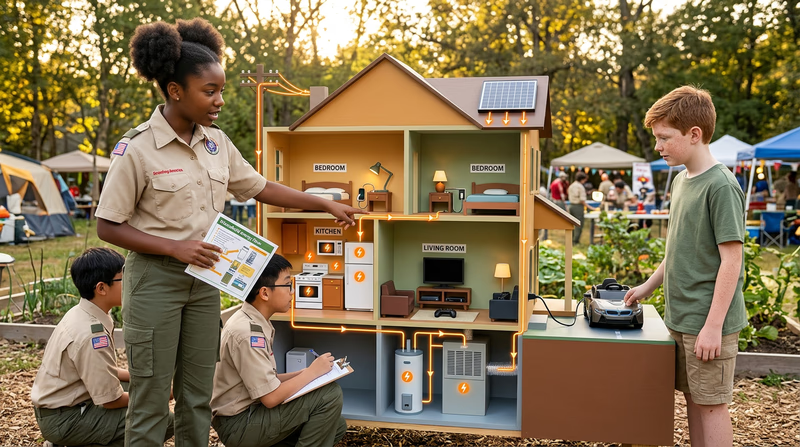
Finding Your Eight Energy Uses
Walk through your home and think about your daily routine. Here are common ways families consume energy:
At Home:
- Heating and cooling — Furnaces, air conditioners, heat pumps, and fans
- Hot water — Water heaters use a significant amount of energy (about 18% of home energy)
- Cooking — Gas or electric stoves, ovens, and microwaves
- Lighting — Overhead lights, lamps, and outdoor lighting
- Electronics — TVs, computers, gaming consoles, phones, and tablets
- Refrigeration — Your fridge runs 24/7, making it one of the biggest energy users in your home
- Laundry — Washing machines and especially dryers use substantial energy
- Dishwashing — Dishwashers use both electricity and hot water
Transportation:
- Family car(s) — Gasoline or diesel vehicles for commuting, errands, and activities
- School bus — Diesel-powered buses that transport students daily
- Air travel — Flying for vacations or family visits
- Recreational vehicles — ATVs, boats, or RVs
Energy Audit Walk-Through
Room-by-room checklist for identifying energy use- Kitchen: Stove, oven, microwave, refrigerator, dishwasher, small appliances
- Living room: TV, gaming systems, lighting, fans or space heaters
- Bedrooms: Lighting, chargers, alarm clocks, fans
- Bathroom: Hot water for showers/baths, hair dryers, heated towel racks
- Laundry room: Washer, dryer, iron
- Garage: Vehicles, power tools, garage door opener
- Whole house: HVAC system, water heater, outdoor lighting
Reducing Home Energy Consumption
Choose one home-related energy use and identify three ways to reduce it. Here is an example:
Example: Heating and Cooling
Adjust the thermostat — Lowering your thermostat by just 2°F in winter (or raising it 2°F in summer) can save about 5% on your heating and cooling bill. A programmable or smart thermostat can do this automatically when you are asleep or away.
Seal air leaks — Feel around windows, doors, and outlets for drafts. Weatherstripping and caulk are inexpensive fixes that can save 10–20% on heating and cooling costs.
Use fans strategically — Ceiling fans make a room feel 4–6°F cooler, letting you set the AC higher. In winter, reverse the fan direction to push warm air down from the ceiling.
Reducing Transportation Energy Consumption
Choose one transportation-related energy use and identify three ways to reduce it. Here is an example:
Example: Family Car
Combine trips — Instead of making three separate drives for errands, plan one loop that covers everything. Each cold start of your engine uses extra fuel.
Walk, bike, or carpool — For short trips (under two miles), walking or biking uses zero fossil fuel. For longer commutes, carpooling with neighbors or friends cuts per-person energy use in half or more.
Maintain the vehicle — Properly inflated tires improve fuel efficiency by up to 3%. Regular oil changes, clean air filters, and a well-tuned engine all help your car use less fuel.
Understanding Your Carbon Footprint
Your carbon footprint is the total amount of greenhouse gases (measured in CO2 equivalents) produced by your activities. The average American’s carbon footprint is about 16 tons of CO2 per year — one of the highest in the world. The global average is about 4 tons.
Every reduction in energy use shrinks your carbon footprint. Some reductions are bigger than others:
- Switching to a fuel-efficient or electric vehicle can save 2–5 tons of CO2 per year
- Improving home insulation can save 1–2 tons per year
- Switching to LED bulbs throughout your home saves about 0.5 tons per year
🎬 Video: How to Reduce Your Carbon Footprint — https://www.youtube.com/watch?v=J_iDcKDAwbA
Req 5c — Reducing Home Energy
Practical Energy Reductions
This requirement goes beyond just identifying energy use — it asks you to propose real changes, weigh the pros and cons, and actually try implementing some of them. Here are strategies to consider, along with their benefits and risks.
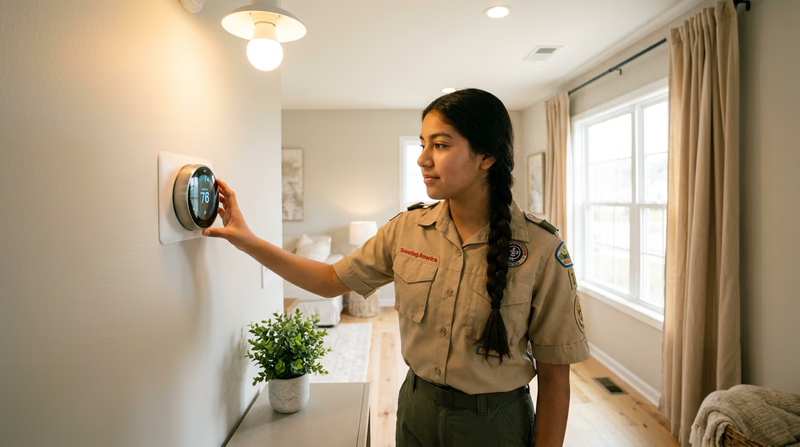
1. Adjust Your Thermostat
What to do: Lower the thermostat 2–3°F in winter and raise it 2–3°F in summer. Use a programmable thermostat to reduce heating/cooling when nobody is home or everyone is asleep.
Benefits:
- Saves 5–10% on heating and cooling costs per degree adjusted
- Reduces greenhouse gas emissions from energy generation
- No cost to implement
Risks:
- Family members may feel uncomfortable at first (bodies adjust in a few days)
- In extreme climates, setting the thermostat too low in winter could risk frozen pipes
2. Use Window Shades Strategically
What to do: In summer, close blinds and curtains on sun-facing windows during the hottest part of the day. In winter, open south-facing curtains during the day to let sunlight warm the room, then close them at night to insulate.
Benefits:
- Reduces cooling costs by up to 33% in summer
- Free solar heating in winter
- No cost to implement with existing curtains
Risks:
- Rooms may feel darker with curtains closed
- Requires daily attention to open and close at the right times
3. Reduce Hot-Water Temperature
What to do: Lower your water heater temperature from the default 140°F to 120°F. Most households will not notice the difference.
Benefits:
- Saves 4–22% on water heating costs
- Reduces the risk of scalding burns (especially important for young children)
- Slows mineral buildup in the water heater, extending its life
Risks:
- Water may feel slightly less hot in the shower (most people adjust quickly)
- Dishwashers may need a booster heater if they require higher temperatures (most modern ones have built-in heaters)
4. Switch to LED Lighting
What to do: Replace incandescent and CFL bulbs with LED bulbs throughout your home.
Benefits:
- LEDs use 75% less energy than incandescent bulbs
- They last 25 times longer (about 25,000 hours)
- They produce less heat, which slightly reduces cooling costs in summer
Risks:
- Higher upfront cost per bulb (though the savings pay for themselves within months)
- Some people prefer the warmer color of incandescent light (LEDs now come in warm tones too)
5. Open Windows for Natural Ventilation
What to do: On mild days, turn off the AC and open windows to let fresh air circulate. Use window fans to create cross-ventilation.
Benefits:
- Zero energy cost for cooling
- Improves indoor air quality with fresh air circulation
- Reduces wear on your HVAC system
Risks:
- Not practical on very hot, very cold, or very humid days
- May let in pollen (a concern for allergy sufferers)
- Security considerations — do not leave ground-floor windows open when away
6. Unplug “Vampire” Electronics
What to do: Many devices draw power even when turned off — this is called “phantom” or “vampire” power. Unplug chargers, gaming consoles, TVs, and small appliances when not in use, or use a power strip with an on/off switch.
Benefits:
- Saves 5–10% on your electricity bill
- Reduces unnecessary energy waste
- Power strips make it easy — one switch cuts power to multiple devices
Risks:
- Inconvenience of unplugging and replugging devices
- Some devices (like DVRs or smart home hubs) need constant power to function properly
7. Air-Dry Clothes
What to do: Use a clothesline or drying rack instead of the dryer, especially in warm weather.
Benefits:
- Clothes dryers are one of the most energy-hungry appliances in your home
- Air-drying is gentler on fabrics, making clothes last longer
- Zero energy cost
Risks:
- Takes longer than machine drying (plan ahead)
- Weather-dependent for outdoor drying
- May not be allowed by HOA rules in some communities (though many states have “right to dry” laws)
Implementing Your Changes
Pick at least two or three changes that you can actually implement in your home. Track the results if possible:
- Compare your electric or gas bill before and after the changes
- Note which changes your family adopted easily and which ones they resisted
- Record any unexpected benefits (like better sleep with a cooler bedroom)
🎬 Video: How to Reduce Energy Consumption in Your Home — https://www.youtube.com/watch?v=AKcfc2WXIWY
Req 6a — Needs vs. Wants
Choose ONE of requirements 6a, 6b, or 6c. This page covers option 6a. Read all three options before deciding which one interests you most.
Needs vs. Wants
Every item you own falls somewhere on a spectrum between “absolutely necessary for survival” and “nice to have.” Understanding the difference between needs and wants is one of the most important skills in sustainability — because the more stuff we buy, produce, transport, and eventually throw away, the more resources we consume.
Needs are things required for health, safety, and basic functioning:
- Soap, toothbrush, and hygiene products
- Clothing appropriate for the weather
- School supplies
- Food and water
- A bed and blankets
Wants are things that make life more enjoyable but are not essential:
- Video games and gaming consoles
- Decorative items and collectibles
- Extra pairs of shoes beyond what you need
- The latest phone when your current one works fine
The line is not always clear. A phone is a want if you are thinking about the newest model — but a basic phone might be a need for safety and communication. A winter coat is a need — but a designer winter coat is a want.
Creating Your List
Look around your room, closet, bathroom, and wherever you keep your personal belongings. Choose 15 items that represent a mix of different types of stuff. For each item, ask yourself:
- Do I need this to stay healthy, safe, or able to do my daily responsibilities? If yes, it is a need.
- Would I be fine without this? If yes, it is a want.
- Have I used this in the past month? If no, it might be excess.
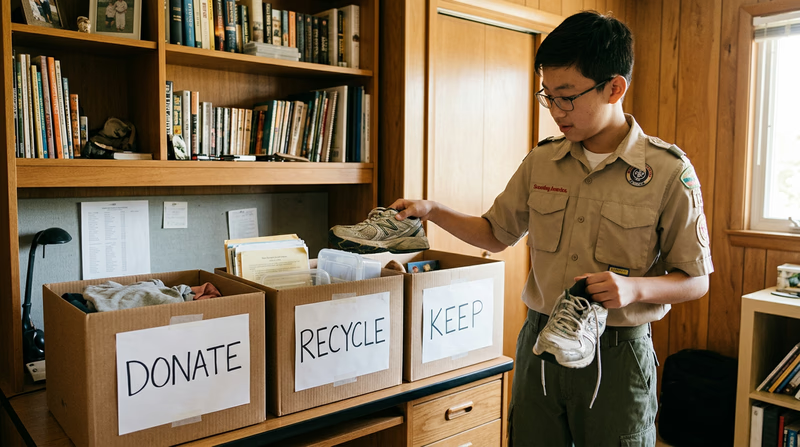
Dealing with Excess Stuff
Once you have classified your items, look for things you no longer need or use. Work with your family to decide what to do with them:
Donate
Items in good condition can go to organizations like Goodwill, Salvation Army, or local shelters. Clothing, books, sports equipment, and household items are always needed. Some organizations will even pick up donations from your home.
Repurpose
Get creative. An old t-shirt can become a cleaning rag. A jar can store art supplies. A bookshelf can be refinished instead of thrown away. Repurposing keeps items out of the landfill and gives them a second life.
Recycle
Electronics, batteries, and certain plastics should not go in the regular trash. Find local recycling drop-off locations for:
- Old phones, tablets, and computers (many electronics stores accept these)
- Batteries (check your local recycling center)
- Clothing that is too worn to donate (some stores have textile recycling programs)
Sell or Swap
Garage sales, online marketplaces, and Scout troop swap events let you pass items to someone who will use them — and maybe earn a little money in the process.
Req 6b — Impact of Too Much Stuff
The Hidden Cost of Too Much Stuff
We live in a culture that constantly encourages buying more. Advertisements, social media, sales events, and peer pressure all push us to accumulate things. But all that stuff comes with hidden costs that go far beyond the price tag.
Five Ways Too Much Stuff Affects Us
1. Financial Strain
Every item you buy costs money — but the expenses do not stop at the register.
- Purchase cost: The obvious expense of buying things
- Maintenance: Items need cleaning, repairing, updating, and replacing parts (think about how much video game controllers cost to replace)
- Storage: When your home fills up, some families rent storage units — the average cost is $100–$200 per month
- Insurance: More stuff means higher insurance premiums to protect it all
- Opportunity cost: Money spent on stuff you do not need is money you cannot spend on experiences, savings, or things that matter more
2. Time Drain
Stuff demands your time in ways you might not notice:
- Shopping: Browsing, comparing, purchasing, and returning items
- Organizing: Sorting, arranging, and reorganizing closets, drawers, and shelves
- Cleaning: More items means more surfaces to dust, more things to wash, and more clutter to manage
- Maintenance and repair: Fixing, updating, and servicing items
- Decision fatigue: Research shows that having too many choices drains mental energy and makes even simple decisions harder
3. Health Effects
The connection between stuff and health is stronger than most people realize:
- Stress and anxiety: Studies show that cluttered environments increase cortisol (the stress hormone) levels. People in cluttered homes report feeling more overwhelmed and less able to relax.
- Physical hazards: Cluttered homes have higher risks of falls, fire, and pest infestations
- Air quality: Stored items collect dust, mold, and allergens
- Mental health: Hoarding — the extreme end of accumulation — is recognized as a mental health disorder
4. Community Impact
Too much stuff at the individual level adds up to community-wide problems:
- Landfill pressure: Communities must build and maintain landfills, which take up land, produce methane, and can contaminate groundwater
- Traffic and congestion: Shopping trips and delivery trucks add to traffic, noise, and air pollution
- Resource strain: Water, energy, and raw materials used to produce consumer goods put pressure on local and regional resources
5. Global Consequences
The global picture is even bigger:
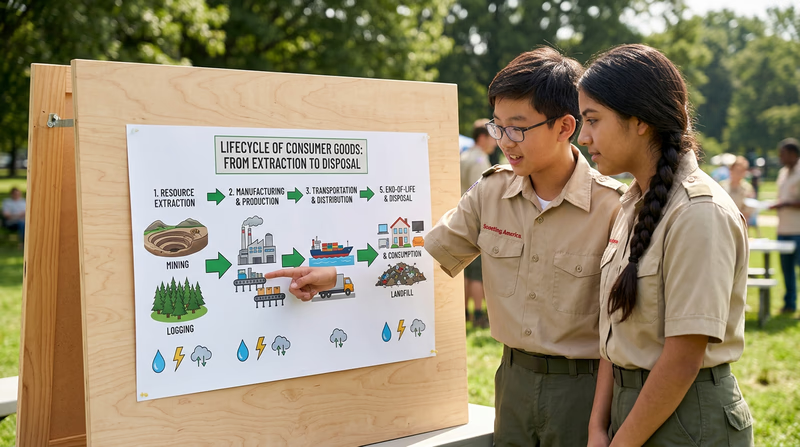
- Resource depletion: Mining, drilling, and harvesting raw materials destroys ecosystems worldwide
- Carbon emissions: Manufacturing, shipping, and disposing of goods generates enormous greenhouse gas emissions
- Ocean pollution: An estimated 8 million tons of plastic enters the oceans every year, much of it from consumer products and packaging
- Labor exploitation: The demand for cheap goods drives poor working conditions in factories around the world
Practices to Avoid Accumulating Too Much
The 30-Day Rule
When you want to buy something non-essential, wait 30 days. If you still want it after a month, consider buying it. Most impulse desires fade within a few days.
One In, One Out
For every new item you bring home, donate or recycle one item of similar type. This keeps your total amount of stuff from growing.
Borrow Before You Buy
Need a tool for a one-time project? Borrow it from a neighbor. Want to try a new hobby? Rent or borrow equipment before investing in your own. Libraries lend far more than books — many offer tools, games, and sporting equipment.
Experience Over Things
Research consistently shows that spending money on experiences (camping trips, concerts, cooking classes) brings more lasting happiness than buying physical objects. Memories do not need storage.
Quality Over Quantity
One well-made item that lasts 10 years is more sustainable than three cheap versions that each last two years. Investing in quality reduces long-term consumption.
🎬 Video: Why Do We Have So Much Stuff? — https://www.youtube.com/watch?v=KtWlmbDsx-U
Req 6c — Waste & Recycling
How Waste Affects the Environment
Every piece of trash you throw away has to go somewhere — and that “somewhere” affects the land, water, and air around it.
Impact on Land
Most waste ends up in landfills — engineered sites where trash is buried. In the U.S., there are about 2,600 active landfills. They take up enormous amounts of space, and despite engineering controls, they can leak toxic chemicals into surrounding soil. Landfills also generate leachate — liquid that seeps through decomposing trash and can contaminate groundwater if the liner fails.
Illegal dumping in forests, fields, and vacant lots damages habitats, introduces toxins into soil, and makes areas unsafe for wildlife and people.
Impact on Water
Waste that is not properly managed often ends up in waterways. Plastic bags, bottles, food packaging, and industrial waste flow into rivers, lakes, and oceans. This pollution:
- Kills marine life (animals mistake plastic for food or become entangled)
- Introduces microplastics into the food chain
- Contaminates drinking water sources
- Creates “dead zones” where decomposing waste depletes oxygen, killing fish and other aquatic life
Impact on Air
Landfills produce methane — a greenhouse gas about 80 times more potent than CO2 over a 20-year period. Burning waste (incineration) releases CO2, dioxins, and heavy metals into the atmosphere. Even transporting waste in diesel trucks generates significant air pollution.
The Trash Vortex (Great Pacific Garbage Patch)
The Great Pacific Garbage Patch — also called the trash vortex — is a massive concentration of plastic debris in the North Pacific Ocean. It is located between Hawaii and California and covers an area estimated at twice the size of Texas.
How It Formed
Ocean currents form large circular patterns called gyres. The North Pacific Subtropical Gyre slowly rotates clockwise, trapping floating debris in its center. Over decades, plastic waste from coastal communities, ships, and rivers across the Pacific Rim has accumulated in this zone.
The patch is not a solid island of trash — it is more like a cloudy soup of plastic fragments, many smaller than a grain of rice (microplastics). These particles are nearly impossible to clean up and are consumed by fish, seabirds, and marine mammals throughout the food chain.
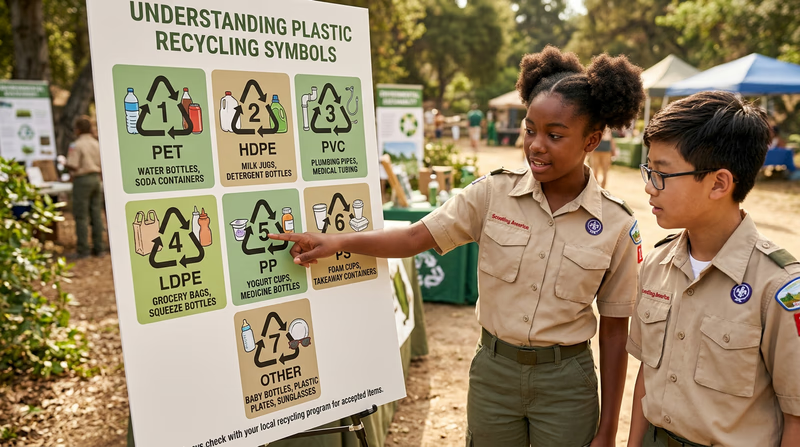
Plastic Recycling Numbers
Look at the bottom of any plastic container and you will see a number inside a triangle of arrows. This resin identification code tells you what type of plastic the item is made from:
| Number | Plastic Type | Common Products | Commonly Recycled? |
|---|---|---|---|
| 1 — PET/PETE | Polyethylene terephthalate | Water bottles, soda bottles | Yes — widely recycled |
| 2 — HDPE | High-density polyethylene | Milk jugs, detergent bottles | Yes — widely recycled |
| 3 — PVC | Polyvinyl chloride | Pipes, window frames | Rarely recycled |
| 4 — LDPE | Low-density polyethylene | Plastic bags, squeeze bottles | Sometimes (special drop-off) |
| 5 — PP | Polypropylene | Yogurt cups, bottle caps | Increasingly recycled |
| 6 — PS | Polystyrene (Styrofoam) | Takeout containers, packing peanuts | Rarely recycled |
| 7 — Other | Mixed or specialty plastics | Water cooler bottles, some food containers | Rarely recycled |
Key takeaway: Only plastics #1 and #2 are consistently recycled across the U.S. The rest often end up in landfills even if you put them in the recycling bin. Check your local recycling program’s website to find out exactly which numbers they accept.
Electronic Waste (E-Waste)
E-waste includes any discarded electronic device — phones, computers, TVs, game consoles, and more. It is the fastest-growing waste stream in the world.
Device Lifespans
The average lifespan of common electronics varies widely:
- Smartphone: 2–4 years (most people replace them every 2–3 years)
- Laptop computer: 3–5 years
- Desktop computer: 5–8 years
- Television: 7–10 years
- Game console: 5–7 years
- Tablet: 3–5 years
Why E-Waste Matters
Electronics contain valuable materials (gold, silver, copper, rare earth metals) alongside hazardous substances (lead, mercury, cadmium). When e-waste goes to a landfill, those toxic materials can leach into soil and groundwater. When it is properly recycled, those valuable materials can be recovered and reused.
Recycling Electronics
Most electronics can be recycled in whole or in part:
- Best Buy, Staples, and Apple stores accept old electronics for recycling
- Manufacturer take-back programs (Dell, HP, Samsung) let you mail back old devices
- Local e-waste collection events are held in many communities
- Certified e-waste recyclers (look for R2 or e-Stewards certification) ensure responsible recycling
For your counselor discussion, pick one electronic device in your household and research its average lifespan, what happens when it is discarded, and your local options for recycling it.
🎬 Video: The Great Pacific Garbage Patch — https://www.youtube.com/watch?v=dtaNqGyHkNE
Req 7a — UN Development Goals
Choose TWO of requirements 7a through 7f. This page covers option 7a. Read all six options before deciding which two interest you most.
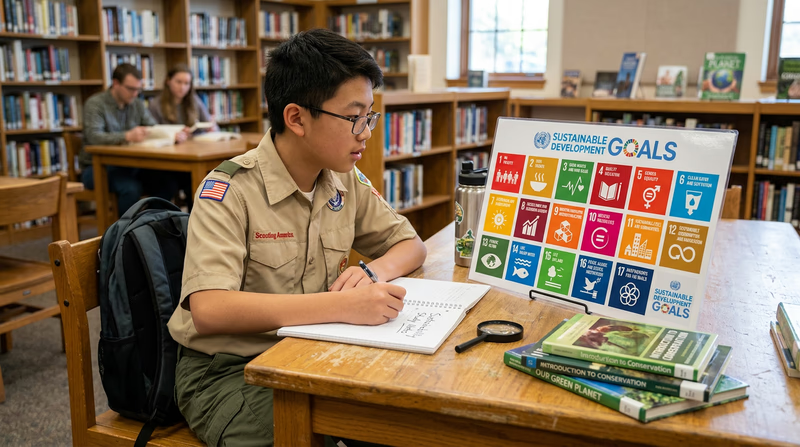
What Are the Sustainable Development Goals?
In 2015, all 193 member nations of the United Nations adopted the 2030 Agenda for Sustainable Development — a shared blueprint for peace and prosperity for people and the planet. At its heart are 17 Sustainable Development Goals (SDGs), each targeting a specific global challenge.
The SDGs are ambitious targets to be achieved by 2030. They recognize that ending poverty, improving health and education, reducing inequality, and protecting the environment are all connected — you cannot solve one without addressing the others.
The Eight Goals You Can Choose From
The requirement focuses on eight of the 17 SDGs. Here is a brief overview of each:
SDG 2 — Zero Hunger
Aim: End hunger, achieve food security, improve nutrition, and promote sustainable agriculture.
- 828 million people worldwide are chronically hungry
- Climate change threatens crop yields in the most vulnerable regions
- Connects to food waste, sustainable farming, and equitable food distribution
SDG 6 — Clean Water and Sanitation
Aim: Ensure availability and sustainable management of water and sanitation for all.
- 2 billion people lack safely managed drinking water
- 3.6 billion people lack safely managed sanitation
- Connects to water conservation, pollution prevention, and ecosystem health
SDG 7 — Affordable and Clean Energy
Aim: Ensure access to affordable, reliable, sustainable, and modern energy for all.
- 675 million people worldwide have no access to electricity
- Fossil fuels remain the dominant energy source globally
- Connects to renewable energy, energy efficiency, and carbon emissions
SDG 11 — Sustainable Cities and Communities
Aim: Make cities and human settlements inclusive, safe, resilient, and sustainable.
- More than half of the world’s population lives in cities
- Cities consume over 75% of global energy and produce 70% of carbon emissions
- Connects to transportation, green buildings, and urban planning
SDG 12 — Responsible Consumption and Production
Aim: Ensure sustainable consumption and production patterns.
- The global material footprint is growing faster than population
- One-third of food is wasted globally each year
- Connects to reducing waste, recycling, and making sustainable choices
SDG 13 — Climate Action
Aim: Take urgent action to combat climate change and its impacts.
- Global temperatures have risen about 1.1°C above pre-industrial levels
- Extreme weather events are increasing in frequency and severity
- Connects to greenhouse gas emissions, adaptation, and resilience
SDG 14 — Life Below Water
Aim: Conserve and sustainably use the oceans, seas, and marine resources.
- Oceans absorb about 30% of CO2 produced by humans
- Overfishing threatens 34% of global fish stocks
- Connects to ocean pollution, marine biodiversity, and coastal communities
SDG 15 — Life on Land
Aim: Protect, restore, and promote sustainable use of terrestrial ecosystems.
- Forests cover 31% of Earth’s land area but are shrinking rapidly
- 1 million plant and animal species are threatened with extinction
- Connects to deforestation, soil degradation, and biodiversity loss
How to Approach This Requirement
Pick the goal that interests you most and research it in depth. For your discussion with your counselor, be ready to cover:
The Goal Itself
- What specific problem does it address?
- What are the measurable targets?
- How much progress has been made so far?
Impact on You and Your Family
- How does this issue affect your daily life?
- What actions does your family already take that support this goal?
- What could you do differently?
Impact on Your Community
- Are there local organizations working on this issue?
- How does your community contribute to the problem or the solution?
- What local policies or programs address this goal?
Impact on the World
- Which countries or regions are most affected?
- What are the biggest obstacles to achieving this goal by 2030?
- What gives you hope about progress?
🎬 Video: UN Sustainable Development Goals - Overview — https://www.youtube.com/watch?v=M-iJM02m_Hg
Req 7b — Planetary Life-Support Systems
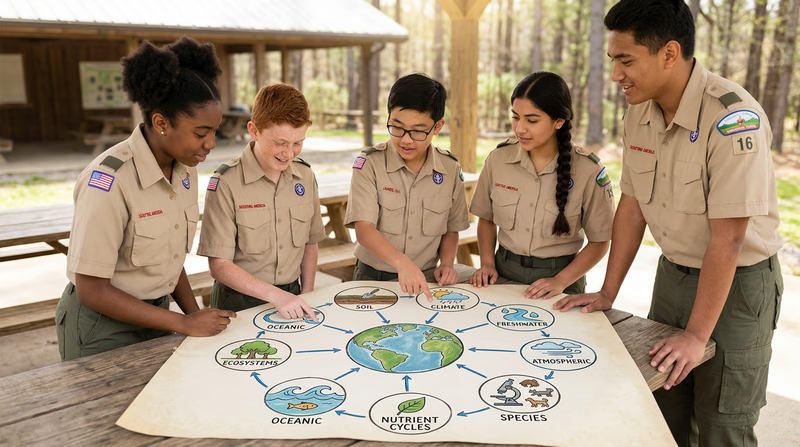
Earth’s Life-Support Systems
Think of Earth as a spaceship — the only one we have. Just like a spaceship has life-support systems that provide air, water, food, and temperature control, Earth has natural systems that make life possible. These systems are interconnected, and if one fails or weakens, the others are affected.
Soil
Soil is far more than dirt. It is a living system teeming with bacteria, fungi, insects, and worms. Soil:
- Grows 95% of the world’s food
- Filters and stores water
- Stores more carbon than the atmosphere and all plant life combined
- Provides habitat for billions of organisms
When disrupted: Overfarming, deforestation, and construction strip away topsoil. It takes nature about 500 years to form one inch of topsoil — but erosion can remove it in a single storm.
Climate
Earth’s climate system — the long-term pattern of temperature, precipitation, and wind — determines where life can thrive. It is regulated by the atmosphere, oceans, ice caps, and land surfaces working together.
When disrupted: Burning fossil fuels adds greenhouse gases that trap heat, shifting weather patterns, melting ice, raising sea levels, and increasing extreme weather events worldwide.
Freshwater
Only 3% of Earth’s water is fresh, and most of that is locked in ice. The freshwater cycle — evaporation, precipitation, and flow through rivers, lakes, and aquifers — provides the water that all land-based life depends on.
When disrupted: Pollution, overuse, and climate change reduce freshwater availability. Aquifers that took thousands of years to fill are being drained in decades.
Atmospheric
The atmosphere is the thin layer of gases surrounding Earth. It provides oxygen for breathing, blocks harmful ultraviolet radiation (via the ozone layer), and regulates temperature through the greenhouse effect.
When disrupted: Air pollution from vehicles, factories, and fires degrades air quality. Excessive greenhouse gases cause the atmosphere to trap too much heat. Ozone-depleting chemicals (largely banned now) thinned the protective ozone layer.
Nutrient Cycles
Elements like carbon, nitrogen, and phosphorus cycle continuously through air, water, soil, and living organisms. These nutrient cycles are the chemical engines of life:
- The carbon cycle moves carbon through the atmosphere, oceans, soil, and living things
- The nitrogen cycle converts atmospheric nitrogen into forms plants can use
- The phosphorus cycle moves this essential nutrient through rocks, soil, water, and organisms
When disrupted: Burning fossil fuels floods the carbon cycle with excess CO2. Agricultural fertilizers overload waterways with nitrogen and phosphorus, causing algal blooms and dead zones.
Oceanic
Oceans cover 71% of Earth’s surface and play a critical role in regulating climate, absorbing CO2, producing oxygen, and supporting food chains.
When disrupted: Ocean acidification (from absorbing excess CO2) threatens coral reefs and shellfish. Overfishing collapses food webs. Plastic pollution and chemical runoff poison marine life.
Ecosystems
An ecosystem is a community of living organisms interacting with their physical environment — a coral reef, a prairie, a rainforest, a wetland. Each ecosystem provides specific services: pollination, water filtration, flood control, carbon storage, and habitat.
When disrupted: Habitat destruction, pollution, and invasive species can collapse entire ecosystems. When a wetland is drained, the community loses flood protection and water filtration.
Species
Every species plays a role in its ecosystem. Pollinators enable food production. Predators control prey populations. Decomposers recycle nutrients. Biodiversity — the variety of life — is the foundation of ecosystem resilience.
When disrupted: When species go extinct, the ecosystem loses functions that may not be replaceable. The decline of bee populations, for example, threatens the pollination of crops worldwide.
How These Systems Interact
None of these systems operate in isolation. Here are key interactions:
- Climate affects freshwater — Warming temperatures melt glaciers, change rainfall patterns, and intensify droughts and floods
- Oceans regulate climate — Oceans absorb heat and CO2, acting as a buffer — but their capacity has limits
- Soil supports ecosystems — Healthy soil grows healthy plants, which support animals, which support other animals
- Nutrient cycles connect everything — Carbon, nitrogen, and water move through atmosphere, ocean, soil, and living things in continuous loops
- Species maintain ecosystems — Remove a keystone species and the entire ecosystem can unravel
🎬 Video: Earth's Interconnected Cycles — https://www.youtube.com/watch?v=6j5iHvYBIcg
Req 7c — Product Life Cycles
What Is a Product Life Cycle?
Every product you own — your phone, your shoes, your backpack — went through a journey before it reached you and will continue on a journey after you are done with it. This journey is called the product life cycle, and it has five stages:
- Design — The product is conceived, engineered, and planned
- Sourcing — Raw materials are extracted or harvested
- Production — Materials are manufactured into the finished product
- Use — You buy and use the product
- Disposal or Reuse — The product is thrown away, recycled, repurposed, or composted
Each stage consumes resources and generates waste. Understanding the full life cycle helps you see the true environmental cost of the things you buy.
The Five Stages in Detail
Stage 1: Design
Sustainability starts — or fails — at the design stage. Designers make choices that determine:
- How long the product will last
- Whether it can be repaired or upgraded
- What materials it uses
- Whether it can be recycled at the end of its life
- How much packaging is needed
Sustainable design considers the entire life cycle from the start. Products designed for durability, repairability, and recyclability have a much smaller environmental footprint than disposable products.
Stage 2: Sourcing
Raw materials must come from somewhere. Mining metals, drilling for oil, harvesting timber, and growing cotton all have environmental impacts:
- Habitat destruction from mining and deforestation
- Water pollution from chemical processing
- Energy use and carbon emissions from extraction
- Labor conditions in mines and farms
Stage 3: Production
Manufacturing turns raw materials into finished products. This stage involves:
- Energy consumption (often from fossil fuels)
- Water use for cooling, cleaning, and processing
- Chemical emissions and waste
- Transportation of materials between factories
Stage 4: Use
This is the stage you are most familiar with. How you use a product affects its sustainability:
- How long you keep it before replacing it
- How well you maintain it
- How much energy or water it consumes during use (for appliances, vehicles, etc.)
Stage 5: Disposal or Reuse
What happens at the end of a product’s life determines whether its materials are lost forever or returned to the cycle:
- Landfill — Materials are buried and lost (least sustainable)
- Incineration — Burned for energy, but releases emissions
- Recycling — Materials are processed into new products
- Composting — Organic materials return nutrients to the soil
- Reuse/Repurpose — The product or its parts find a new life
Example: Life Cycle of a T-Shirt
Here is what the full life cycle looks like for a common cotton t-shirt:
Design
A designer creates the shirt pattern, selects cotton as the material, and chooses dyes and printing methods. Decisions about thread count, stitching quality, and fabric weight determine how long the shirt will last.
Sourcing
Cotton is grown on farms, primarily in China, India, the United States, and Brazil. Growing cotton requires:
- About 700 gallons of water for one shirt’s worth of cotton
- Pesticides and fertilizers (cotton uses about 16% of the world’s insecticides)
- Significant land area
Production
The cotton is spun into thread, woven into fabric, cut, sewn, dyed, and printed. This typically happens across multiple countries:
- Cotton might be grown in Texas
- Spun into yarn in India
- Woven into fabric in China
- Sewn into a shirt in Bangladesh
- Shipped to a warehouse in New Jersey
- Trucked to a store near you
Use
You wear and wash the shirt. Each wash uses water and energy and releases microfibers (tiny plastic or fiber particles) into waterways. The average t-shirt is worn about 30–40 times before being discarded.
Disposal or Reuse
- Best case: Donated, resold, or turned into rags or insulation
- Worst case: Thrown in the trash, where it takes 40+ years to decompose in a landfill — releasing methane as it breaks down
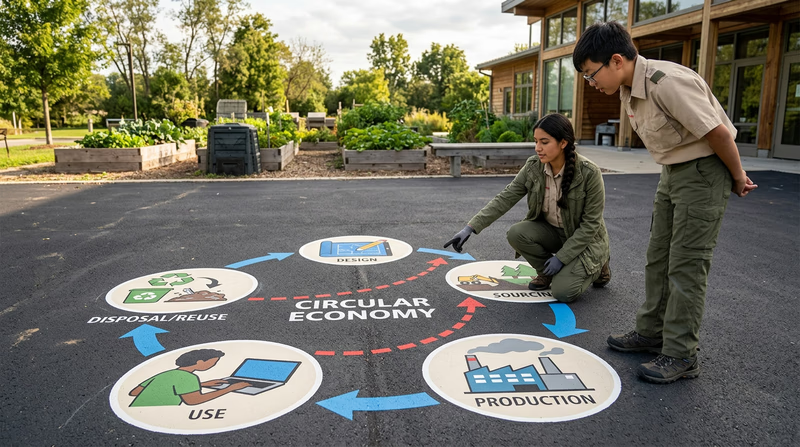
🎬 Video: Product Life Cycle Assessment — https://www.youtube.com/watch?v=-9JRowyICbo
Req 7d — Population & Sustainability
Population and the Planet
In 1800, about 1 billion people lived on Earth. By 1960, it was 3 billion. Today, the world’s population is over 8 billion. The United Nations projects it will peak at around 10.4 billion near the end of this century before slowly declining.
More people means more demand for food, water, energy, housing, and materials. But population size alone does not tell the whole story — how people live matters just as much as how many people there are. A person in the United States consumes roughly 30 times more resources than a person in some developing nations.
The Impact of Population Growth
Population growth puts pressure on Earth’s systems in several ways:
- Food: More mouths to feed means more farmland, more water for irrigation, and more fertilizer — all of which strain the environment
- Water: Growing populations in water-scarce regions intensify competition for limited freshwater
- Energy: More people need more electricity, more heating and cooling, and more transportation fuel
- Housing: Urban expansion converts natural land into cities, suburbs, and infrastructure
- Waste: More people produce more garbage, more sewage, and more pollution
Three Human Activities That Put Earth at Risk
1. Burning Fossil Fuels
Fossil fuel combustion — for electricity, transportation, heating, and industry — is the single largest source of greenhouse gas emissions. These emissions trap heat in the atmosphere, driving climate change that affects every part of the planet:
- Rising global temperatures
- More frequent and intense storms, droughts, and heat waves
- Melting ice caps and rising sea levels
- Ocean acidification
- Shifting ecosystems and agricultural zones
The burning of coal, oil, and natural gas has increased CO2 levels in the atmosphere by about 50% since the Industrial Revolution. Even with growing use of renewable energy, fossil fuels still provide about 80% of the world’s energy.
2. Deforestation and Land Use Change
Humans have cleared roughly half of Earth’s original forests. Deforestation continues at a rate of about 10 million hectares per year — an area roughly the size of South Korea lost every single year. This happens for:
- Agriculture (especially cattle ranching and palm oil production)
- Logging for timber and paper
- Urban expansion
- Mining
Forests are critical for sustainability — they absorb CO2, produce oxygen, regulate rainfall, prevent erosion, and support biodiversity. When forests are destroyed, all of these functions are lost, and the carbon stored in the trees is released into the atmosphere.
3. Industrial Agriculture
Modern farming feeds billions of people, but many of its practices are unsustainable:
- Monoculture (growing the same crop year after year) depletes soil nutrients and increases vulnerability to pests
- Chemical fertilizers and pesticides contaminate waterways and harm pollinators
- Livestock production generates about 14.5% of global greenhouse gas emissions and uses vast amounts of land and water
- Overfishing depletes ocean fish stocks faster than they can reproduce
The challenge is not to stop farming — it is to farm in ways that can sustain food production for future generations without destroying the ecosystems that make farming possible.
What Can Be Done?
Understanding the problem is the first step. Solutions include:
- Transitioning to renewable energy to reduce fossil fuel dependence
- Protecting and restoring forests through conservation policies and reforestation
- Adopting sustainable agriculture practices like crop rotation, reduced chemical use, and regenerative farming
- Reducing consumption in wealthy nations, where per-person resource use is highest
- Investing in education — studies show that when education levels rise (especially for women and girls), population growth rates naturally decline
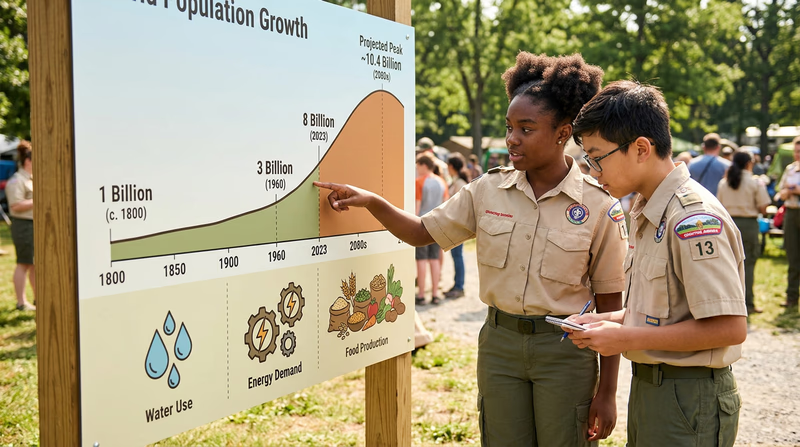
🎬 Video: How Population Growth Impacts the Planet — https://www.youtube.com/watch?v=mRcxGJcBDVo
Req 7e — Species Decline
What Is Species Decline?
Species decline refers to the reduction in the number of individuals within a species over time. When a population shrinks significantly, the species becomes increasingly vulnerable. If the decline continues unchecked, the species may become endangered (at risk of extinction) or eventually extinct (gone forever).
Species decline is not just about individual animals or plants disappearing. It is about the unraveling of entire ecosystems. Every species plays a role — as predator, prey, pollinator, decomposer, or engineer of its habitat. When one species declines, the effects ripple through the food web.
The Scale of the Problem
Scientists estimate that species are currently going extinct at a rate 1,000 times higher than the natural background rate. The International Union for Conservation of Nature (IUCN) Red List — the world’s most comprehensive assessment of species status — currently lists:
- Over 44,000 species as threatened with extinction
- About 1 million plant and animal species at risk overall
- Recent steep declines in insects, amphibians, and freshwater species
Human Activities That Cause Species Decline
Habitat Destruction
This is the number one cause of species decline worldwide. When forests are cleared, wetlands are drained, prairies are plowed, or coral reefs are damaged, the species that depend on those habitats lose their homes. Urban expansion, agriculture, and infrastructure development are the biggest drivers.
Pollution
Pesticides, herbicides, industrial chemicals, plastics, and excess nutrients from fertilizers contaminate air, water, and soil. These pollutants can:
- Poison wildlife directly
- Disrupt reproduction (some chemicals mimic hormones)
- Contaminate food sources
- Create dead zones in waterways
Overexploitation
Overfishing, overhunting, and illegal wildlife trade remove species faster than they can reproduce. Some species are targeted for food, medicine, fashion, or the exotic pet trade.
Invasive Species
When humans introduce species to new environments — intentionally or accidentally — those species can outcompete, prey upon, or bring diseases to native species. Invasive species are one of the top five causes of biodiversity loss.
Climate Change
Rising temperatures, changing rainfall patterns, and more extreme weather events force species to adapt, migrate, or die. Many species cannot move or adapt fast enough to keep up with the rate of change. Coral reefs, for example, are extremely sensitive to warming oceans.
Reversing the Decline
Protect and Restore Habitat
The most effective way to help species recover is to protect the places they live. National parks, wildlife refuges, marine protected areas, and conservation easements all help. Habitat restoration — replanting forests, restoring wetlands, removing dams to reopen rivers — gives declining species room to recover.
Enforce Wildlife Protection Laws
Laws like the Endangered Species Act, the Migratory Bird Treaty Act, and international agreements like CITES (Convention on International Trade in Endangered Species) provide legal protection for threatened species.
Reduce Pollution
Cleaning up waterways, reducing pesticide use, eliminating single-use plastics, and controlling industrial emissions all reduce the toxic burden on wildlife.
Support Breeding and Reintroduction Programs
Zoos, aquariums, and wildlife agencies run captive breeding programs for critically endangered species. Successful reintroductions have brought species like the California condor, gray wolf, and American bison back from the brink.
Address Climate Change
Reducing greenhouse gas emissions slows the rate of environmental change, giving species more time to adapt.
Why Species Decline Matters for Sustainability
Biodiversity is not a luxury — it is the foundation of the ecosystems that provide food, clean water, clean air, medicine, and protection from natural disasters. When species decline:
- Pollination decreases — Fewer bees and butterflies mean lower crop yields
- Pest control weakens — Without predators, pest populations explode
- Water quality drops — Wetland species that filter water disappear
- Soil health declines — Earthworms, fungi, and microbes that build healthy soil are lost
- Ecosystem resilience drops — Less diverse ecosystems are more vulnerable to disease, drought, and other stresses
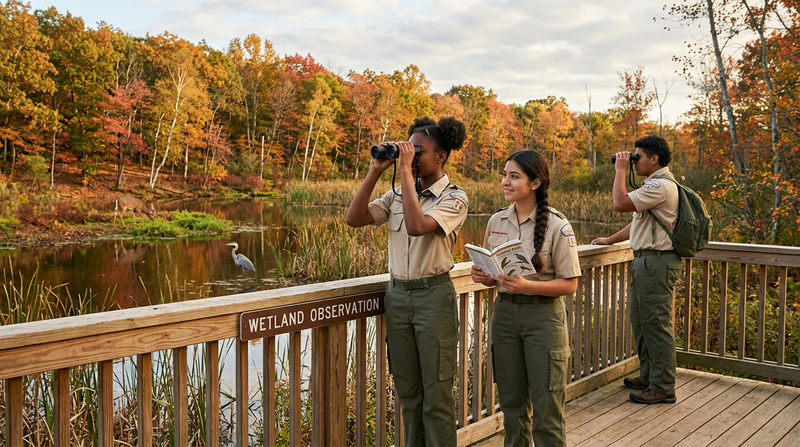
🎬 Video: Animal Extinction Explained — https://www.youtube.com/watch?v=2N8VkDcIhIk
Req 7f — Climate Change
Temperature Change Over 100+ Years
NASA and NOAA maintain detailed records of global temperatures dating back to 1880. These records show a clear pattern: Earth’s average surface temperature has risen by about 1.1°C (2°F) since the late 1800s, with most of the warming occurring since the 1970s.
World maps showing temperature change over time — called temperature anomaly maps — use color coding to show which regions have warmed and by how much. Key observations from these maps:
- The Arctic has warmed faster than any other region — about two to three times the global average
- Land areas have warmed faster than oceans — because water absorbs heat more slowly
- Every continent shows warming — there is no region that has cooled over the past century
- The most recent decade was the warmest on record — each of the last several years has ranked among the hottest ever measured
Three Factors That Affect Global Temperature
1. Greenhouse Gases
Certain gases in the atmosphere — primarily carbon dioxide (CO2), methane (CH4), and nitrous oxide (N2O) — trap heat from the sun like a blanket around Earth. This is called the greenhouse effect, and it is natural and necessary — without it, Earth would be too cold for life.
The problem is that human activities have dramatically increased the concentration of these gases:
- CO2 has risen about 50% since 1750, mainly from burning fossil fuels and deforestation
- Methane has more than doubled, from livestock, rice paddies, landfills, and natural gas leaks
- Nitrous oxide has risen about 20%, from agricultural fertilizers and industrial processes
2. Solar Activity
The sun’s energy output varies slightly over an 11-year cycle (and over longer periods). During periods of higher solar activity, Earth receives slightly more energy. However, solar changes account for only a small fraction of the warming observed since 1900 — scientists estimate solar activity explains less than 10% of recent temperature changes.
3. Volcanic Eruptions and Aerosols
Major volcanic eruptions inject sulfur dioxide and ash into the upper atmosphere, where they reflect sunlight and temporarily cool the planet. The eruption of Mount Pinatubo in 1991 cooled global temperatures by about 0.5°C for roughly two years.
Human-produced aerosols (tiny particles from burning coal, diesel, and other fuels) can have a similar cooling effect by reflecting sunlight. Ironically, cleaning up air pollution — while great for human health — may slightly accelerate warming by removing this cooling mask.
Climate Change and Sustainability
Climate change is not a separate problem from sustainability — it is woven into every aspect of it. Here is how it affects key resources:
Impact on Food
- Crop yields decline when temperatures exceed optimal growing ranges
- Droughts and floods destroy harvests and disrupt planting seasons
- Pest ranges expand as warmer temperatures allow insects to move into new areas
- Pollinators are disrupted as flowering seasons shift out of sync with pollinator lifecycles
Impact on Water
- Glaciers and snowpack that provide freshwater to billions of people are shrinking
- Drought intensity and duration are increasing in many regions
- Flooding is becoming more severe as warmer air holds more moisture
- Sea level rise threatens freshwater supplies in coastal areas through saltwater intrusion
Impact on Other Resources
- Forests face increased wildfire risk, pest outbreaks, and heat stress
- Fisheries are disrupted as ocean temperatures and chemistry change
- Energy systems are strained by increased cooling demand and extreme weather damage
- Infrastructure (roads, bridges, buildings) is damaged by extreme heat, flooding, and storms
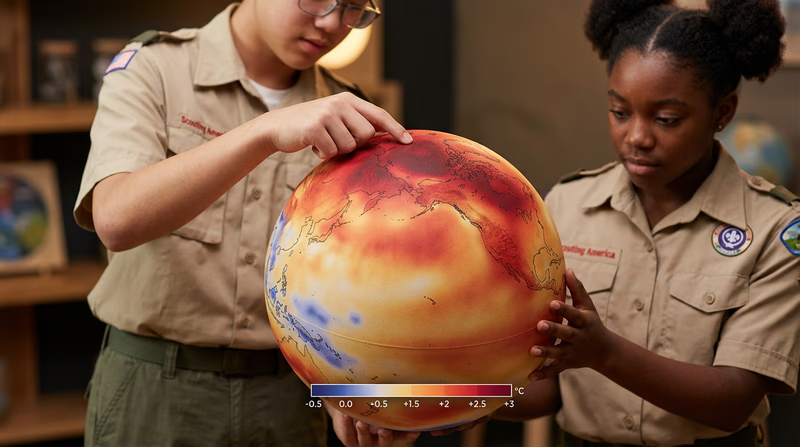
🎬 Video: Global Warming from 1880 to 2022 — https://www.youtube.com/watch?v=LwRTw_7NNJs
Req 8a — Campout Observations
Complete ALL of requirements 8a, 8b, and 8c.
Sustainability in the Field
Everything you have learned so far in this badge — water, food, energy, waste, communities — comes together when you step outdoors. A campout is a miniature community with its own resource needs and environmental impact. This requirement asks you to be a sustainability observer at an actual Scouting event.
What to Observe
Bring a notebook and pen to your next campout or outdoor activity. Pay attention to these eight areas:
Transportation
How did everyone get to the activity?
- Did families drive separately, or did you carpool?
- How far did people travel?
- Were there opportunities to reduce the number of vehicles?
- Did anyone bike, walk, or take public transit?
Forestry
How is the forested area managed?
- Are trails maintained to prevent erosion and protect root systems?
- Is firewood gathered responsibly (using dead and downed wood only)?
- Are living trees protected from damage (no cutting, carving, or stripping bark)?
- Is there evidence of sustainable forest management (trail markers, managed growth)?
Soil Conservation
How is the soil being treated?
- Are trails well-maintained to prevent erosion?
- Are tent sites on durable surfaces (established pads, gravel, rock) rather than delicate ground?
- Is there evidence of soil compaction or erosion from overuse?
- Are campfire areas contained to prevent soil damage?
Water Resources
How is water being used and protected?
- Is clean water available, and where does it come from?
- Are Scouts washing dishes and themselves at least 200 feet from water sources?
- Is gray water (from washing) being strained and dispersed properly?
- Are waterways free of litter and contamination?
Habitat
How are wildlife and natural habitats treated?
- Is food stored properly to avoid attracting wildlife (bear boxes, bear bags)?
- Are Scouts staying on trails to protect vegetation?
- Is wildlife observed from a distance without disturbance?
- Are nesting areas, dens, and sensitive habitats avoided?
Buildings
If the activity is at a camp with structures:
- Are buildings energy-efficient (LED lighting, insulation)?
- Is water used efficiently in bathrooms and kitchens?
- Are recycling and composting options available?
- Are buildings maintained with sustainable materials?
Campsites
How sustainable are the campsite practices?
- Are tents set up on established sites rather than creating new ones?
- Are campfires kept in existing fire rings?
- Is the campsite left cleaner than it was found?
- Are Leave No Trace principles being followed?
Sanitation
How is waste — both human and otherwise — managed?
- Are latrines or restrooms maintained properly?
- Is trash separated for recycling?
- Are pack-it-in, pack-it-out policies followed?
- Is human waste disposed of properly (cat holes at least 200 feet from water)?
Campout Observation Checklist
Bring this to your next outdoor activity- Transportation: How many vehicles? Carpooling used?
- Forestry: Firewood source? Tree protection?
- Soil: Trail conditions? Erosion evidence?
- Water: Distance from water sources? Proper dishwashing?
- Habitat: Food storage? Wildlife distance? Trail discipline?
- Buildings: Energy efficiency? Recycling available?
- Campsites: Established sites? Fire ring use? Cleanup?
- Sanitation: Waste disposal? Trash separation? Pack-it-out?
🎬 Video: What Does Leave No Trace Mean to Scouts? — https://www.youtube.com/watch?v=oTs29BZzf8U
Req 8b — Scout Values & Sustainability
Scouting Values Are Sustainability Values
You might not think of the Scout Oath and Scout Law as sustainability documents — but they contain ideas that align perfectly with living sustainably. This requirement asks you to make those connections explicit.
The Scout Oath and Sustainability
On my honor I will do my best to do my duty to God and my country and to obey the Scout Law; to help other people at all times; to keep myself physically strong, mentally awake, and morally straight.
- “Do my duty to my country” — Part of that duty is protecting the land, water, and air that make life in this country possible. Sustainability is patriotic.
- “Help other people at all times” — Sustainable practices help not only people alive today but future generations. Reducing waste, conserving water, and protecting ecosystems are all forms of helping others.
- “Keep myself physically strong” — Clean air, clean water, and healthy food are necessary for physical health. Sustainability protects the conditions that keep people strong.
- “Mentally awake” — Being aware of how your choices affect the environment and other people is exactly what sustainability requires.
The Scout Law and Sustainability
Each point of the Scout Law connects to sustainability:
- Trustworthy — When you commit to sustainable practices, people can count on you to follow through
- Loyal — Loyalty to your community means protecting its resources
- Helpful — Helping others includes leaving them a healthy planet
- Friendly — Building relationships across communities is key to social sustainability
- Courteous — Respecting shared spaces and resources is an act of courtesy to everyone who uses them
- Kind — Kindness extends to the natural world — treating animals, forests, and waterways with care
- Obedient — Following environmental regulations and Leave No Trace principles
- Cheerful — Approaching sustainability with a positive attitude inspires others to join in
- Thrifty — “A Scout is thrifty” is one of the most direct connections to sustainability. Using resources wisely, avoiding waste, and making things last are both thrifty and sustainable.
- Brave — Standing up for environmental protection, even when it is unpopular or inconvenient
- Clean — Keeping the environment clean is just as important as personal cleanliness
- Reverent — Reverence for creation motivates care for the natural world
Leave No Trace Seven Principles
The Leave No Trace principles are a direct guide to environmental sustainability in the outdoors — but they apply to daily life too:
Plan Ahead and Prepare — Planning meals reduces food waste. Planning trips reduces unnecessary driving. Planning purchases reduces impulse buying.
Travel and Camp on Durable Surfaces — In daily life, this means using existing infrastructure and pathways rather than damaging new areas.
Dispose of Waste Properly — Recycling, composting, and reducing trash at home is the everyday version of packing out your garbage.
Leave What You Find — Respecting natural spaces, historical sites, and shared resources instead of taking or damaging them.
Minimize Campfire Impacts — Using energy efficiently and minimizing your environmental impact at home mirrors this principle.
Respect Wildlife — Supporting biodiversity, avoiding products that harm wildlife, and keeping pets under control.
Be Considerate of Other Visitors — In daily life, this means being a good neighbor — keeping noise down, maintaining shared spaces, and considering how your actions affect others.
The Outdoor Code
As an American, I will do my best to — Be clean in my outdoor manners, Be careful with fire, Be considerate in the outdoors, and Be conservation-minded.
The Outdoor Code’s call to be conservation-minded is a direct charge to practice sustainability. Conservation — using resources wisely and protecting the natural world — is the heart of sustainability.
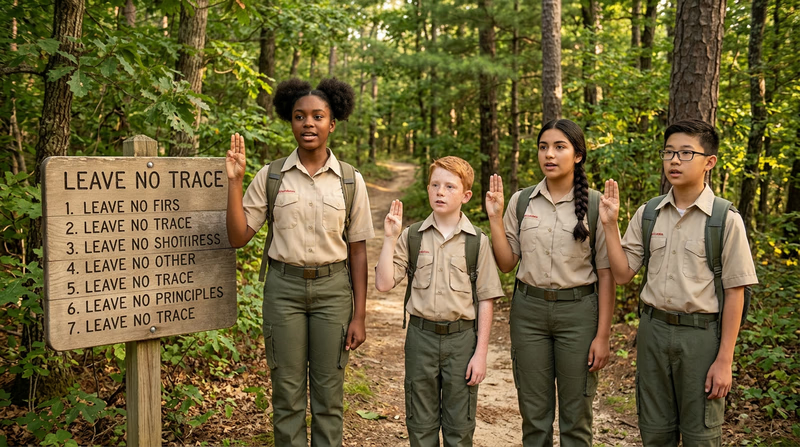
🎬 Video: Camping Tricks: The Scout Turn Around Rule LNT — https://www.youtube.com/watch?v=kc59VSGN-dg
Req 8c — Household Behavior Changes
Making Sustainability a Habit
By this point in the badge, you have explored water, food, energy, waste, communities, global challenges, and Scouting values. Now it is time to pull it all together and identify specific changes that you and your family can actually commit to.
The best behavioral changes are ones that are:
- Specific — Not “use less water” but “take showers under 5 minutes”
- Measurable — You can track whether you are doing it
- Achievable — It fits into your family’s lifestyle
- Impactful — It makes a real difference for sustainability
Behavior Change Ideas by Category
Water
- Shorter showers — Set a timer and keep showers to 5 minutes or less. Saves 10–15 gallons per shower.
- Full loads only — Run the dishwasher and washing machine only when they are completely full.
- Fix leaks — Make it a household rule to report and fix dripping faucets and running toilets within 48 hours.
Energy
- Unplug and switch off — Unplug chargers when not in use. Turn off lights when leaving a room. Use a power strip for electronics.
- Adjust the thermostat — Set a household agreement on temperature settings (68°F winter, 76°F summer) and stick to it.
- Line-dry clothes — Air-dry laundry when weather permits, reducing dryer energy use.
Food
- Meal planning — Plan meals for the week before grocery shopping to reduce impulse buys and food waste.
- Eat leftovers first — Before cooking something new, check the fridge for leftovers that need to be eaten.
- Start composting — Set up a compost bin for food scraps and yard waste.
Stuff and Waste
- Bring reusable bags — Keep reusable shopping bags in the car so they are always available.
- Refuse single-use — Say no to plastic straws, disposable utensils, and single-use water bottles.
- One in, one out — For every new item brought into the house, donate or recycle one similar item.
Transportation
- Walk or bike short trips — If a destination is within a mile, walk or bike instead of driving.
- Carpool — Coordinate with neighbors or friends for school drop-offs, sports practices, and Scout meetings.
- Combine errands — Plan car trips to cover multiple stops in one outing.
Getting Your Family on Board
Sustainability works best when the whole household participates. Here are strategies for getting your family involved:
Make It a Team Effort
Present your five changes as a family challenge rather than a lecture. “Hey, let’s see if we can cut our water bill by 10% this month” is more engaging than “We all need to use less water.”
Start with Quick Wins
Begin with changes that save money or make life easier — like meal planning (less food waste = lower grocery bill) or shorter showers (lower water bill). When people see results, they are more motivated to try harder changes.
Track Progress Together
Post a chart on the fridge showing your goals and progress. Celebrate milestones. Make it visible and fun.
Respect Different Comfort Levels
Not everyone will embrace every change immediately. If someone is not ready to give up long showers, maybe they are willing to carpool more. Find each person’s entry point.
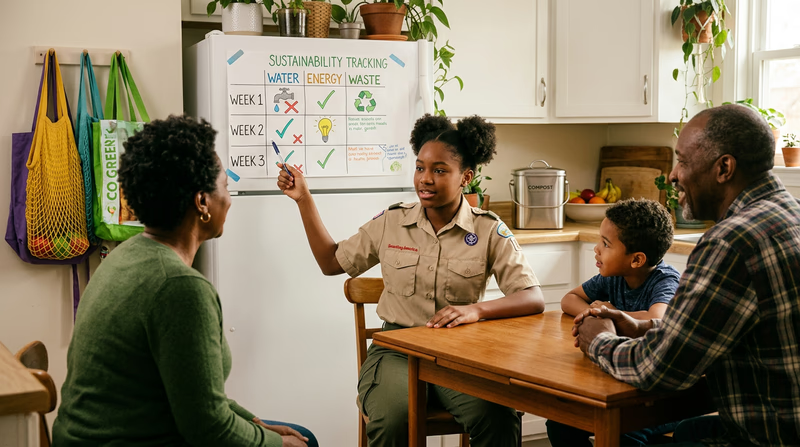
🎬 Video: Sustainability in Your Life — https://www.youtube.com/watch?v=kZIrIQDf1nQ
Req 9 — Career Exploration
Careers in Sustainability
Sustainability is not just a hobby or a badge topic — it is a rapidly growing career field. As businesses, governments, and communities work to reduce their environmental impact, they need professionals who understand sustainability science, policy, engineering, and communication. The U.S. Bureau of Labor Statistics projects that many sustainability-related careers will grow faster than the national average over the coming decade.
Types of Sustainability Careers
Environmental Science and Conservation
Environmental scientists study how humans interact with the natural world. They collect data, analyze environmental problems, and develop solutions.
- Education: Bachelor’s degree in environmental science, biology, or chemistry (some positions require a master’s)
- Training: Fieldwork experience, GIS (geographic information systems), data analysis
- Example roles: Environmental consultant, conservation biologist, water quality specialist, wildlife manager
- Median salary: About $76,000 per year
Renewable Energy
The transition to clean energy is creating thousands of jobs in solar, wind, geothermal, and battery technology.
- Education: Ranges from trade certificates (solar panel installation) to engineering degrees (designing wind turbines)
- Training: Technical training, electrical knowledge, safety certifications
- Example roles: Solar installer, wind turbine technician, energy engineer, battery storage specialist
- Median salary: $48,000–$100,000+ depending on role
Urban Planning and Architecture
Sustainability planners and green architects design buildings, neighborhoods, and cities that minimize environmental impact while maximizing quality of life.
- Education: Bachelor’s or master’s degree in urban planning, architecture, or landscape architecture
- Training: LEED certification (Leadership in Energy and Environmental Design), CAD software, community engagement skills
- Example roles: Urban planner, green building architect, landscape architect, sustainability consultant
- Median salary: $80,000–$110,000
Corporate Sustainability
Many companies now hire sustainability managers to reduce their environmental footprint, meet regulatory requirements, and communicate their efforts to stakeholders.
- Education: Bachelor’s degree in environmental science, business, or sustainability; MBA with a sustainability focus is increasingly valued
- Training: Carbon accounting, supply chain analysis, ESG (Environmental, Social, and Governance) reporting
- Example roles: Chief Sustainability Officer, ESG analyst, corporate sustainability manager, supply chain sustainability specialist
- Median salary: $80,000–$130,000+
Waste Management and Recycling
Waste management professionals design and operate systems that minimize waste, maximize recycling, and safely handle hazardous materials.
- Education: Bachelor’s degree in environmental engineering, environmental science, or related field
- Training: Hazardous waste handling certifications, regulatory compliance, logistics
- Example roles: Recycling coordinator, waste management engineer, composting facility manager, hazardous waste specialist
- Median salary: $60,000–$90,000
Environmental Policy and Law
Environmental lawyers and policy analysts shape the laws and regulations that protect the environment.
- Education: Law degree (for attorneys) or master’s in public policy, environmental policy, or related field
- Training: Understanding of environmental law, regulatory frameworks, policy analysis
- Example roles: Environmental attorney, policy analyst, government regulatory specialist, nonprofit advocacy director
- Median salary: $80,000–$150,000+
Agriculture and Food Systems
Sustainable agriculture specialists work to make food production more environmentally responsible.
- Education: Bachelor’s degree in agriculture, food science, or environmental science
- Training: Soil science, organic farming practices, food safety, supply chain management
- Example roles: Organic farm manager, food systems researcher, agricultural extension agent, aquaculture specialist
- Median salary: $55,000–$85,000
Researching a Career
When you pick a career to research, find out:
Career Research Checklist
Questions to answer for your chosen career- What does a typical day look like in this job?
- What education is required (degree, certifications)?
- What experience is helpful (internships, volunteer work)?
- What skills are most important (technical, communication, leadership)?
- What is the job outlook (growing, stable, declining)?
- What is the typical salary range?
- Where do people in this career usually work (office, field, lab, outdoors)?
- What organizations or companies hire for this role?
Why This Career Might Interest You
Your counselor will want to know what draws you to the career you chose. Think about:
- Does it connect to something you already enjoy (being outdoors, working with technology, helping people)?
- Does it use skills you are building in Scouting?
- Does it feel meaningful — like work that makes a real difference?
- Can you see yourself doing this kind of work in the future?
You do not need to commit to a career at your age. The goal is to explore the possibilities and see how the topics you have studied in this badge connect to real-world work.
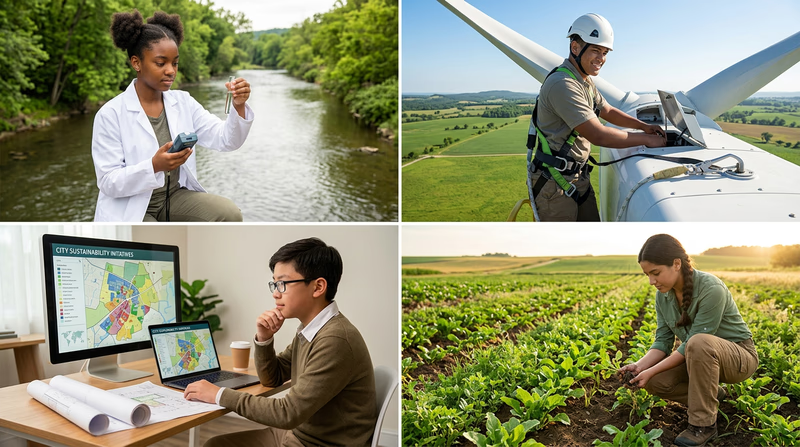
🎬 Video: Career Paths in Sustainability — https://www.youtube.com/watch?v=u1uQk7UVuvA
Extended Learning
A. Congratulations!
You have earned one of the most important merit badges in Scouting. The Sustainability merit badge covers more ground than almost any other — from the water in your pipes to the food on your plate, from the energy powering your home to the global systems that keep our planet alive. The knowledge you have built does not expire when you finish the last requirement. It is a lens for seeing the world differently and making better decisions every day.
The sections below go deeper into practical sustainability skills you can use right now and throughout your life.
B. The Circular Economy: Rethinking “Throw Away”
Most of our economy operates on a linear model: take raw materials, make products, use them, throw them away. This “take-make-dispose” approach assumes unlimited resources and unlimited space for waste. It has neither.
The circular economy is a fundamentally different approach. Instead of designing products to be thrown away, a circular economy designs them to be:
- Reused — Products are built to last and to be used by multiple owners
- Repaired — When something breaks, you fix it instead of replacing it
- Remanufactured — Old products are disassembled and their components are used to build new ones
- Recycled — At the very end of life, materials are recovered and fed back into production
Companies like Patagonia (which repairs and resells used clothing), Apple (which recovers rare earth metals from old devices), and IKEA (which has started buying back used furniture) are pioneering circular business models.
You can practice circular economy thinking in your own life. Before throwing something away, ask: Can it be repaired? Can someone else use it? Can its materials be recovered? The most sustainable product is the one that never becomes waste.
Right to Repair
A growing movement called Right to Repair advocates for laws that require manufacturers to make repair parts, tools, and manuals available to consumers. Several states have passed Right to Repair laws, and the Federal Trade Commission has expressed support for the concept. When you can fix your phone screen instead of buying a new phone, that is a win for sustainability.
Biomimicry
Biomimicry is a design approach that looks to nature for solutions to human problems. Nature has been “designing” solutions for 3.8 billion years — and it produces zero waste. Examples include:
- Velcro — inspired by the way burdock burrs stick to animal fur
- Bullet train nose cones — shaped like a kingfisher’s beak to reduce noise and energy use
- Self-cleaning surfaces — modeled after lotus leaves that repel water and dirt
- Building ventilation systems — designed after termite mound airflow patterns
When engineers and designers study how nature solves problems, they often find solutions that are more efficient, more durable, and more sustainable than conventional approaches.
C. Food Forests and Regenerative Agriculture
Traditional farming often works against nature — clearing land, planting a single crop, and using chemicals to keep everything else away. Regenerative agriculture takes the opposite approach, working with natural systems to build soil health, increase biodiversity, and capture carbon.
Key regenerative practices include:
- Cover cropping — Planting crops specifically to protect and nourish the soil between growing seasons, rather than leaving fields bare
- No-till farming — Avoiding plowing, which disrupts soil structure, kills beneficial organisms, and releases stored carbon
- Crop rotation — Growing different crops in sequence to naturally replenish soil nutrients and break pest cycles
- Integrated pest management — Using beneficial insects, companion planting, and targeted interventions instead of blanket pesticide application
- Agroforestry — Integrating trees with crops and livestock to create more productive, resilient, and diverse farming systems
A food forest takes this even further. It is a garden designed to mimic a natural forest ecosystem, with layers of fruit and nut trees, berry bushes, ground cover plants, root vegetables, and climbing vines all working together. Once established, a food forest requires minimal maintenance and produces food year after year with almost no external inputs.
Starting a small food forest or regenerative garden at your school, Scout camp, or community center is an ambitious service project that combines sustainability with hands-on learning. You would learn about soil biology, plant ecology, and food production while creating something that benefits your community for decades.
D. Citizen Science: Collecting Data That Matters
You do not need a lab or a degree to contribute to real scientific research. Citizen science projects allow ordinary people — including Scouts — to collect data that scientists use to study environmental change. Participating in citizen science is one of the most impactful things you can do beyond the badge.
Notable citizen science programs include:
- iNaturalist — Photograph plants and animals to help scientists track biodiversity worldwide. AI helps identify species from your photos.
- Globe Observer (NASA) — Measure cloud cover, tree height, land cover, and mosquito habitats. Your observations help validate satellite data.
- Christmas Bird Count (Audubon Society) — The longest-running citizen science project in the world (since 1900). Volunteers count birds during a specific period each winter.
- CoCoRaHS — Measure daily precipitation with a simple rain gauge. Your data helps meteorologists improve weather forecasts and track drought.
- Water quality monitoring — Many local organizations train volunteers to test streams and rivers for pH, dissolved oxygen, temperature, and pollutants.
Most citizen science projects require no special equipment beyond a smartphone and some patience. They are perfect for Scouts who want to combine outdoor time with meaningful contributions to science.
E. Real-World Experiences
These activities can deepen your understanding of sustainability beyond the badge requirements:
Local Recycling Center or Materials Recovery Facility (MRF) Tour a recycling facility to see how materials are sorted, processed, and prepared for reuse. Many MRFs offer free group tours. Use Earth911 to find facilities near you. Link: Local Recycling Center or Materials Recovery Facility (MRF) — https://earth911.com/ Community Solar or Wind Farm Visit Visit a renewable energy installation to see how clean energy is generated at scale. Many solar and wind farms welcome educational group visits. Link: Community Solar or Wind Farm Visit — https://www.energy.gov/eere/solar/community-solar Water Treatment Plant Tour See firsthand how your community's water is treated before and after household use. Contact your local water utility to arrange a group tour. Link: Water Treatment Plant Tour — https://www.epa.gov/watersense Sustainable Farm or Community Garden Visit a farm practicing regenerative agriculture or volunteer at a community garden. LocalHarvest helps you find farms, CSAs, and farmers markets near you. Link: Sustainable Farm or Community Garden — https://www.localharvest.org/ Sustainability-Themed Service Project Organize a trail cleanup, community recycling drive, tree planting event, or energy audit workshop with your troop. Leave No Trace offers resources for planning outdoor service projects. Link: Sustainability-Themed Service Project — https://lnt.org/get-involved/F. Organizations
These organizations offer resources, volunteer opportunities, and educational materials to help you continue your sustainability journey:
Leave No Trace Center for Outdoor Ethics The leading nonprofit dedicated to responsible outdoor recreation. Offers training courses, educational materials, and volunteer programs for youth groups. Link: Leave No Trace Center for Outdoor Ethics — https://lnt.org/ U.S. Environmental Protection Agency (EPA) The federal agency responsible for protecting human health and the environment. Extensive educational resources, data tools, and program information. Link: U.S. Environmental Protection Agency (EPA) — https://www.epa.gov/ National Wildlife Federation America's largest conservation organization, with programs for youth, educators, and families focused on wildlife conservation and environmental education. Link: National Wildlife Federation — https://www.nwf.org/ The Nature Conservancy A global environmental organization working on conservation, climate change, and sustainable development. Offers volunteer opportunities and youth programs. Link: The Nature Conservancy — https://www.nature.org/ United Nations Sustainable Development Goals The official home of the 17 SDGs, with progress data, educational resources, and ways to take action at every level — from individual to global. Link: United Nations Sustainable Development Goals — https://sdgs.un.org/ Project Drawdown A research organization that identifies and analyzes the most impactful solutions to climate change, ranked by potential to reduce greenhouse gas emissions. Link: Project Drawdown — https://drawdown.org/