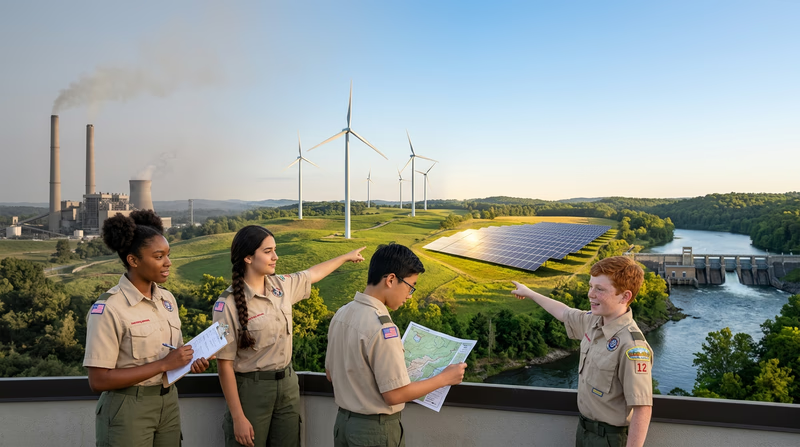
Req 5a — Energy Sources
Choose ONE of requirements 5a, 5b, or 5c. This page covers option 5a. Read all three options before deciding which one interests you most.
Understanding Energy Sources
Energy powers everything — your lights, your phone, your car, your school’s heating system, and the factories that make everything you buy. But not all energy sources are created equal when it comes to sustainability. Some will run out. Some pollute. Some are clean and renewable. Understanding the differences is essential.
Energy sources fall into two main categories:
Non-renewable — These exist in limited quantities and take millions of years to form. Once used, they are gone.
Renewable — These are naturally replenished and will not run out in any human timescale.
The Energy Sources
Coal (Non-Renewable)
Coal is a fossil fuel formed from ancient plant material over millions of years. It is burned in power plants to generate electricity. Coal was once the backbone of American energy, but its use has declined sharply.
- Sustainability concerns: Highest carbon emissions of any energy source. Mining damages landscapes, pollutes water, and endangers workers. Burning coal releases sulfur dioxide, mercury, and particulate matter.
- Current status: Coal’s share of U.S. electricity has dropped from about 50% in 2005 to under 20% today.
Natural Gas (Non-Renewable)
Natural gas is a fossil fuel found deep underground, often alongside oil. It is used for electricity generation, home heating, and cooking.
- Sustainability concerns: Burns cleaner than coal (about half the CO2) but still produces greenhouse gases. Extraction through fracking can contaminate groundwater and cause small earthquakes. Methane leaks during production are a potent greenhouse gas.
- Current status: Natural gas is currently the largest source of U.S. electricity, generating about 40%.
Petroleum / Oil (Non-Renewable)
Petroleum is refined into gasoline, diesel, jet fuel, and heating oil. It is also the raw material for plastics, chemicals, and many products.
- Sustainability concerns: Burning petroleum is a major source of greenhouse gases and air pollution. Oil spills devastate marine ecosystems. Extraction and refining are energy-intensive.
- Current status: Petroleum provides about 36% of total U.S. energy, mostly for transportation.
Nuclear (Non-Renewable, but Long-Lasting)
Nuclear power plants split uranium atoms in a process called fission, releasing enormous amounts of heat to generate electricity.
- Sustainability concerns: Produces no greenhouse gases during operation. However, mining uranium has environmental impacts, and nuclear waste remains radioactive for thousands of years. The risk of accidents (like Chernobyl or Fukushima), though rare, carries enormous consequences.
- Current status: Nuclear provides about 19% of U.S. electricity from 93 reactors.
Solar (Renewable)
Solar panels convert sunlight directly into electricity. Solar farms and rooftop installations are growing rapidly.
- Sustainability concerns: Zero emissions during operation. Manufacturing panels requires energy and materials, but they produce clean energy for 25–30 years. Land use for large solar farms can be a concern, though panels can also go on rooftops and parking structures.
- Current status: Solar is the fastest-growing energy source in the U.S., now providing about 6% of electricity.
Wind (Renewable)
Wind turbines convert the kinetic energy of wind into electricity. They are installed on land (onshore) and at sea (offshore).
- Sustainability concerns: Zero emissions during operation. Turbines can affect birds and bats, though modern designs reduce this. Manufacturing and installing turbines requires energy and materials. Some people object to their visual impact.
- Current status: Wind provides about 10% of U.S. electricity and is growing steadily.
Hydropower (Renewable)
Hydropower uses the force of moving water — usually from a dam on a river — to spin turbines and generate electricity.
- Sustainability concerns: Zero emissions during operation. However, dams can block fish migration, flood ecosystems, and alter river flows. Sediment buildup behind dams can reduce their effectiveness over time.
- Current status: Hydropower provides about 6% of U.S. electricity, mostly from large dams built decades ago.
Geothermal (Renewable)
Geothermal energy taps heat from deep within the Earth to generate electricity or heat buildings directly.
- Sustainability concerns: Very low emissions and a tiny physical footprint. However, it is only available in areas with significant underground heat (like Iceland, parts of the western U.S.). Drilling can sometimes trigger minor seismic activity.
- Current status: Geothermal provides less than 1% of U.S. electricity but is widely used for direct heating in some regions.
Three Common U.S. Energy Sources
The three largest sources of U.S. electricity are natural gas (~40%), nuclear (~19%), and coal (~16%). However, wind and solar are growing rapidly and are expected to overtake coal within a few years.
For this requirement, choose three energy sources and be ready to explain how each one’s production and consumption affects sustainability — including its environmental impact, economic costs, and long-term availability.