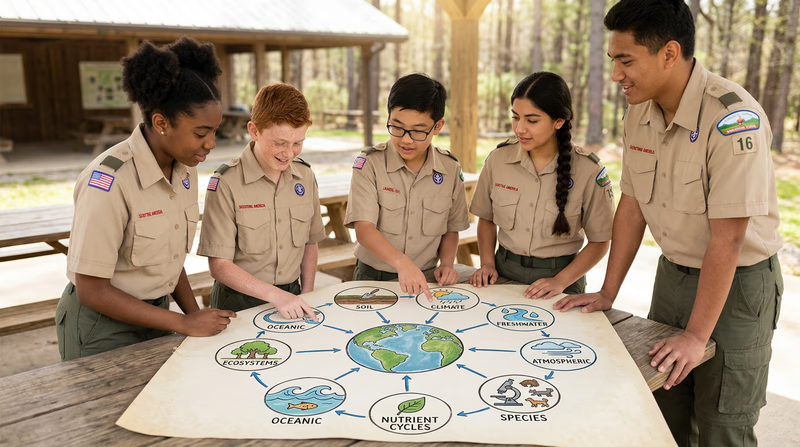
Req 7b — Planetary Life-Support Systems
Earth’s Life-Support Systems
Think of Earth as a spaceship — the only one we have. Just like a spaceship has life-support systems that provide air, water, food, and temperature control, Earth has natural systems that make life possible. These systems are interconnected, and if one fails or weakens, the others are affected.
Soil
Soil is far more than dirt. It is a living system teeming with bacteria, fungi, insects, and worms. Soil:
- Grows 95% of the world’s food
- Filters and stores water
- Stores more carbon than the atmosphere and all plant life combined
- Provides habitat for billions of organisms
When disrupted: Overfarming, deforestation, and construction strip away topsoil. It takes nature about 500 years to form one inch of topsoil — but erosion can remove it in a single storm.
Climate
Earth’s climate system — the long-term pattern of temperature, precipitation, and wind — determines where life can thrive. It is regulated by the atmosphere, oceans, ice caps, and land surfaces working together.
When disrupted: Burning fossil fuels adds greenhouse gases that trap heat, shifting weather patterns, melting ice, raising sea levels, and increasing extreme weather events worldwide.
Freshwater
Only 3% of Earth’s water is fresh, and most of that is locked in ice. The freshwater cycle — evaporation, precipitation, and flow through rivers, lakes, and aquifers — provides the water that all land-based life depends on.
When disrupted: Pollution, overuse, and climate change reduce freshwater availability. Aquifers that took thousands of years to fill are being drained in decades.
Atmospheric
The atmosphere is the thin layer of gases surrounding Earth. It provides oxygen for breathing, blocks harmful ultraviolet radiation (via the ozone layer), and regulates temperature through the greenhouse effect.
When disrupted: Air pollution from vehicles, factories, and fires degrades air quality. Excessive greenhouse gases cause the atmosphere to trap too much heat. Ozone-depleting chemicals (largely banned now) thinned the protective ozone layer.
Nutrient Cycles
Elements like carbon, nitrogen, and phosphorus cycle continuously through air, water, soil, and living organisms. These nutrient cycles are the chemical engines of life:
- The carbon cycle moves carbon through the atmosphere, oceans, soil, and living things
- The nitrogen cycle converts atmospheric nitrogen into forms plants can use
- The phosphorus cycle moves this essential nutrient through rocks, soil, water, and organisms
When disrupted: Burning fossil fuels floods the carbon cycle with excess CO2. Agricultural fertilizers overload waterways with nitrogen and phosphorus, causing algal blooms and dead zones.
Oceanic
Oceans cover 71% of Earth’s surface and play a critical role in regulating climate, absorbing CO2, producing oxygen, and supporting food chains.
When disrupted: Ocean acidification (from absorbing excess CO2) threatens coral reefs and shellfish. Overfishing collapses food webs. Plastic pollution and chemical runoff poison marine life.
Ecosystems
An ecosystem is a community of living organisms interacting with their physical environment — a coral reef, a prairie, a rainforest, a wetland. Each ecosystem provides specific services: pollination, water filtration, flood control, carbon storage, and habitat.
When disrupted: Habitat destruction, pollution, and invasive species can collapse entire ecosystems. When a wetland is drained, the community loses flood protection and water filtration.
Species
Every species plays a role in its ecosystem. Pollinators enable food production. Predators control prey populations. Decomposers recycle nutrients. Biodiversity — the variety of life — is the foundation of ecosystem resilience.
When disrupted: When species go extinct, the ecosystem loses functions that may not be replaceable. The decline of bee populations, for example, threatens the pollination of crops worldwide.
How These Systems Interact
None of these systems operate in isolation. Here are key interactions:
- Climate affects freshwater — Warming temperatures melt glaciers, change rainfall patterns, and intensify droughts and floods
- Oceans regulate climate — Oceans absorb heat and CO2, acting as a buffer — but their capacity has limits
- Soil supports ecosystems — Healthy soil grows healthy plants, which support animals, which support other animals
- Nutrient cycles connect everything — Carbon, nitrogen, and water move through atmosphere, ocean, soil, and living things in continuous loops
- Species maintain ecosystems — Remove a keystone species and the entire ecosystem can unravel