Req 7c — Product Life Cycles
What Is a Product Life Cycle?
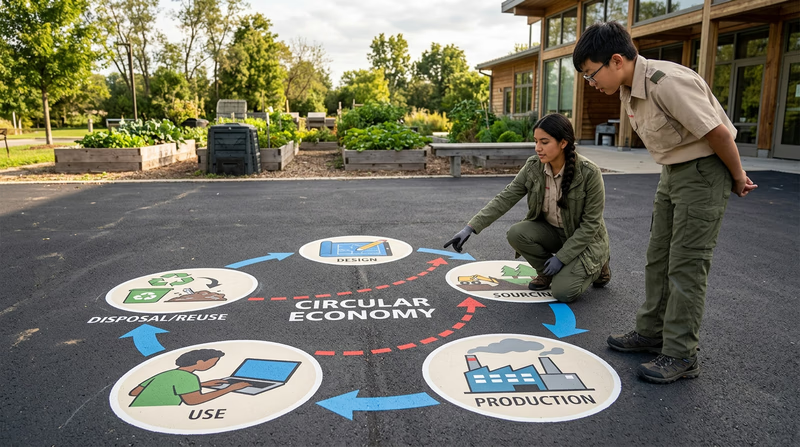
Every product you own — your phone, your shoes, your backpack — went through a journey before it reached you and will continue on a journey after you are done with it. This journey is called the product life cycle, and it has five stages:
- Design — The product is conceived, engineered, and planned
- Sourcing — Raw materials are extracted or harvested
- Production — Materials are manufactured into the finished product
- Use — You buy and use the product
- Disposal or Reuse — The product is thrown away, recycled, repurposed, or composted
Each stage consumes resources and generates waste. Understanding the full life cycle helps you see the true environmental cost of the things you buy.
The Five Stages in Detail
Stage 1: Design
Sustainability starts — or fails — at the design stage. Designers make choices that determine:
- How long the product will last
- Whether it can be repaired or upgraded
- What materials it uses
- Whether it can be recycled at the end of its life
- How much packaging is needed
Sustainable design considers the entire life cycle from the start. Products designed for durability, repairability, and recyclability have a much smaller environmental footprint than disposable products.
Stage 2: Sourcing
Raw materials must come from somewhere. Mining metals, drilling for oil, harvesting timber, and growing cotton all have environmental impacts:
- Habitat destruction from mining and deforestation
- Water pollution from chemical processing
- Energy use and carbon emissions from extraction
- Labor conditions in mines and farms
Stage 3: Production
Manufacturing turns raw materials into finished products. This stage involves:
- Energy consumption (often from fossil fuels)
- Water use for cooling, cleaning, and processing
- Chemical emissions and waste
- Transportation of materials between factories
Stage 4: Use
This is the stage you are most familiar with. How you use a product affects its sustainability:
- How long you keep it before replacing it
- How well you maintain it
- How much energy or water it consumes during use (for appliances, vehicles, etc.)
Stage 5: Disposal or Reuse
What happens at the end of a product’s life determines whether its materials are lost forever or returned to the cycle:
- Landfill — Materials are buried and lost (least sustainable)
- Incineration — Burned for energy, but releases emissions
- Recycling — Materials are processed into new products
- Composting — Organic materials return nutrients to the soil
- Reuse/Repurpose — The product or its parts find a new life
Example: Life Cycle of a T-Shirt
Here is what the full life cycle looks like for a common cotton t-shirt:
Design
A designer creates the shirt pattern, selects cotton as the material, and chooses dyes and printing methods. Decisions about thread count, stitching quality, and fabric weight determine how long the shirt will last.
Sourcing
Cotton is grown on farms, primarily in China, India, the United States, and Brazil. Growing cotton requires:
- About 700 gallons of water for one shirt’s worth of cotton
- Pesticides and fertilizers (cotton uses about 16% of the world’s insecticides)
- Significant land area
Production
The cotton is spun into thread, woven into fabric, cut, sewn, dyed, and printed. This typically happens across multiple countries:
- Cotton might be grown in Texas
- Spun into yarn in India
- Woven into fabric in China
- Sewn into a shirt in Bangladesh
- Shipped to a warehouse in New Jersey
- Trucked to a store near you
Use
You wear and wash the shirt. Each wash uses water and energy and releases microfibers (tiny plastic or fiber particles) into waterways. The average t-shirt is worn about 30–40 times before being discarded.
Disposal or Reuse
- Best case: Donated, resold, or turned into rags or insulation
- Worst case: Thrown in the trash, where it takes 40+ years to decompose in a landfill — releasing methane as it breaks down