Req 7d — Population & Sustainability
Population and the Planet
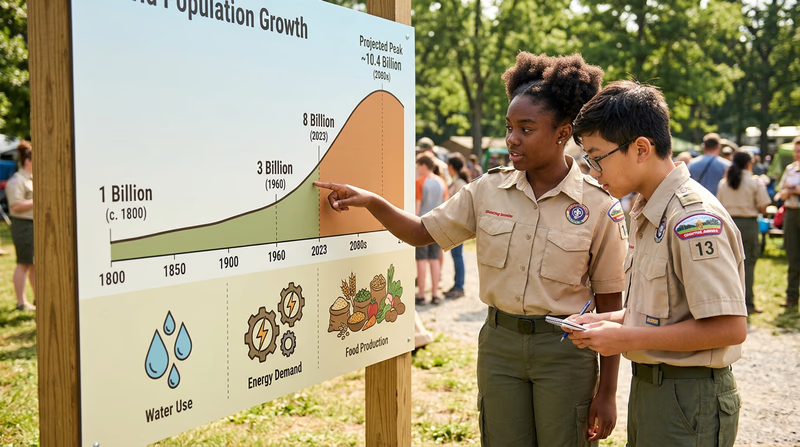
In 1800, about 1 billion people lived on Earth. By 1960, it was 3 billion. Today, the world’s population is over 8 billion. The United Nations projects it will peak at around 10.4 billion near the end of this century before slowly declining.
More people means more demand for food, water, energy, housing, and materials. But population size alone does not tell the whole story — how people live matters just as much as how many people there are. A person in the United States consumes roughly 30 times more resources than a person in some developing nations.
The Impact of Population Growth
Population growth puts pressure on Earth’s systems in several ways:
- Food: More mouths to feed means more farmland, more water for irrigation, and more fertilizer — all of which strain the environment
- Water: Growing populations in water-scarce regions intensify competition for limited freshwater
- Energy: More people need more electricity, more heating and cooling, and more transportation fuel
- Housing: Urban expansion converts natural land into cities, suburbs, and infrastructure
- Waste: More people produce more garbage, more sewage, and more pollution
Three Human Activities That Put Earth at Risk
1. Burning Fossil Fuels
Fossil fuel combustion — for electricity, transportation, heating, and industry — is the single largest source of greenhouse gas emissions. These emissions trap heat in the atmosphere, driving climate change that affects every part of the planet:
- Rising global temperatures
- More frequent and intense storms, droughts, and heat waves
- Melting ice caps and rising sea levels
- Ocean acidification
- Shifting ecosystems and agricultural zones
The burning of coal, oil, and natural gas has increased CO2 levels in the atmosphere by about 50% since the Industrial Revolution. Even with growing use of renewable energy, fossil fuels still provide about 80% of the world’s energy.
2. Deforestation and Land Use Change
Humans have cleared roughly half of Earth’s original forests. Deforestation continues at a rate of about 10 million hectares per year — an area roughly the size of South Korea lost every single year. This happens for:
- Agriculture (especially cattle ranching and palm oil production)
- Logging for timber and paper
- Urban expansion
- Mining
Forests are critical for sustainability — they absorb CO2, produce oxygen, regulate rainfall, prevent erosion, and support biodiversity. When forests are destroyed, all of these functions are lost, and the carbon stored in the trees is released into the atmosphere.
3. Industrial Agriculture
Modern farming feeds billions of people, but many of its practices are unsustainable:
- Monoculture (growing the same crop year after year) depletes soil nutrients and increases vulnerability to pests
- Chemical fertilizers and pesticides contaminate waterways and harm pollinators
- Livestock production generates about 14.5% of global greenhouse gas emissions and uses vast amounts of land and water
- Overfishing depletes ocean fish stocks faster than they can reproduce
The challenge is not to stop farming — it is to farm in ways that can sustain food production for future generations without destroying the ecosystems that make farming possible.
What Can Be Done?
Understanding the problem is the first step. Solutions include:
- Transitioning to renewable energy to reduce fossil fuel dependence
- Protecting and restoring forests through conservation policies and reforestation
- Adopting sustainable agriculture practices like crop rotation, reduced chemical use, and regenerative farming
- Reducing consumption in wealthy nations, where per-person resource use is highest
- Investing in education — studies show that when education levels rise (especially for women and girls), population growth rates naturally decline