Extended Learning
A. Congratulations!
You have completed all nine requirements for the Swimming merit badge — one of the most important Eagle-required badges in Scouting. You now have the knowledge and skills to swim safely, rescue others, survive in the water, and stay fit for life. But earning the badge is just the beginning. The world of swimming and water activities is enormous, and there is always more to explore.
B. Competitive Swimming and Racing
If you enjoyed pushing yourself during the endurance swim and stroke demonstrations, competitive swimming might be your next step. Swimmers compete in events ranging from 50-yard sprints to mile-long distance races, plus relays and individual medley events that combine all four competitive strokes (butterfly, backstroke, breaststroke, and freestyle).
Most communities have a local swim team affiliated with USA Swimming, the national governing body. Teams are organized by age group, so you will train and compete with swimmers your own age. Many high schools also have varsity swim teams.
Getting started: Contact your local YMCA, recreation center, or USA Swimming club to find a team near you. Most teams accept swimmers of all skill levels — you do not need to be fast to start competing. What matters is a willingness to train hard and improve.
Masters Swimming is the adult version of competitive swimming, open to anyone 18 and older. It is a great way to stay connected to the sport after high school.
If open water appeals to you more than pool lanes, open water swimming events take place in lakes, rivers, and oceans at distances from 1 mile to 10 kilometers and beyond. Open water swimming became an Olympic event in 2008 and has been growing in popularity ever since. These events require comfort with navigation, sighting (looking up to stay on course), and changing conditions — skills that build directly on what you learned in this merit badge.
C. Lifeguarding and Water Safety Instruction
Your Swimming merit badge training introduced you to rescue techniques and water safety. Taking the next step into lifeguarding or water safety instruction lets you use those skills to protect others.
Lifeguard certification is available through the American Red Cross and the YMCA, typically starting at age 15. The course covers surveillance techniques, rescue skills, first aid, CPR, and AED use. Lifeguarding is one of the most popular summer jobs for teens, and the skills you learn are valuable for a lifetime.
Water Safety Instructor (WSI) certification trains you to teach swimming lessons. The Red Cross WSI course is available starting at age 16. Teaching others to swim is deeply rewarding — and every person you teach to swim is one fewer person at risk of drowning. Many Scout camps need WSIs on staff, making this a natural fit for Scouts who want to work at camp.
The Lifesaving merit badge builds directly on Requirements 5 and 6 of this badge, teaching advanced rescue swimming, in-water rescue techniques, and victim management. If you found the rescue requirements interesting, the Lifesaving merit badge is the logical next step.
D. Underwater Skills and Aquatic Sports
The surface diving skills you learned in Requirement 7 are the gateway to a whole world of underwater activities:
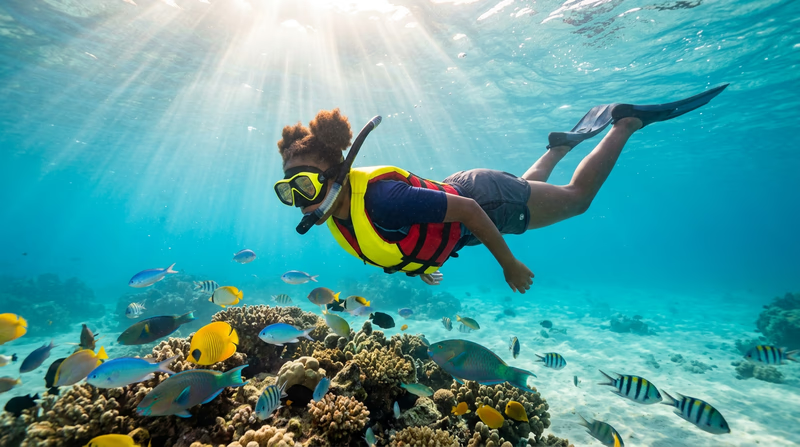
Snorkeling lets you explore underwater environments while breathing through a snorkel at the surface. It requires minimal equipment — just a mask, snorkel, and fins — and opens up coral reefs, kelp forests, and freshwater springs to explore. Many Scout troops include snorkeling in beach trips and summer camp programs.
Scuba diving takes you deeper, allowing you to breathe underwater using a self-contained breathing apparatus. The Scuba Diving merit badge introduces the basics, and organizations like PADI and SSI offer junior certifications starting at age 10 (with restrictions) and full open water certification at age 15.
Water polo is a team sport played in deep water that combines swimming endurance, ball-handling skills, and team strategy. It is one of the most physically demanding sports in the world — players tread water for the entire game while passing, shooting, and defending. Many high schools and recreation centers have water polo programs.
Synchronized swimming (now called artistic swimming) combines swimming, dance, and gymnastics in the water. Performers execute choreographed routines set to music, often involving complex formations and underwater maneuvers. It requires exceptional breath control, flexibility, and teamwork.
E. Real-World Experiences
Swimming Experiences to Seek Out
Take your skills beyond the pool
- Volunteer as a swim lesson aide: Help teach younger children to swim at your local pool or YMCA. Contact your local recreation department to ask about volunteer opportunities.
- Participate in a swim-a-thon: Many communities host charity swim events where you swim laps to raise money for a cause. It is a great way to test your endurance and give back.
- Try a new aquatic environment: If you usually swim in pools, try an open water swim at a supervised beach or lake. If you are a lake swimmer, visit a community pool and try lap swimming. New environments build adaptability.
- Visit an aquatic center: Tour a competitive swim facility or Olympic training center. Watch a swim meet to see elite technique in action. USA Swimming’s website lists events near you.
- Earn another aquatic merit badge: The Lifesaving, Canoeing, Kayaking, Rowing, Scuba Diving, and Water Sports merit badges all build on your swimming skills.
F. Organizations and Resources
USA Swimming The national governing body for competitive swimming in the United States. Find a local swim team, learn about events, and access training resources. American Red Cross — Aquatics Swimming lessons, lifeguard certification, and water safety instructor training from the American Red Cross. YMCA Water Safety The YMCA's water safety programs, including swim lessons, lifeguard training, and community water safety education. U.S. Masters Swimming Organized swimming for adults ages 18 and older, with local clubs, coached workouts, and competitions at every level. World's Largest Swimming Lesson An annual global event that brings together thousands of swimmers to set a world record and raise awareness about drowning prevention. Find a participating location near you. Stop Drowning Now A nonprofit dedicated to drowning prevention through education, water safety resources, and community outreach.