Req 1a — Safe Swim Defense
What Is Safe Swim Defense?
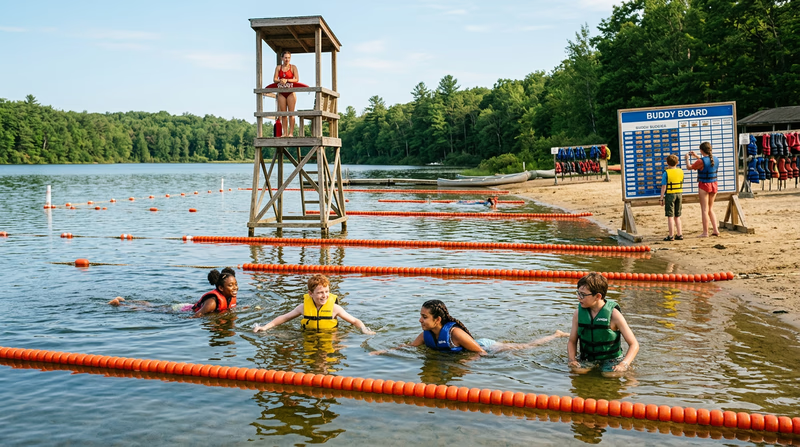
Safe Swim Defense is Scouting America’s official framework for keeping everyone safe during swimming activities. It is built around eight key points that address the most common causes of drowning. Every Scout leader must complete Safe Swim Defense training before supervising any Scouting swim activity, and every Scout should understand these principles.
The eight points of Safe Swim Defense are:
- Qualified Supervision — A responsible adult who understands water safety must be in charge.
- Personal Health Review — Swimmers should be in good health and free from conditions that could impair them in the water.
- Safe Area — The swimming area must be inspected for hazards before anyone enters the water.
- Response Personnel — Trained rescue personnel must be present and ready to act.
- Lookout — A designated lookout watches swimmers from a fixed position at all times.
- Ability Groups — Swimmers are divided by skill level (nonswimmer, beginner, swimmer) and assigned to appropriate areas.
- Buddy System — Every swimmer has a buddy. They enter the water together, stay together, and leave together.
- Discipline — Everyone follows the rules. No exceptions. Horseplay, diving in shallow water, and ignoring boundaries are not tolerated.
Common Drowning Situations
Your counselor will want you to explain how Safe Swim Defense addresses each of these specific scenarios. Here is what you need to know:
Unfenced Residential Pools
Home pools are one of the most dangerous water environments, especially for young children. Without fences and self-latching gates, children can wander into the pool area unsupervised. Safe Swim Defense addresses this through qualified supervision and discipline — no one enters the water without a responsible adult present.
Nonswimmers Entering Deep Water
When people who cannot swim wander into water over their heads, they can drown in seconds. Safe Swim Defense prevents this through ability groups — nonswimmers are restricted to shallow water with a maximum depth of chest-high. The buddy system adds another layer of protection, since a buddy would immediately notice if someone was in trouble.
Risky Behaviors
Running on a pool deck, diving into shallow water, pushing others into the water, and holding someone underwater are all behaviors that lead to injuries and drownings. The discipline point of Safe Swim Defense exists specifically for this: clear rules are established and enforced before anyone enters the water.
Medical Impairment in the Water
Seizures, heart conditions, diabetic episodes, or even a full stomach can impair a swimmer in the water. The personal health review identifies these risks beforehand. Swimmers with medical conditions should inform the supervisor so accommodations can be made.
Drop-Offs
A drop-off is a sudden change in water depth — the bottom goes from waist-deep to over your head in a single step. Drop-offs are especially dangerous in natural water settings like lakes and rivers. The safe area point requires the swimming area to be checked for drop-offs and marked clearly before swimming begins.
Cold Water
Cold water saps your energy and can cause hypothermia faster than most people realize. Water does not need to be icy to be dangerous — even 70°F water can cause hypothermia over time. Safe Swim Defense addresses this through the safe area inspection, which includes checking water temperature, and through qualified supervision to recognize signs of cold stress.
Murky Water
If you cannot see the bottom, you cannot see hazards — or a struggling swimmer. Murky water makes it nearly impossible for a lookout to spot someone in trouble. Safe Swim Defense requires the safe area to have adequate visibility. If visibility is poor, swimming should be restricted or canceled.
River Currents
Rivers can look calm on the surface but have powerful currents underneath. Swimmers can be swept downstream, pinned against obstacles, or pulled under. Safe Swim Defense deals with river currents through the safe area check — current speed is evaluated, and the swimming area is positioned to avoid strong currents.
Rip Currents
A rip current is a narrow, powerful channel of water flowing away from shore. It can pull even strong swimmers out to sea quickly. If you are caught in a rip current, do not swim against it. Swim parallel to shore until you are out of the current, then swim back to shore at an angle.
Surf
Ocean waves add complexity to swimming. Waves can knock you off your feet, push you underwater, and disorient you. Strong surf combined with rip currents and undertow can overwhelm even experienced swimmers. Safe Swim Defense requires qualified supervision with knowledge of ocean conditions and the safe area to be evaluated for surf hazards.
Scouting America Safe Swim Defense The official Safe Swim Defense page from Scouting America, including the full guidelines and training information.