Req 3 — Swimming Strokes
For this requirement, you need to demonstrate five swimming strokes with good form. Your counselor will watch your technique and provide feedback. Below is a breakdown of each stroke — what it looks like, what makes it “good form,” and common mistakes to avoid.
Front Crawl (Freestyle)
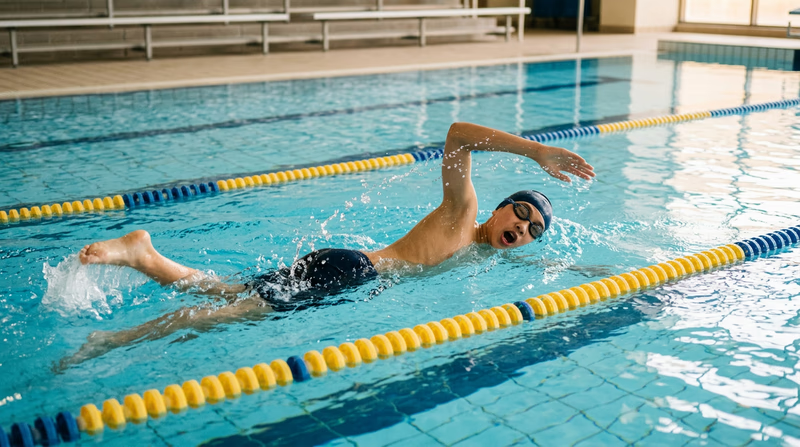
The front crawl is the fastest and most commonly used swimming stroke. You will use it more than any other stroke in both competitive and recreational swimming.
Body position: Lie facedown in the water with your body as flat and streamlined as possible. Keep your hips near the surface.
Arm movement: Alternate arms in a continuous windmill motion. Reach forward with one arm, enter the water fingertips first, pull straight back under your body, then recover by lifting the arm out of the water and swinging it forward.
Kick: Flutter kick — small, quick, alternating kicks from the hips. Keep your legs mostly straight with relaxed ankles.
Breathing: Turn your head to one side during the arm recovery. Exhale underwater through your nose or mouth. Inhale quickly when your mouth clears the water. Do not lift your head forward — that drops your hips and creates drag.
Trudgen
The trudgen is an older stroke that combines an overarm crawl motion with a scissor kick. It is less common today but still part of the Swimming merit badge requirements as an alternative to the front crawl.
Body position: Similar to the front crawl — facedown, body flat.
Arm movement: Same alternating overarm motion as the front crawl.
Kick: Instead of a flutter kick, use a scissor kick timed with the arm strokes. The kick happens on one side, typically when the breathing-side arm enters the water.
Breathing: Turn to the side to breathe, same as the front crawl.
Back Crawl (Backstroke)
The back crawl is the only competitive stroke swum entirely on your back. It is excellent for building back and shoulder strength.
Body position: Lie on your back with your body flat and ears in the water. Keep your hips up — do not sit in the water.
Arm movement: Alternate arms in a windmill pattern. One arm reaches overhead and enters the water pinky-first, pulls down along your side, then exits at the hip and recovers overhead.
Kick: Flutter kick, same as the front crawl but on your back. Keep kicks small and from the hips.
Breathing: Since your face is always out of the water, breathing is easy. Establish a rhythm: inhale on one arm recovery, exhale on the other.
Sidestroke
The sidestroke is a restful, efficient stroke used for long-distance swimming and lifesaving. Lifeguards use a modified sidestroke when towing someone to safety.
Body position: Lie on your side with your bottom arm extended forward and your top arm resting along your body. Your ear rests on your extended lower arm.
Arm movement: The lead arm (bottom) reaches forward, sweeps down toward your chest, and extends forward again. The trailing arm (top) reaches from your hip up to your chest, then pushes back down to your hip. The arms move in an alternating “pick the apple, put it in the basket” motion.
Kick: Scissor kick — your legs separate (one forward, one back), then snap together like scissors. Time the kick with the arm pull for maximum glide.
Glide: The sidestroke has a distinct glide phase. After the kick and arm pull, let your momentum carry you forward before starting the next stroke. This is what makes it so efficient.
Breaststroke
The breaststroke is one of the oldest known swimming strokes and is popular for recreational swimming because your head can stay above water.
Body position: Facedown with your body as streamlined as possible. During the glide, your arms are extended forward and legs are together.
Arm movement: Start with arms extended. Sweep your hands outward and downward in a heart-shaped pattern. Pull back to your chest, then shoot your hands forward into the glide position.
Kick: Whip kick (frog kick) — bring your heels toward your buttocks, turn your feet outward, then push back and together in a circular motion. The kick provides most of the power in the breaststroke.
Breathing: Lift your head forward to breathe during the arm pull. Your head comes up naturally as your arms sweep outward.
Timing: Pull, breathe, kick, glide. The glide is important — rushing eliminates the resting phase and makes the stroke less efficient.
Elementary Backstroke
The elementary backstroke is the easiest stroke to learn and the best stroke for resting in the water. You will use it during the endurance swim in Requirement 4.
Body position: On your back, body flat, arms at your sides, legs together. This is your glide position.
Arm movement: Slide your hands up along your sides to your armpits. Extend your arms outward at shoulder level, then sweep them back down to your sides. Think “chicken, airplane, soldier” — hands to armpits (chicken wings), arms out (airplane), arms at sides (soldier/glide).
Kick: Whip kick, same as the breaststroke but on your back. Draw your heels toward your buttocks, turn your feet outward, push back and together.
Timing: Arms and legs move together. Pull and kick simultaneously, then glide. The glide is the longest phase — relax and let the water carry you.
USA Swimming — Learn to Swim Resources from USA Swimming on stroke technique, finding lessons, and improving your skills.